
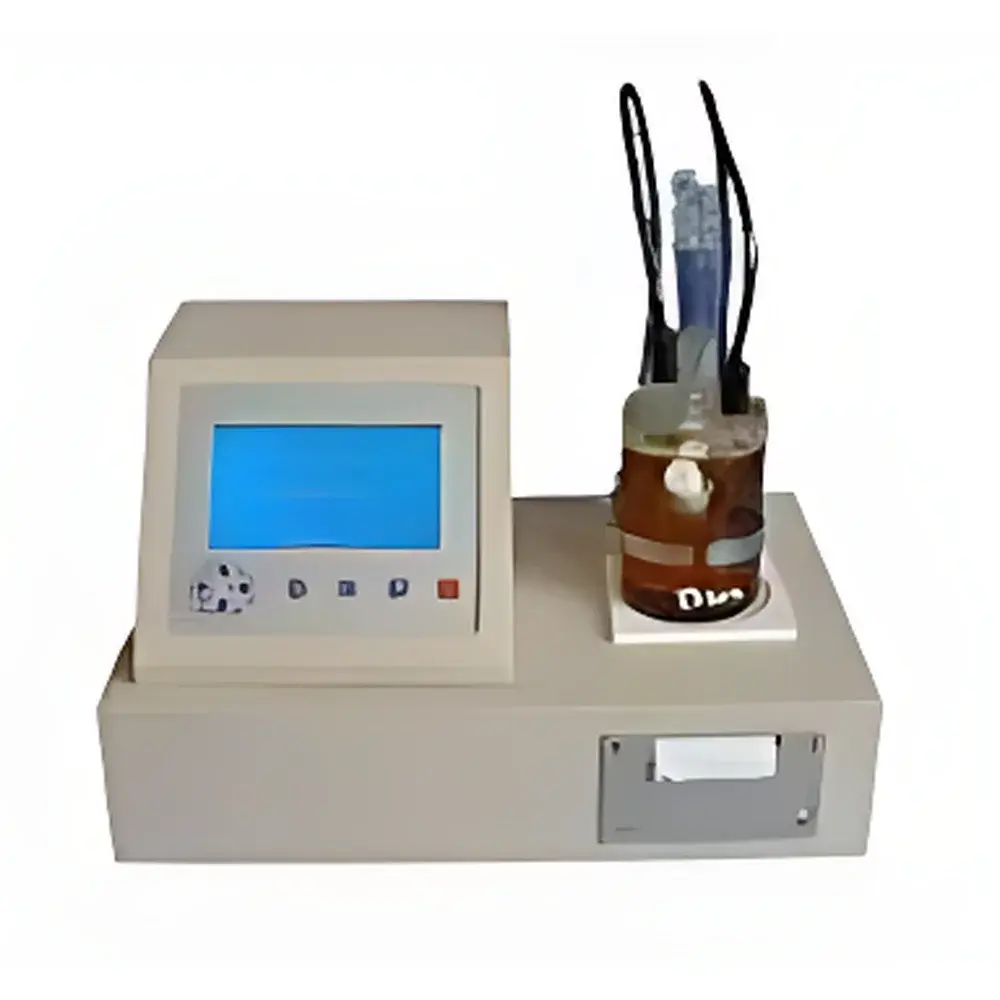
PLD-GRS6 Automatic Karl Fischer Coulometric Moisture Analyzer
| Origin | Shaanxi, China |
|---|---|
| Manufacturer Type | Authorized Distributor |
| Origin Category | Domestic (China) |
| Model | PLD-GRS6 |
| Price | USD 680 (FOB) |
| Measurement Principle | Coulometric Karl Fischer Titration |
| Detection Electrode | Dual Platinum Electrodes |
| Control System | PULL T 8.0 Embedded Microcontroller Platform |
| Measurement Range | 1 µg – 30 mg H₂O (standard mode) |
| Sensitivity | 0.1 µg H₂O |
| Accuracy | ±5% relative or ±1 µg absolute, whichever is greater |
| Sample Types | Liquids, Gases, Solids (with optional oven adapter) |
| Titration Cell Volume | 150 mL |
| Stirring Mechanism | Integrated Magnetic Stirrer |
| Display | 20×2 Character LCD with real-time clock, electrolysis rate (µg/s), and endpoint status |
| Endpoint Detection | Dual-platinum amperometric detection |
| Output | Built-in thermal printer (16-character line, auto-print of parameters and results) |
| Power Supply | 220 V ±10%, 50 Hz ±0.5 Hz |
| Power Consumption | 40 W |
| Operating Temperature | 10–40 °C |
| Relative Humidity | ≤70% RH |
| Compliance Standards | GB/T 7600, GB/T 11133, GB/T 6283, SH/T 0207, SH/T 0246, SH/T 0255 |
Overview
The PLD-GRS6 Automatic Karl Fischer Coulometric Moisture Analyzer is a precision-engineered instrument designed for trace-level water quantification in diverse industrial and laboratory environments. It operates on the fundamental electrochemical principle of coulometric Karl Fischer titration—where iodine is generated *in situ* via controlled electrolysis of iodide ions in the reagent, and stoichiometrically reacts with water according to the classic Karlsruhe reaction: I₂ + SO₂ + H₂O + 3RN + CH₃OH → 2RN·HI + RN·HSO₄CH₃. The dual platinum electrode system continuously monitors current flow across the titration cell, enabling real-time, amperometric endpoint detection with high specificity and minimal drift. Unlike volumetric KF systems, the coulometric method eliminates reagent standardization and delivers superior sensitivity and reproducibility for samples containing less than 1000 ppm water. The PLD-GRS6 is calibrated and validated against internationally recognized reference standards and adheres strictly to the measurement protocols defined in multiple Chinese national standards (GB/T and SH/T series), ensuring regulatory alignment for quality control laboratories operating under ISO/IEC 17025, GLP, or industry-specific QA frameworks.
Key Features
- True coulometric generation of iodine with microprocessor-controlled current regulation, achieving sub-microgram detection limits (0.1 µg H₂O)
- Dual platinum amperometric endpoint detection ensures unambiguous, noise-resistant termination without manual intervention
- Embedded PULL T 8.0 control platform provides autonomous baseline correction, blank compensation, and adaptive electrolysis rate adjustment
- Integrated magnetic stirring ensures homogeneous mixing and rapid equilibrium—critical for viscous or low-conductivity samples
- Real-time 20×2 character LCD display showing date/time stamp, dynamic electrolysis rate (µg/s), cumulative water mass, and endpoint confirmation
- Built-in thermal printer outputs fully traceable reports including sample ID, measurement time, endpoint current, total water mass (µg), and calculated concentration (ppm or %)
- Robust 150 mL sealed titration cell design minimizes atmospheric moisture ingress and supports extended run stability (>8 h continuous operation)
- Compliant power architecture (220 V ±10%, 50 Hz) with low thermal load (40 W) enables stable deployment in shared lab environments without dedicated circuits
Sample Compatibility & Compliance
The PLD-GRS6 accommodates liquid, gaseous, and solid-phase matrices. For liquids—including petroleum distillates, solvents, pharmaceutical excipients, and organic intermediates—the instrument achieves full compliance with GB/T 11133 (liquid petroleum products), GB/T 7600 (in-service transformer oil), and SH/T 0246 (light hydrocarbons). Gas-phase analysis is supported via optional gas sampling modules with flow-controlled injection and dry carrier gas purging, satisfying SH/T 0207 requirements for insulating oils and ASTM D6304 Annex A2 for dissolved gas analysis. Solid samples (e.g., polymers, catalysts, APIs) require coupling with a heated oven module (sold separately) to liberate bound water thermally, aligning with GB/T 6283 methodology. All measurement procedures are documented with full audit trail capability—including operator ID, calibration history, and environmental condition logging—to support FDA 21 CFR Part 11 readiness when integrated into validated LIMS workflows.
Software & Data Management
While the PLD-GRS6 operates as a standalone benchtop analyzer with embedded firmware, its data output format is ASCII-compatible and structured for seamless ingestion into third-party laboratory information management systems (LIMS) or Excel-based QA databases. Each printed report includes a unique timestamp, instrument serial number, and user-defined sample identifier. The PULL T 8.0 platform stores up to 100 recent measurement records internally with recall functionality. For regulated environments, external PC connectivity (RS-232 or USB-to-serial adapter) enables raw current-time datasets export for advanced statistical process control (SPC) analysis, Gage R&R assessment, and long-term trend monitoring per ISO 10012 requirements. All firmware updates are delivered via secure binary patch files with cryptographic signature verification to maintain integrity in GxP settings.
Applications
- Petrochemical QC: Water content verification in crude fractions, jet fuels, lubricants, and transformer oils per ASTM D1744 and IEC 60814 equivalents
- Pharmaceutical manufacturing: Residual moisture testing of lyophilized powders, active pharmaceutical ingredients (APIs), and excipients per USP <921> and EP 2.5.12
- Electronics materials: Quantification of moisture in solder pastes, conformal coatings, and encapsulation resins where <50 ppm H₂O is critical for reliability
- Food & beverage R&D: Water activity correlation studies in powdered dairy, starch derivatives, and hygroscopic flavor carriers
- Environmental testing labs: Determination of water in contaminated soil extracts and aqueous waste streams per EPA Method 9060A adaptations
- Academic research: Kinetic studies of hydration/dehydration reactions and sorption isotherm modeling using programmable multi-step titration sequences
FAQ
What sample volume is required for accurate coulometric analysis?
For liquids, 0.1–2.0 mL is typical; optimal injection volume depends on expected water concentration and must fall within the 1–30,000 µg H₂O linear range. Gas samples require flow-controlled introduction at 10–100 mL/min for 30–120 s.
Can the PLD-GRS6 be used for Karl Fischer titration of aldehydes or ketones?
Yes—when equipped with aldehyde/ketone-compatible reagents (e.g., two-component methanol-free KF reagents), the system maintains accuracy per GB/T 6283 Annex B. Standard reagents are not recommended for carbonyl-rich matrices due to side reactions.
Is routine calibration required between analyses?
No. Coulometric KF is inherently self-calibrating: iodine generation is governed by Faraday’s law (1 mole e⁻ ≡ 13.4 mg H₂O). Daily verification with certified 1.00 mg H₂O standard (e.g., Hydranal®-Water Standard) satisfies traceability requirements under ISO/IEC 17025 Clause 6.6.
How does the instrument handle high-salt or conductive samples?
The dual-platinum sensor design and adaptive current threshold logic minimize interference from ionic conductivity. For brines or battery electrolytes, dilution with dry acetonitrile prior to injection is recommended to maintain cell stability and endpoint resolution.





