
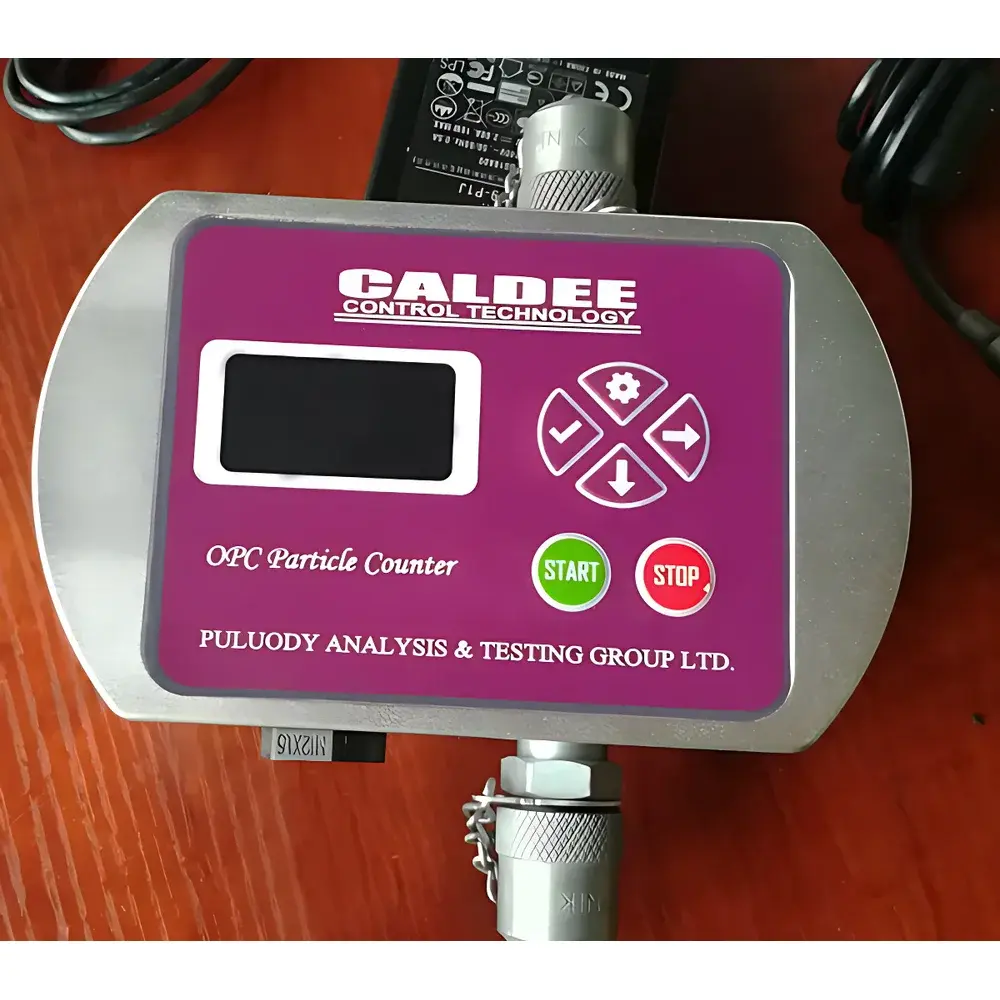
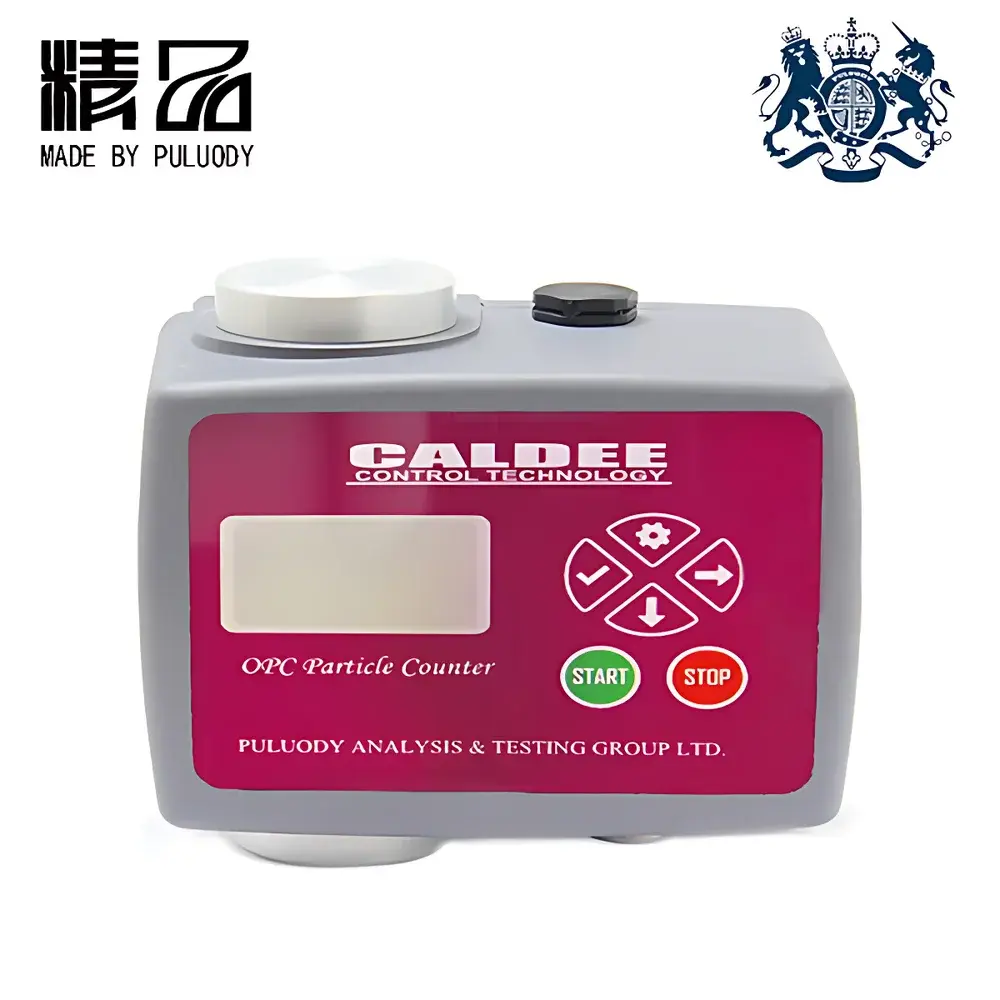
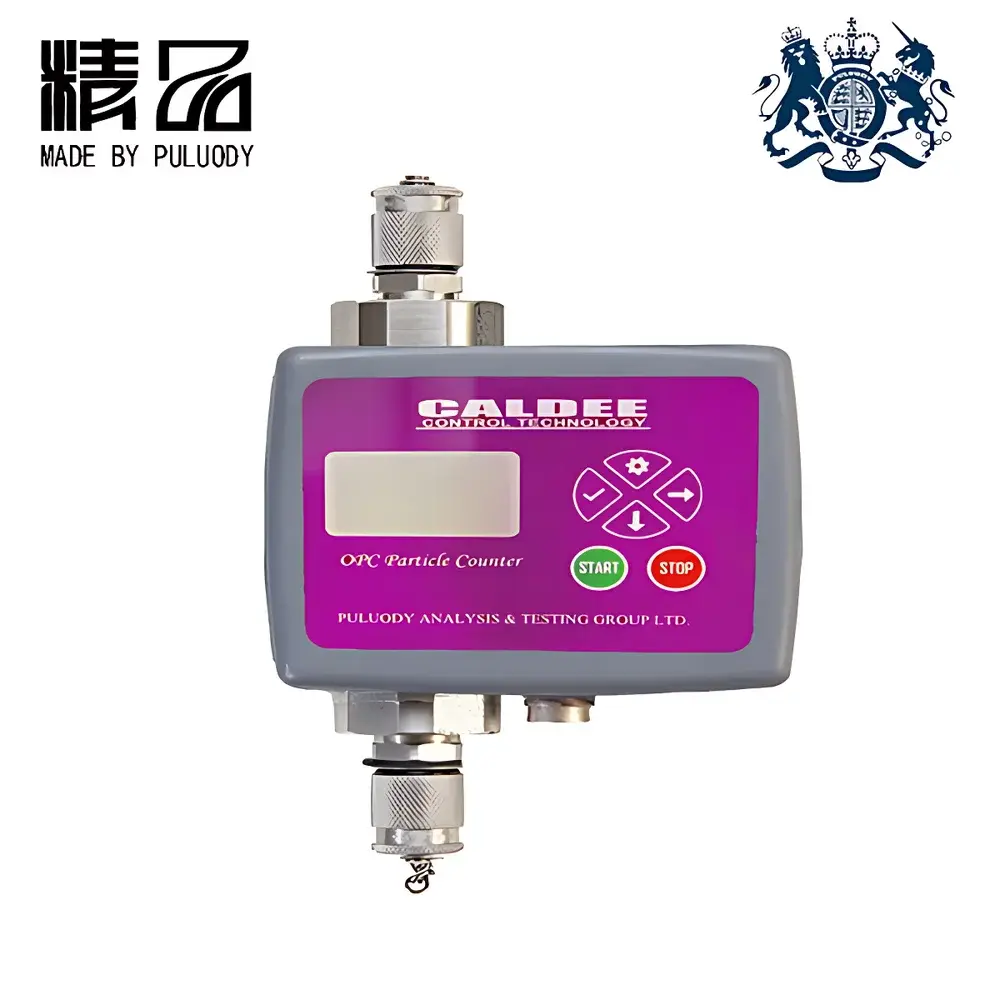
CALDEE OPC Online Oil Particle Contamination Monitor
| Brand | CALDEE |
|---|---|
| Origin | Shaanxi, China |
| Model | OPC |
| Instrument Type | Optical Particle Counter |
| Detection Principle | Dual-Laser Narrow-Beam Light Scattering (7th Generation) |
| Detection Range | 1–150 µm |
| Number of Channels | 8 |
| Calibration Standards Supported | ISO 4406, NAS 1638, GJB 420B, GOST 17216, SAE AS4059, ISO 11171, MIL-STD-1246C, IP 564/565, GB/T 14039, DL/T 432, JB/T 9737 |
| Accuracy | ±1 contamination grade |
| Maximum Online Pressure | 0–0.6 MPa (standard), 0–31.5 MPa (with pressure-reducing valve) |
| Viscosity Range | 0–400 cSt |
| Flow Rate | 20–100 mL/min |
| Operating Fluid Temperature | −10 °C to +80 °C |
| Output Interfaces | RS232, RS485, analog (4–20 mA / 0–5 V optional), alarm relay |
| Reporting | particles/mL + ISO/NAS/GJB contamination grade |
| Compliance | Designed for GLP/GMP-aligned environments |
Overview
The CALDEE OPC Online Oil Particle Contamination Monitor is an industrial-grade optical particle counter engineered for continuous, real-time monitoring of particulate contamination in hydraulic oils, lubricants, turbine oils, and other critical fluid systems. It operates on the principle of dual-laser narrow-beam light scattering—specifically the 7th-generation detection architecture licensed from PALL Corporation’s UK-based Particle Measuring Systems (PMS) technology platform—ensuring high signal-to-noise ratio, minimal coincidence error, and stable baseline performance across wide dynamic ranges. Unlike benchtop or offline analyzers, the OPC integrates directly into pressurized fluid loops via inline sampling, enabling uninterrupted assessment of system cleanliness without process interruption. Its design targets predictive maintenance workflows, supporting early detection of component wear, filter breakthrough, and ingress-related contamination events in mission-critical infrastructure.
Key Features
- True online operation with continuous flow-through measurement at up to 100 mL/min, compatible with pressures up to 31.5 MPa (with integrated pressure-reducing valve)
- 8-channel optical detection covering 1–150 µm particle sizes, calibrated per ISO 11171:2010 and traceable to NIST-traceable reference materials
- Multi-standard compliance engine: configurable reporting against ISO 4406:2017, NAS 1638 Class, GJB 420B, SAE AS4059 Rev D, GOST 17216-2014, and 12+ national standards including GB/T 14039 and DL/T 432
- Ruggedized housing rated for industrial environments: IP65 ingress protection, operating temperature range −10 °C to +80 °C, and resistance to electromagnetic interference (EMI)
- Flexible interface options: RS232 and RS485 serial protocols, analog outputs (4–20 mA or 0–5 V configurable), and discrete alarm relays for integration with DCS, PLC, or SCADA systems
- Onboard data storage and timestamped event logging, supporting traceability and periodic export for QA/QC review
Sample Compatibility & Compliance
The OPC is validated for use with mineral-based, synthetic, and biodegradable hydraulic fluids; turbine oils; compressor oils; and phosphate ester fire-resistant fluids. It accommodates viscosities from 0 to 400 cSt and maintains accuracy under turbulent flow conditions typical in high-pressure servo systems. All calibration procedures follow ISO 21501-4:2018 for light-scattering particle counters, and factory calibration certificates include uncertainty budgets compliant with ISO/IEC 17025. The instrument meets mechanical safety requirements per IEC 61000-6-2 (immunity) and IEC 61000-6-3 (emissions). When deployed in regulated environments—including power generation, aerospace MRO, naval propulsion, and pharmaceutical manufacturing—the OPC supports documentation of calibration history, user access logs, and electronic signature capability when used with validated software platforms compliant with FDA 21 CFR Part 11 and EU Annex 11.
Software & Data Management
The OPC operates in standalone mode with embedded firmware or connects to CALDEE’s PC-based analysis suite (OPC-View v3.x), which provides real-time dashboard visualization, trend analysis, historical comparison, and automated report generation in PDF or CSV format. Software features include configurable alarm thresholds per channel or cumulative grade, statistical process control (SPC) charting, and deviation alerts based on delta-change algorithms. Audit trails record all configuration changes, calibration events, and user actions with timestamps and operator IDs. Data export complies with ASTM D7647-10 (Standard Practice for Reporting Particle Count Data) and supports import into LIMS or enterprise asset management (EAM) systems via ODBC or REST API.
Applications
- Real-time contamination monitoring of hydraulic systems in heavy machinery, wind turbine pitch/yaw controls, and mobile equipment fleets
- Condition-based maintenance of filtration systems—detecting filter degradation, bypass activation, or media fatigue
- Wear debris analysis during component life-cycle testing (e.g., servo valve qualification, pump endurance trials)
- Acceptance testing of new oil batches prior to commissioning in turbine lube systems or transformer cooling circuits
- Monitoring of ultra-clean fluids in semiconductor tool coolant loops and aerospace ground support equipment
- Compliance verification for naval vessel hydraulic systems per MIL-STD-1246C cleanliness verification protocols
FAQ
Does the OPC require annual recalibration?
Yes—per ISO 17025 and internal quality protocols, annual traceable recalibration is recommended. CALDEE provides certified calibration services using ISO 11171-compliant reference emulsions and accredited laboratories.
Can the OPC be installed on high-pressure fuel lines?
Yes, when equipped with the optional pressure-reducing valve assembly, it supports continuous operation at up to 31.5 MPa, making it suitable for common rail diesel injection systems and aircraft hydraulic manifolds.
Is raw particle count data accessible for custom analytics?
Yes—the RS485 interface supports Modbus RTU protocol, enabling direct acquisition of channel-specific counts, total concentration (particles/mL), and calculated contamination grades for integration into proprietary analytics platforms.
How is sensor fouling mitigated during long-term deployment?
The OPC incorporates self-flushing logic during idle periods and supports optional ultrasonic cleaning cycles. Its optical path geometry minimizes particle adhesion, and field-replaceable flow cells reduce downtime during maintenance.
Does the device meet explosion-proof certification requirements?
The standard unit is not ATEX or IECEx certified; however, intrinsically safe variants (e.g., Ex ia IIC T4 Ga) are available upon request for Zone 1/21 hazardous area installations.



