
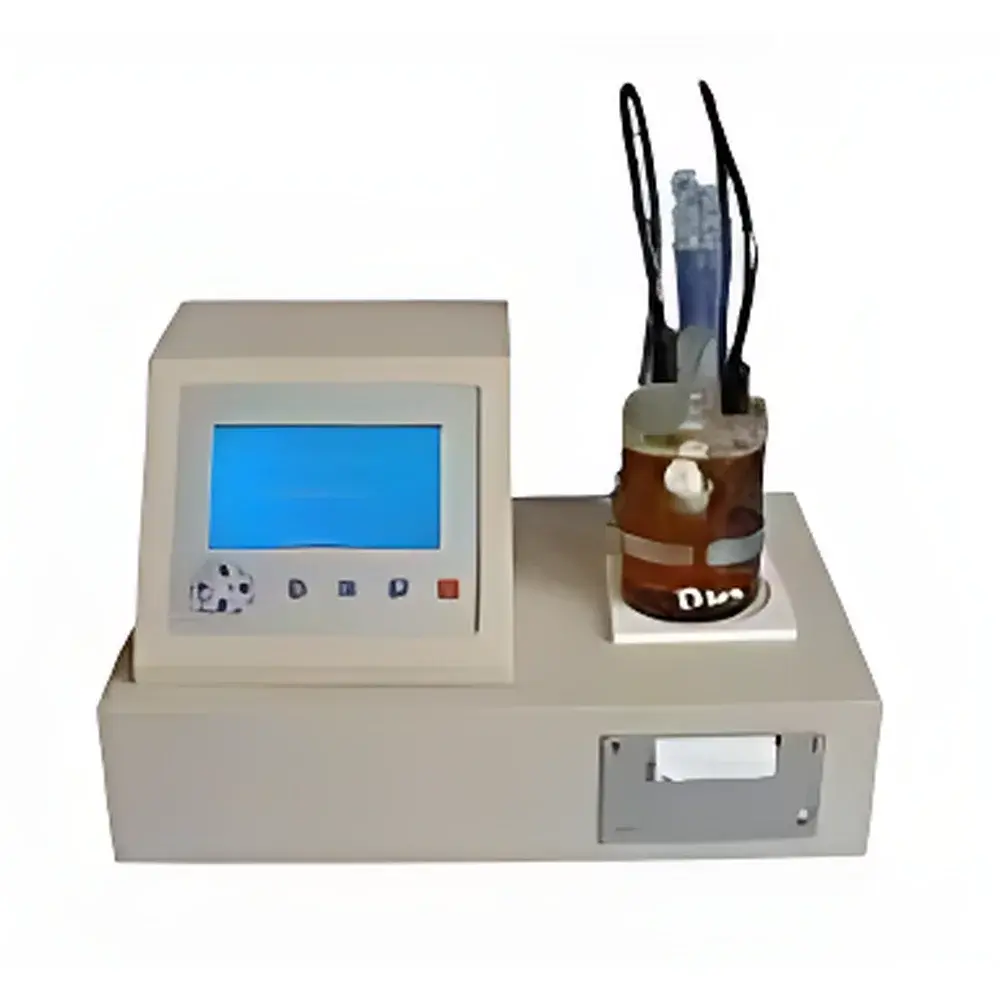
PLD-GRS6 Automatic Coulometric Karl Fischer Moisture Analyzer
| Origin | Shaanxi, China |
|---|---|
| Manufacturer Type | Authorized Distributor |
| Origin Category | Domestic (China) |
| Model | PLD-GRS6 |
| Price | USD 6,700 (approx.) |
| Measurement Principle | Coulometric Karl Fischer Titration |
| Measurement Range | 1 μg – 500 mg H₂O |
| Sensitivity | 0.1 μg |
| Accuracy | ±5% ±1 μg |
| Control System | PULL T 8.0 Test Platform |
| Single-Test Duration | 2–4 min |
| Endpoint Detection | Dual Platinum Electrodes |
| Titration Cell Volume | 150 mL |
| Stirring Method | Magnetic Stirrer |
| Power Supply | 220 V ±10%, 50 Hz ±0.5 Hz |
| Power Consumption | 40 W |
| Operating Temperature | 10–40 °C |
| Relative Humidity | ≤70% |
| Compliance Standards | GB/T 7600, GB/T 11133, GB/T 6283, SH/T 0207, SH/T 0246, SH/T 0255 |
Overview
The PLD-GRS6 Automatic Coulometric Karl Fischer Moisture Analyzer is a precision laboratory instrument engineered for trace-level water quantification in diverse sample matrices using the coulometric Karl Fischer (KF) titration method. Unlike volumetric KF systems, the PLD-GRS6 generates iodine electrochemically within the titration cell via controlled current application—enabling high sensitivity and exceptional reproducibility for samples containing ultra-low water concentrations (1 μg to 500 mg). Its core measurement architecture relies on dual platinum electrodes for real-time endpoint detection, ensuring robust discrimination between stoichiometric reaction completion and background drift. Designed for compliance-critical environments—including transformer oil testing, pharmaceutical excipient qualification, and high-purity solvent verification—the analyzer meets the metrological requirements of multiple Chinese national standards (GB/T and SH/T series), which align closely with ISO 8533 and ASTM D6304 methodologies for coulometric moisture determination.
Key Features
- Coulometric generation of iodine: Eliminates need for standardized KF reagents; enables sub-microgram detection limit (0.1 μg) and superior long-term stability.
- Dual platinum electrode system: Provides rapid, noise-resistant endpoint recognition with automatic baseline correction and blank compensation algorithms embedded in the PULL T 8.0 control platform.
- Integrated magnetic stirring: Ensures homogeneous mixing in the 150 mL titration cell without mechanical wear or seal degradation.
- Real-time parameter display: 20×2 LCD shows date/time, electrolysis rate (μg/s), accumulated water mass (μg), and status indicators—optimized for GLP-compliant documentation.
- Automated result output: Built-in thermal printer produces auditable hard copies of test parameters, endpoint time, total water mass, and calculation metadata—supporting 21 CFR Part 11–aligned record retention when paired with external audit-log software.
- Compact benchtop design: Low power consumption (40 W), wide operating temperature range (10–40 °C), and humidity tolerance (≤70% RH) ensure reliable deployment in QC labs, field service vans, and production-floor environments.
Sample Compatibility & Compliance
The PLD-GRS6 accommodates liquid, gaseous, and soluble solid samples after appropriate conditioning (e.g., dissolution in KF-compatible solvents or carrier gas sparging). It is routinely deployed for moisture analysis in insulating oils (per GB/T 7600 and SH/T 0207), light hydrocarbons (SH/T 0246), lubricant additives (SH/T 0255), and pharmaceutical intermediates (aligned with USP ). Its coulometric methodology satisfies the fundamental performance criteria outlined in ISO 8533:2017 (“Petroleum products — Determination of water — Coulometric Karl Fischer titration method”) and supports internal validation protocols required under GMP and ISO/IEC 17025 accreditation frameworks. The instrument’s fixed-cell geometry and electrode calibration routine minimize inter-operator variability—critical for multi-shift laboratories conducting routine release testing.
Software & Data Management
Controlled by the PULL T 8.0 embedded test platform, the PLD-GRS6 executes fully automated sequence logic: solvent purging, baseline stabilization, sample injection, electrolysis initiation, endpoint confirmation, and result computation—all without manual intervention. While the unit lacks Ethernet or USB host capability, its RS-232 interface permits connection to external PCs running validated LIMS or ELN systems. Audit-trail functionality (timestamped start/stop, operator ID placeholder, and raw μg/s profile export) can be enabled via third-party middleware compliant with FDA 21 CFR Part 11 requirements. All printed reports include mandatory metadata: test ID, analyst code (manually entered), ambient conditions, cell volume, and reagent batch number—facilitating traceability during regulatory inspections.
Applications
- Power industry: Quantifying dissolved water in transformer, turbine, and switchgear oils to assess dielectric integrity and prevent hydrolytic degradation.
- Petrochemical QA/QC: Verifying water limits in jet fuels (ASTM D6304 equivalence), naphthas, and polymer-grade monomers where ppm-level hydration impacts catalyst life.
- Pharmaceutical manufacturing: Testing residual moisture in lyophilized APIs, excipients, and packaging headspace gases per ICH Q5C guidelines.
- Electronics materials: Measuring trace H₂O in photoresists, etchants, and ultrapure solvents to prevent microdefect formation during wafer processing.
- Environmental & food safety labs: Analyzing water content in biodiesel blends (EN 14103 alignment) and hygroscopic food additives where water activity correlates with microbial stability.
FAQ
What sample types require pretreatment before analysis on the PLD-GRS6?
Samples with low solubility (e.g., waxes, polymers) or reactive functional groups (e.g., aldehydes, anhydrides) must be dissolved in KF-compatible solvents (e.g., Hydranal–Composite 5) or pre-treated to avoid side reactions. Gas-phase analysis requires calibrated sparging with dry carrier gas and trapping in solvent-saturated KF reagent.
How often must the titration cell be cleaned and reconditioned?
Cell maintenance is recommended after every 50–100 analyses or when baseline drift exceeds 0.5 μg/s. Cleaning involves sequential rinsing with methanol, acetone, and dried KF solvent—followed by overnight drying at 110 °C under inert gas purge.
Does the PLD-GRS6 support multi-point calibration verification?
Yes. The PULL T 8.0 platform allows manual entry of certified water standards (e.g., 1.00 mg/g Disodium Tartrate Dihydrate) to generate linearity checks across the 1–500 mg range. Calibration verification data is printable and timestamped.
Can the instrument be integrated into a networked lab environment?
Native network connectivity is not supported; however, RS-232 output enables integration with centralized data acquisition systems via serial-to-Ethernet converters configured for Modbus RTU protocol emulation.
Is the dual platinum electrode system user-replaceable?
Yes. Electrode assemblies are field-serviceable with standard Torx tools. Replacement kits include factory-calibrated electrodes and alignment fixtures to maintain geometric consistency critical for coulometric current efficiency.
Related Products




