
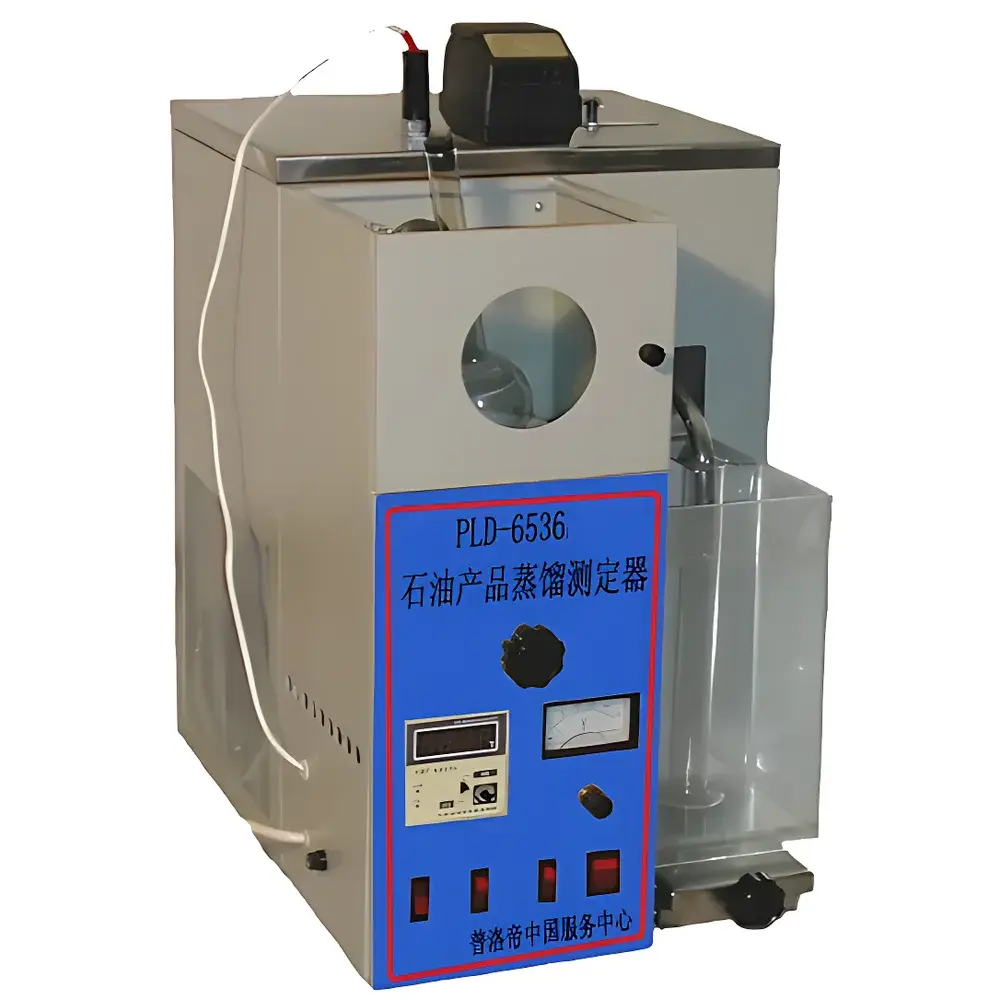
PULUODY PLD-6536B Petroleum Distillation Apparatus
| Brand | PULUODY |
|---|---|
| Origin | Shaanxi, China |
| Manufacturer Type | Direct Manufacturer |
| Country of Origin | China |
| Model | PLD-6536B |
| Heating Power | 0–1200 W (continuously adjustable) |
| Heating Mantle Vertical Adjustment Range | 35 mm |
| Flask Support Plate Aperture Options | Ø37.5 mm and Ø50 mm |
| Condensate Bath Temperature Range (with chiller) | –5 to 80 °C |
| Power Supply | AC 220 V, 50 Hz |
Overview
The PULUODY PLD-6536B Petroleum Distillation Apparatus is a precision-engineered laboratory instrument designed for standardized distillation analysis of volatile petroleum fractions in accordance with ASTM D86, ISO 3405, and GB/T 6536. It implements the classical atmospheric batch distillation method—where a representative sample is heated at a controlled rate in a calibrated distillation flask, and vaporized components are condensed and collected sequentially in a graduated cylinder. This apparatus delivers reproducible boiling point distribution data critical for refinery process control, fuel specification compliance, and quality assurance in downstream product certification. Its modular architecture integrates thermal management, mechanical positioning, and condensate handling into a single benchtop platform suitable for QC laboratories operating under GLP or ISO/IEC 17025-accredited conditions.
Key Features
- Adjustable heating power (0–1200 W) via solid-state voltage regulator, enabling precise control over distillation rate per standard-defined ramp profiles.
- Vertically adjustable heating mantle with 35 mm travel range, facilitating optimal alignment between flask neck and condenser inlet across varying flask geometries.
- Dual-flask support plate configuration (Ø37.5 mm and Ø50 mm apertures) accommodates standard ASTM D86 flasks—including 125 mL and 200 mL sizes—for gasoline, jet fuel, naphtha, kerosene, and diesel distillates.
- Integrated refrigerated condensate bath with temperature control from –5 °C to +80 °C, ensuring consistent condensation efficiency across low-boiling (e.g., aviation gasoline) and mid-range fractions (e.g., No. 2 diesel).
- Quartz-tube heating furnace provides uniform radiant heat distribution, enhanced oxidation resistance, electrical insulation, and splash protection—critical when handling flammable hydrocarbon samples.
- Hinged front observation window allows unobstructed visual monitoring during distillation, simplifies flask loading/unloading, and permits rapid cooling access without disassembly.
- Acrylic-made receiving cylinder bath with built-in LED illumination enables real-time, glare-free volume reading under ambient lab lighting while maintaining thermal stability of the collection system.
Sample Compatibility & Compliance
The PLD-6536B is validated for use with light to medium distillates including but not limited to: motor gasoline (ASTM D439/D4814), aviation turbine fuels (ASTM D1655), petroleum solvents (ASTM D235), kerosene (ASTM D3699), and middle distillates such as No. 1 and No. 2 diesel fuel (ASTM D975). All operational parameters—including heating rate, condenser coolant temperature, and receiver placement—adhere strictly to the procedural constraints defined in ASTM D86 Annex A1 and ISO 3405 Clause 6. The apparatus supports full traceability documentation required for internal audit and external accreditation (e.g., ISO/IEC 17025 clause 7.8), and its mechanical repeatability meets the ±0.5 °C repeatability tolerance specified in GB/T 6536 for initial boiling point determination.
Software & Data Management
While the PLD-6536B operates as a manually monitored analog system, it is fully compatible with third-party digital data acquisition systems via optional PT100 sensor integration points (available upon request). Users may connect external temperature loggers, digital volume readers, or automated fraction collectors to generate time-stamped, CSV-exportable datasets aligned with 21 CFR Part 11-compliant electronic record workflows. Calibration certificates for auxiliary sensors (e.g., immersion thermometers, volumetric cylinders) can be maintained within a laboratory’s LIMS or QMS, supporting full audit readiness for regulatory inspections under FDA, EPA, or CNAS frameworks.
Applications
- Refinery laboratory verification of crude cut points and fractionator performance.
- Quality control of finished fuels prior to dispatch—ensuring compliance with Reid Vapor Pressure (RVP), T10/T50/T90 specifications, and volatility limits per EN 228 or ASTM D4814.
- Investigation of contamination events (e.g., gasoline adulteration with ethanol or benzene) through deviation analysis in distillation curve shape.
- Supporting research on alternative fuel blends (e.g., bio-diesel/diesel mixtures) by quantifying volatility shifts relative to baseline hydrocarbon profiles.
- Training platform for ASTM D86 methodology in technical education programs accredited by ABET or national petroleum training institutes.
FAQ
Does the PLD-6536B support vacuum distillation?
No—the PLD-6536B is configured exclusively for atmospheric distillation per ASTM D86, ISO 3405, and GB/T 6536. For reduced-pressure applications (e.g., ASTM D1160), a separate vacuum-capable distillation unit is required.
Can the condensate bath operate without an external chiller?
Yes—the bath includes provisions for circulating tap water or glycol-water mixtures; however, sub-ambient temperatures (below 10 °C) require connection to a dedicated recirculating chiller.
Is the heating mantle compatible with ASTM D86 Specification E1 specification thermometers?
Yes—the flask support geometry and mantle clearance conform to ASTM D86 Figure 1 requirements, permitting proper insertion and immersion depth (≥25 mm below side-arm opening) for certified mercury-in-glass or digital thermometers meeting E1 accuracy class.
What maintenance intervals are recommended for long-term reliability?
Daily inspection of quartz tube integrity and electrical connections; quarterly verification of voltage regulator linearity and bath temperature uniformity using NIST-traceable references; annual recalibration of auxiliary temperature and volume measurement devices per ISO/IEC 17025 clause 6.5.





