
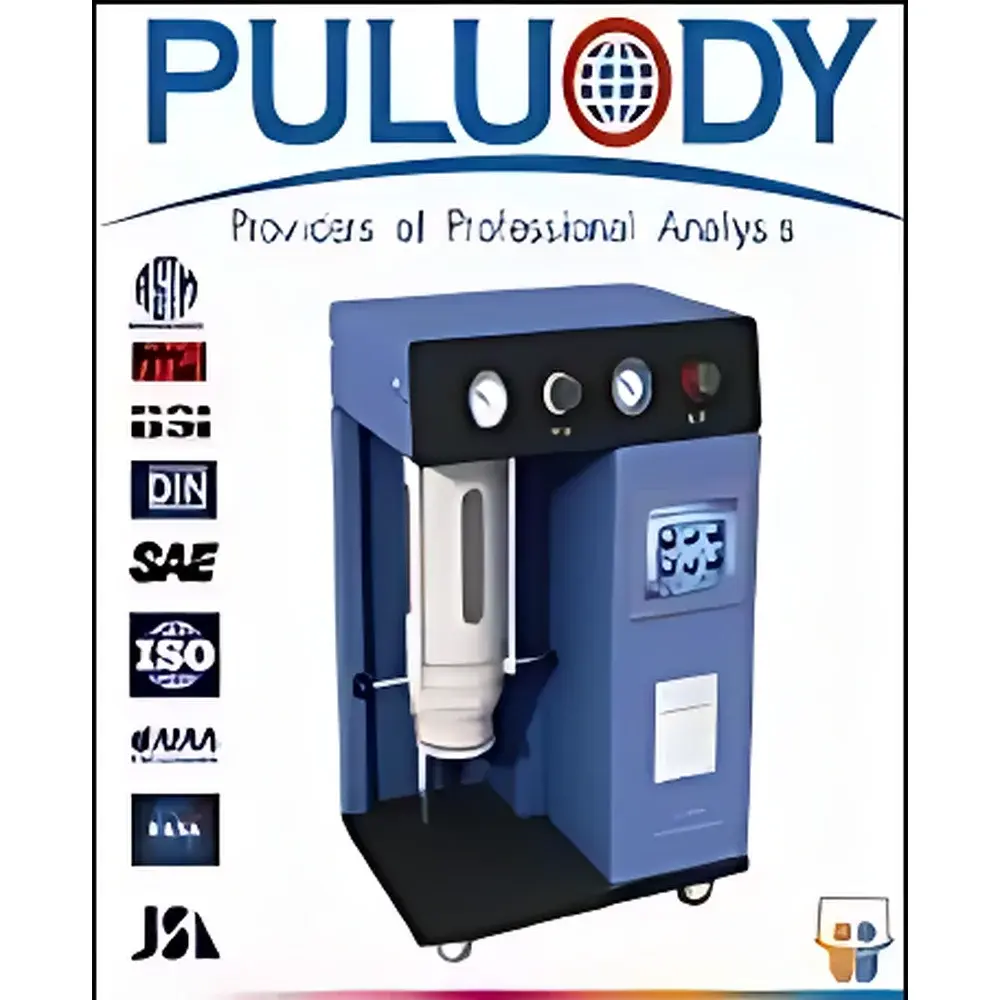

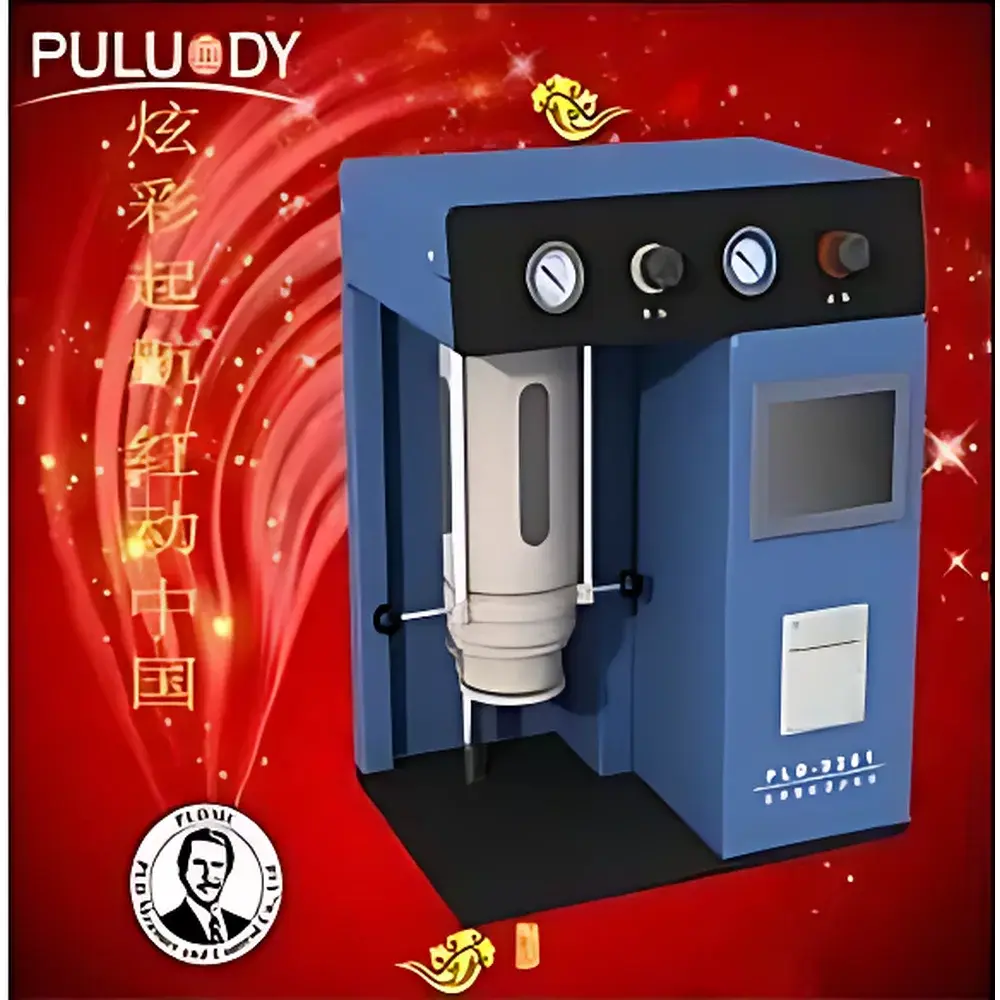
PULUODY PLD-0201 Optical Particle Counter
| Brand | PULUODY |
|---|---|
| Origin | Shaanxi, China |
| Manufacturer Type | Manufacturer |
| Product Category | Domestic |
| Model | PLD-0201 (Latest) |
| Instrument Type | Optical Particle Counter |
| Measurement Principle | Light Obscuration (LO) |
| Calibration Standards | ISO 11171:1999, GB/T 18854–2002, JJG 066–95 |
| Sensitivity | 1 µm (per ISO 4402), 4 µm(c) (per ISO 11171) |
| Particle Size Range | 1–450 µm |
| Channel Resolution | 1000 adjustable channels (user-selectable 8-channel configuration) |
| Counting Accuracy | ≤5% coincidence error at 10,000 particles/mL |
| Sample Volume Precision | ±1% |
| Flow Rate | 5–60 mL/min |
| Test Duration | Adjustable down to 12.5 s |
| Pressure Range | –0.6 to +0.7 MPa (integrated positive/negative pressure pre-treatment system) |
| Max. Viscosity Handling | ≤350 cSt |
| Operating Temperature | Ambient to 65 °C |
| Ambient Temperature Range | 0–50 °C |
| Power Supply | 220 VAC, 50 Hz, <80 W |
Overview
The PULUODY PLD-0201 Optical Particle Counter is a high-precision, laboratory- and field-deployable instrument engineered for quantitative analysis of solid particulate contamination in liquid media—primarily hydraulic oils, lubricants, insulating oils, turbine oils, and other industrial fluids. It operates on the internationally standardized light obscuration (LO) principle—also known as the optical blockage or photometric shadow method—in which particles suspended in a flowing fluid stream pass through a focused laser beam; each particle generates a transient reduction in transmitted light intensity proportional to its cross-sectional area. This analog pulse signal is digitized and classified into user-defined size channels to yield statistically robust particle count data per unit volume. Designed for compliance with ISO 4406:2017, NAS 1638, GJB 420B, and GJB 380, the PLD-0201 delivers traceable, repeatable, and auditable contamination assessments essential for predictive maintenance, fluid lifecycle management, and regulatory conformance in critical infrastructure.
Key Features
- Sixth-generation narrow-beam laser sensor optimized for stability, linearity, and low-noise signal acquisition across the 1–450 µm range
- Dual-controlled volumetric sampling via precision plunger pump and electromagnetic flow regulation—ensuring consistent flow rate (5–60 mL/min) and exact sample volume (1 mL to unlimited, programmable)
- Integrated pressure-managed sampling chamber supporting both vacuum-assisted degassing and pressurized aspiration for high-viscosity or volatile samples (≤350 cSt)
- 1000-channel high-resolution detection architecture with fully customizable channel thresholds—enabling flexible binning for ISO, NAS, or proprietary grading schemes
- Onboard embedded operating system with 7-inch capacitive touchscreen, dual-input interface (touch + physical keypad), and real-time graphical display of histograms, cumulative curves, and raw pulse data
- Integrated thermal printer for immediate hardcopy reporting—including contamination grade classification (e.g., ISO code 18/16/13), particle concentration per size bin, and pass/fail status against preset limits
- RS232 serial interface compliant with SCPI command syntax for automated integration into LIMS, MES, or centralized QA/QC platforms
- Self-cleaning fluidic pathway with programmable rinse cycles using compatible solvents (e.g., Isopropyl Alcohol, filtered mineral oil)
Sample Compatibility & Compliance
The PLD-0201 is validated for direct analysis of undiluted, unfiltered samples including mineral-based and synthetic hydraulic fluids, aviation turbine fuels (Jet A-1, JP-8), transformer insulating oils, gear oils, engine crankcase oils, water-glycol hydraulic fluids, and polymer solutions. No pre-filtration, centrifugation, or dilution is required under standard operating conditions. Its measurement traceability aligns with national and international metrological frameworks: calibration follows GB/T 18854–2002 (equivalent to ISO 11171:1999), and verification may be performed by the National Defense Science & Technology Industry Particle Metrology Station (No. 116)—a certified Class I metrology laboratory accredited under CNAS and recognized by MIL-STD-45662A. The instrument supports full audit trails and electronic signature capability when connected to compliant software environments, facilitating adherence to GLP, GMP, and FDA 21 CFR Part 11 requirements where integrated data governance is mandated.
Software & Data Management
The system ships with P6.4 Analysis Software—available in both embedded firmware and standalone PC versions—with support for multi-standard reporting (ISO 4406, NAS 1638, SAE AS4059F, GJB 420B). Raw pulse data, size distribution histograms, temporal trend charts, and batch summary reports are exportable in CSV, PDF, and XML formats. The software implements configurable pass/fail logic based on user-defined limit tables, auto-generates calibration logs with timestamped operator ID, and maintains revision-controlled method files. When deployed in regulated environments, optional validation packages—including IQ/OQ documentation, electronic record integrity assessments, and 21 CFR Part 11-compliant user access controls—are available upon request.
Applications
- Condition monitoring of hydraulic systems in aerospace ground support equipment, naval vessels, and armored vehicle fleets
- Acceptance testing of new oil batches prior to commissioning in 500 kV power transformers and nuclear plant turbine lube systems
- In-service fluid surveillance for wind turbine gearboxes, excavator hydraulic circuits, and marine propulsion systems
- Quality control of high-purity hydraulic fluids used in semiconductor manufacturing tooling and cleanroom-compatible machinery
- Research-grade particulate characterization in polymer processing, pharmaceutical excipient suspensions, and battery electrolyte formulations
- Third-party certification testing per ISO 4406 for OEM component suppliers serving automotive, rail, and energy sectors
FAQ
What calibration standards does the PLD-0201 support?
It complies with ISO 11171:1999, GB/T 18854–2002, and JJG 066–95. Certified reference materials (CRM) from NIST-traceable sources (e.g., ISO Medium Test Dust, AC Fine) are recommended for routine verification.
Can the instrument measure particles below 1 µm?
No—the stated lower detection limit is 1 µm per ISO 4402 and 4 µm(c) per ISO 11171. Sub-micron analysis requires complementary techniques such as nanoparticle tracking analysis (NTA) or dynamic light scattering (DLS).
Is external PC operation mandatory?
No. All core functions—including method setup, real-time counting, grade assignment, and printed reporting—are fully autonomous via the onboard OS and touchscreen interface.
How is sample degassing achieved?
The integrated pressure manifold enables controlled vacuum application (down to –0.6 MPa) to remove entrained air prior to measurement—critical for accurate counts in low-saturation oils or after cold-start sampling.
Does the system support multi-language UI?
Yes. Firmware v3.2+ includes selectable English, Chinese, Russian, and Spanish language packs—configured via system settings without requiring software reinstallation.
Related Products



