
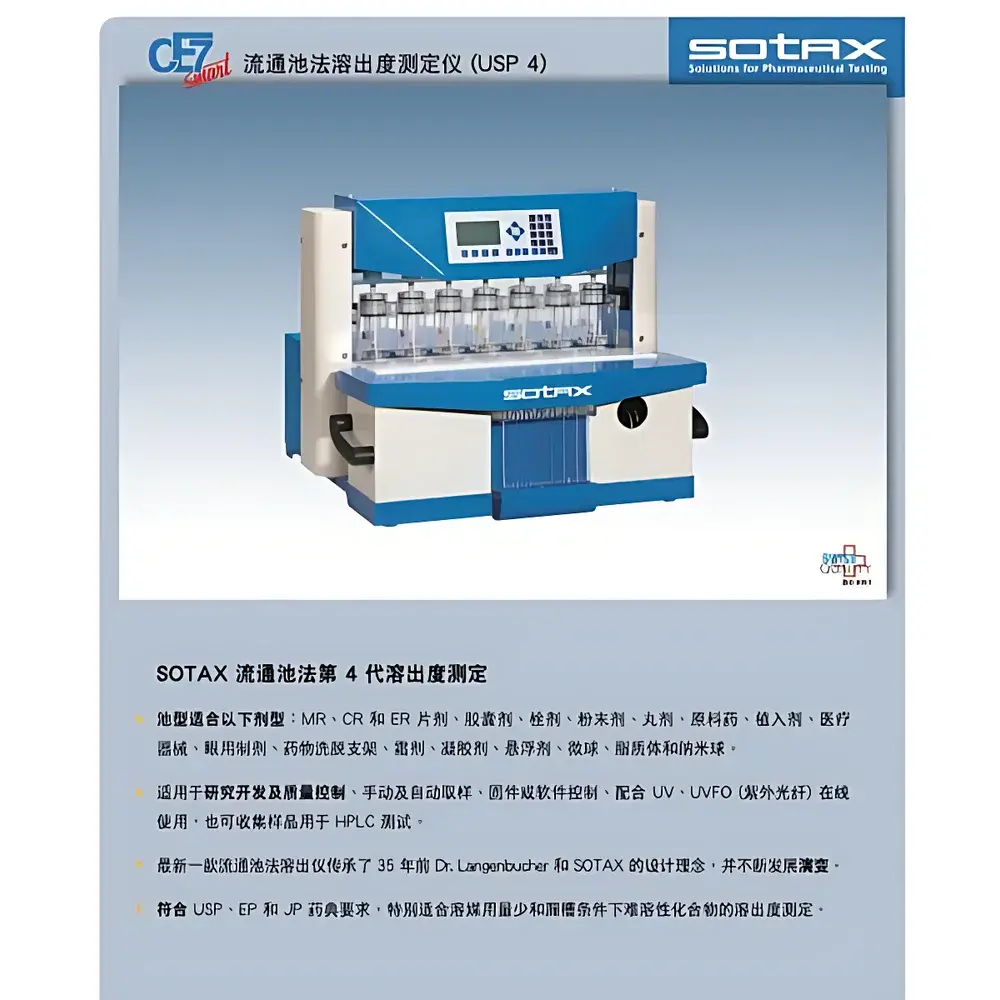
SOTAX CE 7smart USP Apparatus 4 Flow-Through Cell Dissolution Tester
| Brand | SOTAX |
|---|---|
| Model | CE 7smart |
| Apparatus Type | USP <724> Apparatus 4 (Flow-Through Cell) |
| Compliance | USP <711>, <1088>, Ph. Eur. 2.9.3, 2.9.42, 2.9.43, JP Dissolution Test Method 3 |
| Temperature Control Range | Ambient – 45 °C (±0.2 °C) |
| Flow Rate Range | 1.5–35 mL/min (with CP 7-35 piston pump) |
| Cell Capacity | 6 positions |
| Bath Volume | 8 L |
| Dimensions (H×D×W) | 470 × 600 × 580 mm |
| Weight | 36 kg |
| Software | WinSOTAX (21 CFR Part 11 compliant, client-server architecture supported) |
| Sample Handling | Online UV/Vis/UV-FO coupling or offline fraction collection for HPLC analysis |
Overview
The SOTAX CE 7smart is a precision-engineered USP Apparatus 4 flow-through cell dissolution tester, originally co-developed over 35 years ago by Dr. Fritz Langenbucher and SOTAX to address the physicochemical complexity of extended-release, implantable, and low-solubility drug products. Unlike basket (USP 1) or paddle (USP 2) methods, Apparatus 4 employs laminar, controlled-flow hydrodynamics through a vertically oriented cylindrical cell—enabling reproducible simulation of in vivo fluid shear and mass transfer conditions across diverse dosage forms. The system maintains physiological temperature (37 °C ± 0.2 °C) throughout the dissolution medium, cell inlet, and individual flow cells via a thermostatically regulated water bath and integrated temperature monitoring at three critical points (bath, pre-cell, and intra-cell). This architecture ensures compliance with biorelevant dissolution modeling requirements and supports mechanistic interpretation of release kinetics under sink- or non-sink conditions.
Key Features
- True six-position parallel testing with independent flow control per cell, minimizing inter-run variability and supporting statistical robustness per ICH Q5C and Q2(R2) guidelines.
- Modular cell configuration system accommodating standardized diameters (12 mm and 22.6 mm), plus specialized inserts for powders, granules, suspensions, soft gelatin capsules, implants, drug-eluting stents, transdermal diffusion cells (T-cells), ophthalmic formulations, liposomes, and nanocarriers.
- Integrated CP 7-35 high-precision piston pump delivering stable, pulse-free flow across 1.5–35 mL/min—calibrated traceably to NIST standards and validated per ASTM E2503 and USP flow uniformity criteria.
- Front-panel graphical user interface (GUI) enabling real-time display and adjustment of method parameters: sampling frequency, dissolution medium composition, bath temperature, flow rate, cell type, and total dissolution volume.
- Dual analytical integration pathways: direct online coupling to UV/Vis spectrophotometers or UV fiber-optic (UV-FO) systems from major vendors (e.g., Agilent, Shimadzu, Thermo Fisher), or automated fraction collection into chilled vials for subsequent HPLC/UPLC quantification.
Sample Compatibility & Compliance
The CE 7smart meets regulatory expectations for method suitability and instrument qualification across global pharmacopoeias. It fulfills USP (Dissolution), (Performance Verification Tests), Ph. Eur. 2.9.3 (Dissolution Testing), 2.9.42 (Apparatus 4 Specifications), 2.9.43 (Verification Procedures), and JP General Chapter “Dissolution Test, Method 3”. All cell geometries and insert configurations are designed to preserve hydrodynamic equivalence per USP and avoid wall effects or channeling artifacts. Temperature and flow verification protocols follow documented SOPs aligned with ISO/IEC 17025 and FDA guidance on analytical instrument qualification (AIQ), including dual-point calibration, stability assessment over 24 h, and uncertainty budgeting per EURACHEM/CITAC Guide.
Software & Data Management
WinSOTAX is a validated, 21 CFR Part 11-compliant software platform supporting electronic records, role-based access control, full audit trail generation (including parameter changes, user logins, and result modifications), and electronic signatures. It enables centralized method management, multi-instrument synchronization (including USP 1/2 dissolution systems), and client-server deployment for enterprise-scale deployment. Raw data export is supported in CSV, XML, and PDF formats; all chromatographic integrations (via UV-FO or fraction collectors) are timestamp-synchronized and metadata-tagged for GLP/GMP traceability. System suitability tests (SST) and performance verification reports are auto-generated per predefined templates meeting WHO TRS 992 Annex 6 and MHRA GxP Data Integrity requirements.
Applications
The CE 7smart is routinely deployed in formulation development, quality control, and regulatory submission support for challenging dosage forms where conventional apparatuses fail to discriminate meaningful differences. These include: sustained-release tablets and pellets; mucoadhesive buccal films; intravitreal implants; polymer-based depots; lipid nanoparticle (LNP) and polymeric micelle formulations; and drug-eluting cardiovascular devices. Its ability to maintain constant flow and temperature during prolonged runs (up to 72 h) supports biphasic or triphasic release profiling and enables correlation studies with in vivo PK data using convolution-based modeling (e.g., deconvolution with WinNonlin or GastroPlus).
FAQ
What validation documentation is provided with the CE 7smart?
SOTAX supplies a comprehensive IQ/OQ/PQ protocol package aligned with ASTM E2503, USP , and EU Annex 15, including temperature mapping reports, flow uniformity test data, and mechanical verification certificates.
Can the CE 7smart be integrated into an existing LIMS environment?
Yes—WinSOTAX supports ASTM E1578-compliant data export and can interface with major LIMS platforms via secure API or flat-file transfer with configurable metadata tagging.
Is third-party UV/Vis instrumentation compatible with online detection?
All commercially available UV/Vis and UV-FO systems with analog output (0–10 V) or RS-232/USB connectivity are supported; no proprietary hardware interfaces are required.
How is flow rate accuracy verified during routine operation?
Weight-based gravimetric verification is performed per USP using calibrated analytical balances (±0.1 mg) and certified volumetric flasks; optional automated verification workstations (SOTAX FlowCheck Pro) provide real-time deviation alerts and trend reporting.
Does the system support dissolution testing under non-sink conditions?
Yes—the closed-loop design, adjustable flow rates, and interchangeable cell volumes (12 mm vs. 22.6 mm) allow precise control of saturation ratio and residence time, facilitating mechanistic evaluation of diffusion- or erosion-controlled release.




