
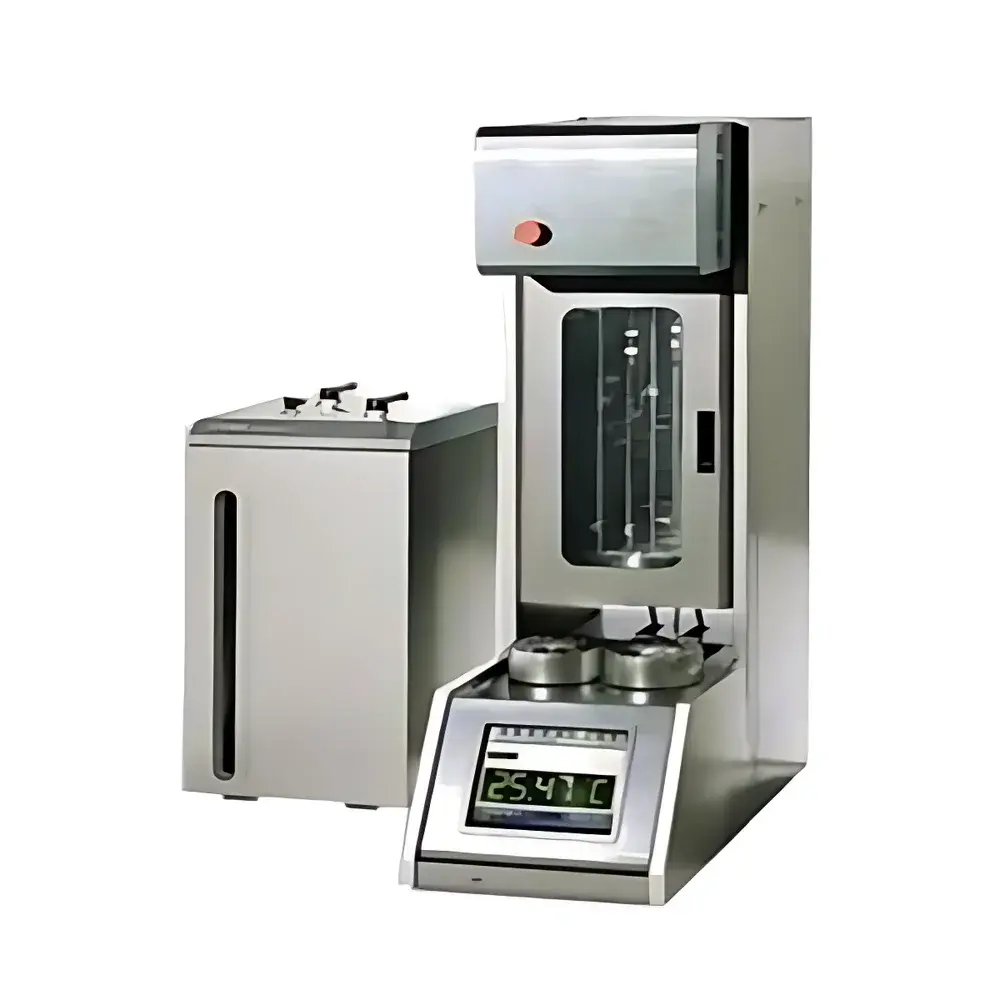
PULUODY PLD-VZ6.0 Fully Automated Kinematic Viscosity Tester
| Brand | PULUODY |
|---|---|
| Origin | Shaanxi, China |
| Manufacturer Type | Direct Manufacturer |
| Country of Origin | China |
| Model | PLD-VZ6.0 |
| Price Range | USD 7,000 – 14,000 |
| Power Supply | 220 V ±10%, 50 Hz |
| Total Power Consumption | 2.0 kW |
| Temperature Control Range | 20 °C to 100 °C |
| Temperature Stability | ±0.01 °C |
| Sample Capacity | 2 × 12 positions |
| Timing Resolution | 0.01 s |
| Display | 10.4″ LCD touchscreen |
| Control System | Microcontroller-based digital PID control |
| Relative Humidity Limit | <85% RH |
| Compliance Standards | ASTM D445, ISO 3104, GB/T 265 |
Overview
The PULUODY PLD-VZ6.0 Fully Automated Kinematic Viscosity Tester is an engineered solution for precise, repeatable kinematic viscosity measurement of transparent and opaque Newtonian petroleum liquids—including base oils, lubricants, diesel fuels, jet fuels, and transformer oils—according to internationally recognized test methods: ASTM D445, ISO 3104, and GB/T 265. Kinematic viscosity (ν), expressed in mm²/s (equivalent to centistokes, cSt), is determined by measuring the time required for a fixed volume of liquid to flow under gravity through a calibrated glass capillary viscometer at a precisely controlled temperature. The PLD-VZ6.0 automates the entire gravimetric capillary timing process—eliminating operator-dependent variables such as meniscus judgment, stopwatch activation, and manual sample handling—thereby ensuring compliance with GLP and laboratory accreditation requirements (e.g., ISO/IEC 17025).
Key Features
- Fully autonomous workflow: automatic sample positioning, vacuum-assisted aspiration, thermal equilibration (immersion time programmable per standard), capillary timing, solvent rinse, and hot-air drying—executed without user intervention between samples.
- Dual independent 12-position sample carousels enable unattended batch processing of up to 24 samples, supporting high-throughput QC laboratories and refinery quality control environments.
- High-stability temperature bath with ±0.01 °C precision over 20–100 °C range, achieved via microcontroller-driven PID regulation and immersion-type platinum resistance thermometers (PRTs) traceable to NIST standards.
- Integrated vacuum servo module and cleaning servo station—both constructed with corrosion-resistant materials (e.g., 316 stainless steel fluid paths, PTFE-sealed valves)—ensure long-term reliability and minimal carryover risk.
- 10.4-inch industrial-grade LCD touchscreen interface with dual-language support (English/Chinese); firmware includes self-diagnostic routines, real-time error logging, and predictive fault alerts (e.g., capillary blockage, insufficient bath level, temperature deviation).
- All critical hardware components—including capillary viscometers, solenoid valves, vacuum pumps, and thermal sensors—are sourced from Tier-1 international suppliers to guarantee metrological integrity and mean time between failures (MTBF) exceeding 15,000 hours.
Sample Compatibility & Compliance
The PLD-VZ6.0 is validated for use with Newtonian fluids meeting the scope definitions of ASTM D445 and ISO 3104—specifically, liquids whose shear-rate-independent viscosity allows direct correlation between efflux time and kinematic viscosity using the Ubbelohde or Cannon-Fenske capillary geometry. It accommodates both transparent (e.g., mineral oils, synthetic esters) and opaque (e.g., dark fuel oils, used engine oils diluted per ASTM D445 Annex A3) samples via optical flow detection and pressure-differential timing validation. Instrument qualification documentation supports IQ/OQ protocols; audit trails—including operator ID, timestamped test records, calibration logs, and environmental parameters—are exportable in CSV or PDF format for regulatory review. The system meets functional requirements for FDA 21 CFR Part 11 compliance when deployed with optional electronic signature and role-based access modules.
Software & Data Management
The embedded Windows XP-based control software provides full method configuration—including bath setpoint, immersion duration, number of replicate runs per sample, and pass/fail criteria based on repeatability limits defined in ASTM D445 Section 11. All raw timing data, calculated viscosity values, intermediate thermal readings, and system status flags are stored in a relational SQLite database with immutable timestamps. Data export supports LIMS integration via ODBC drivers and HL7-compliant structured output. Audit trail functionality records every user action (login/logout, parameter change, result override) with cryptographic hashing to prevent tampering. Software updates are delivered via secure USB media with SHA-256 checksum verification.
Applications
- Refinery final product release testing for gasoline, diesel, kerosene, and residual fuel oils.
- Lubricant formulation QC: base stock grading, additive package verification, and oxidation stability monitoring via sequential viscosity tracking.
- Aviation turbine fuel (Jet A/A-1) certification per ASTM D1655 and DEF STAN 91-91.
- Transformer oil condition assessment in power generation and transmission facilities (IEC 60296, ASTM D877/D1816).
- Research applications involving temperature-dependent viscosity profiling (e.g., Arrhenius modeling, viscosity index calculation per ASTM D2161).
- Third-party testing laboratories accredited to ISO/IEC 17025 requiring documented traceability, uncertainty budgets, and interlaboratory comparison readiness.
FAQ
Does the PLD-VZ6.0 support non-Newtonian fluids such as polymer-thickened multigrade oils?
No. This instrument is designed exclusively for Newtonian liquids per ASTM D445 scope. Non-Newtonian behavior requires rotational rheometry (e.g., ASTM D7042 or ISO 6721-10).
Can capillary viscometers be calibrated in-house using certified reference standards?
Yes. The system accepts user-loaded calibration constants (k-values) traceable to NIST SRM 2786 or equivalent primary standards; calibration certificates must include uncertainty statements per ISO/IEC 17025 Clause 6.6.
Is remote monitoring or network connectivity available?
Standard configuration includes RS-232 and Ethernet ports for local network integration; optional OPC UA server module enables SCADA-level supervision in industrial automation environments.
What maintenance intervals are recommended for vacuum and cleaning subsystems?
Solvent filtration cartridges require replacement every 200 tests; vacuum pump oil should be changed quarterly or after 1,000 operating hours; capillary viscometers are inspected visually before each calibration cycle.
How is thermal uniformity across the bath verified during installation qualification?
IQ protocol includes 9-point temperature mapping using calibrated PRT probes per ASTM E74 and ISO 17025 Annex C; spatial deviation must remain within ±0.02 °C at all designated test positions.




