
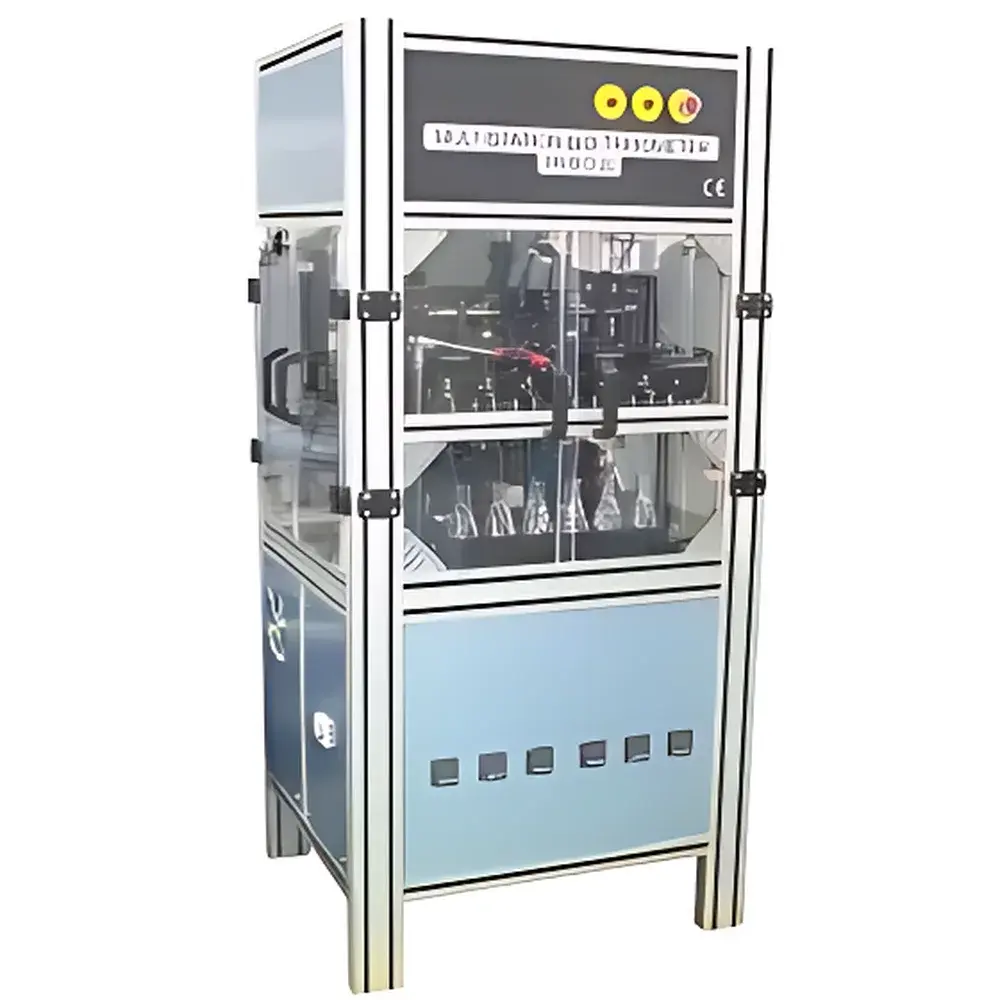
Ducom Bio-Tribometer for Implant Wear Simulation
| Origin | Hong Kong |
|---|---|
| Manufacturer Type | Authorized Distributor |
| Origin Category | Mainland China Manufactured |
| Model | Ducom BT-2000 Series |
| Price Range | USD 7,000 – 14,000 |
| High-Temperature Range (°C) | 3–48 |
| Low-Temperature Range (°C) | –6 |
| Thermal Shock Range (°C) | 12 |
| Temperature Stability (°C) | ±2.4 |
| Heating Rate (°C/min) | 3 |
| Cooling Rate (°C/min) | 3 |
Overview
The Ducom Bio-Tribometer BT-2000 Series is an engineered multi-axis tribological testing platform designed specifically for preclinical evaluation of orthopedic implant materials under physiologically relevant biomechanical and environmental conditions. It operates on the principle of controlled multi-directional motion coupled with dynamic load application—mimicking the complex kinematics and contact mechanics observed in human synovial joints such as the hip and knee. Unlike conventional pin-on-disk or fretting wear testers—which apply simplified, unidirectional sliding—the BT-2000 implements programmable X-Y translational motion, optional rotational articulation (pin/sphere), synchronized loading, and temperature-regulated lubricant environments to replicate in vivo joint loading profiles. This enables quantification of volumetric wear, friction coefficient evolution, debris generation, and surface topography changes across millions of cycles—while maintaining metrological traceability and repeatability required for regulatory-grade material qualification.
Key Features
- Modular multi-station architecture supporting 1, 2, 4, or 6 independent test stations within a single frame
- Independent or collective axial loading: 40–400 N per station (electromechanical feedback-controlled) or up to 3000 N total (hydraulic master load system)
- Programmable bi-directional X-Y motion with adjustable amplitude (±2 mm), frequency, and waveform (sinusoidal, trapezoidal, custom-defined)
- Optional rotational module: 1–120 rpm pin/sphere rotation, synchronizable with translational motion
- Integrated real-time bidirectional friction force measurement per station (X & Y axes, 0–400 N range, 5000–100,000 Hz sampling)
- Temperature-controlled test environment: operational range from –6 °C to +48 °C, with ±2.4 °C stability and ±3 °C/min ramp rates
- Onboard lubricant recirculation system with filtration and temperature regulation (optional per station)
- Dedicated wear debris collection per station for gravimetric and morphological analysis (SEM/EDS compatible)
- Standardized sample fixtures: pins (Ø8/10/12 × 12 mm), spheres (Ø8/10/12 mm), disks (Ø54 × 15 mm); fully customizable fixtures available for non-standard geometries
Sample Compatibility & Compliance
The BT-2000 accommodates metallic (CoCr, Ti-6Al-4V), polymeric (UHMWPE, PEEK), ceramic (Al₂O₃, ZrO₂), and composite implant specimens—including retrieved explants. Its mechanical configuration satisfies ASTM F732 (Standard Test Method for Wear Testing of Polymeric Materials for Total Joint Replacement) and, when equipped with optional joint-specific motion profiles and load controllers, supports ISO 14242-1/-2 (Implants for Surgery — Wear of Total Hip Joint Prostheses). All hardware and software architecture comply with GLP documentation requirements; audit trails, user access control, and electronic signature support are available for FDA 21 CFR Part 11-compliant validation.
Software & Data Management
The proprietary Tribosoft™ v5.2 platform provides closed-loop control of motion, load, temperature, and data acquisition. It supports sequence-based protocol scripting, real-time visualization of friction force vs. displacement/load/time, automated cycle counting, and export of raw time-series data (CSV, HDF5). Wear volume calculations integrate surface profilometry data (e.g., from Ducom 3D non-contact profilometers) via standardized API interfaces. Data files include embedded metadata (operator ID, calibration timestamp, environmental log), enabling full traceability for ISO 17025-accredited laboratories.
Applications
- Preclinical screening of novel bearing couples (e.g., highly crosslinked UHMWPE vs. oxidized zirconium)
- Validation of surface treatments (plasma nitriding, DLC coatings, laser texturing) under simulated joint kinematics
- Long-term wear mapping of retrievals for failure mode analysis
- Effect of synovial fluid composition (protein concentration, hyaluronic acid content) on wear mechanisms
- Correlation studies between in vitro wear rates and clinical revision data
- Development of predictive wear models for ISO 14242-compliant certification
FAQ
What standards does the BT-2000 directly support out-of-the-box?
ASTM F732 is fully implemented; ISO 14242 compliance requires optional joint-motion modules and calibrated load cells traceable to NIST standards.
Can the system operate continuously for >5 million cycles without recalibration?
Yes—engineered for high-cycle durability with maintenance intervals specified at 10 million cycles under nominal load (400 N, 1 Hz, 37 °C), per manufacturer’s service schedule.
Is lubricant temperature independently controllable per station?
Standard configuration includes bulk bath temperature control; independent per-station thermal regulation is available as an add-on module.
What is the minimum measurable wear volume using integrated profiling workflows?
When paired with Ducom’s 3D non-contact profilometer (5 nm vertical resolution), volumetric wear detection limit is <0.001 mm³ after 100,000 cycles.
Does the system support third-party data acquisition integration?
Yes—Tribosoft™ exposes RESTful APIs and LabVIEW-compatible drivers for synchronization with external DAQ systems, environmental chambers, or Raman spectrometers.



