
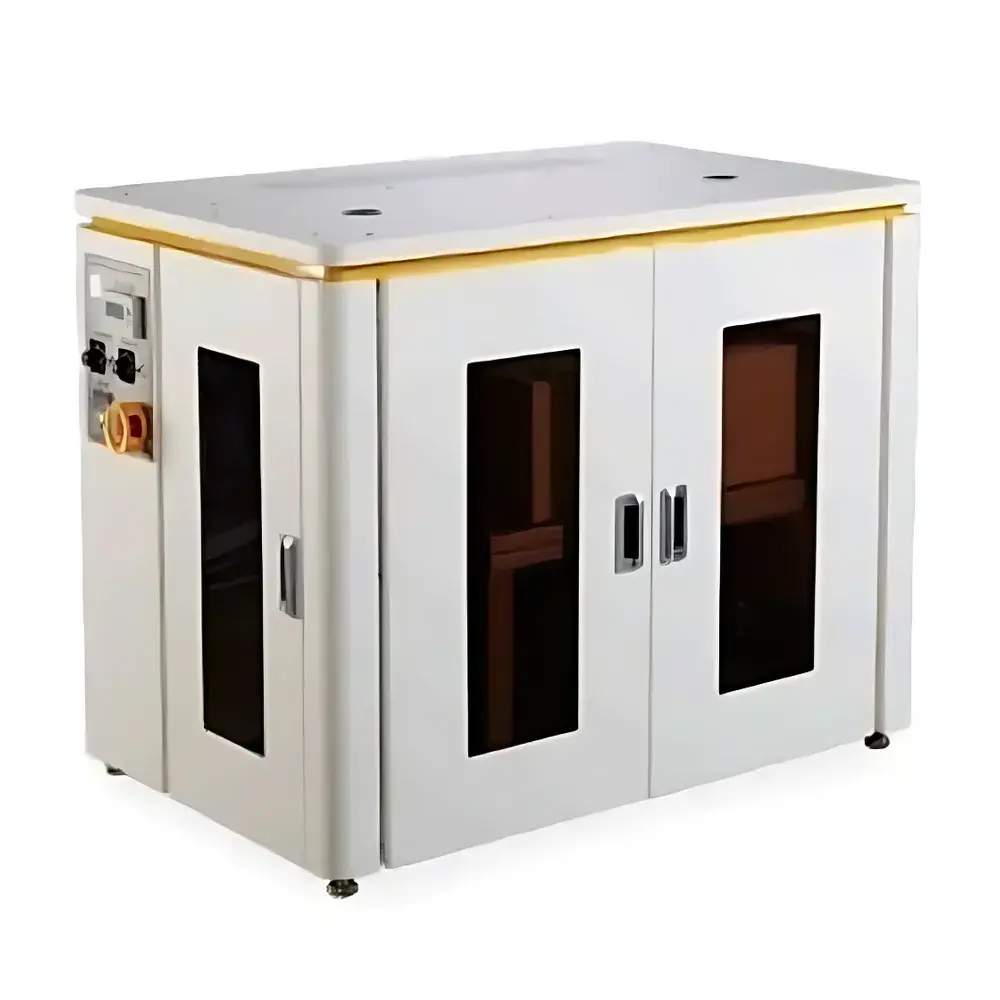
Roll-to-Roll Coating System (Laboratory-Scale) – LR Model
| Origin | South Korea |
|---|---|
| Manufacturer Type | Authorized Distributor |
| Import Status | Imported |
| Model | LR |
| Pricing | Available Upon Request |
Overview
The Roll-to-Roll (R2R) Coating System (Laboratory-Scale) – LR Model is an engineered platform for precision thin-film deposition and functional coating development on flexible substrates. Based on continuous web processing principles, it implements controlled fluid delivery—via slot-die or micro-gravure printing—and synchronized substrate transport to achieve uniform, repeatable coatings at laboratory scale. Unlike batch-mode spin or spray coaters, this system replicates industrial R2R manufacturing conditions while enabling rapid process parameter screening (e.g., web speed, gap control, temperature, dwell time) under low material consumption. It serves as a critical bridge between formulation development and pilot-scale validation in advanced materials research.
Key Features
- Laboratory-optimized mechanical architecture with dual-width capability: 150 mm and 300 mm web handling widths—designed for compatibility with standard lab roll stock and minimal substrate waste.
- Modular coating head options: interchangeable slot-die and micro-gravure modules, each calibrated for shear-sensitive, high-viscosity, or nanoparticle-based inks (typical viscosity range: 1–10,000 mPa·s).
- Integrated drying and curing stations: configurable hot-air convection oven (up to 120 °C), medium-wave infrared (IR) heater array, and UV LED curing module (365 nm or 395 nm, intensity adjustable up to 5 W/cm²).
- Precision web tension control via servo-driven unwind/rewind shafts with closed-loop feedback; line speed range: 0.01–2.0 m/min with ±0.5% repeatability.
- Stainless-steel frame with ESD-safe construction and ISO Class 7 cleanroom-compatible housing (optional laminar flow hood integration available).
- Compliance-ready design: meets CE machinery directive requirements; electrical safety per IEC 61000-6-2/6-4; compatible with GLP documentation workflows.
Sample Compatibility & Compliance
The LR system accommodates polyimide (PI), PET, PEN, stainless-steel foil, aluminum foil, and glass-reinforced polymer substrates (thickness range: 25–250 µm). It supports aqueous, solvent-based, and UV-curable formulations—including conductive inks (Ag, Cu, PEDOT:PSS), perovskite precursors, Li-ion battery slurries (NMC, LFP), anti-reflective and barrier coatings, and dielectric layers for flexible electronics. All wet-processing modules are chemically resistant to common solvents (e.g., NMP, DMF, IPA, toluene). The system is designed to align with ASTM D7267 (Standard Test Method for Measuring Coating Uniformity on Flexible Substrates) and supports traceable calibration protocols required for ISO/IEC 17025-accredited labs.
Software & Data Management
Operation is managed through a Windows-based HMI with real-time monitoring of web speed, tension, temperature profiles, and coating gap position. All process parameters are logged with timestamped metadata (CSV export). Audit trail functionality complies with FDA 21 CFR Part 11 requirements when deployed in regulated environments—supporting electronic signatures, user access levels (admin/operator), and immutable data archiving. Optional LabVIEW or Python API enables integration with external rheometers, in-line spectroscopic sensors (e.g., NIR film thickness monitors), or automated material dispensing systems.
Applications
- Development of OLED and QLED emissive layer stacks on flexible PI substrates.
- Screening of perovskite ink formulations for large-area photovoltaic cells (OPV, PSCs).
- Electrode slurry coating and drying optimization for solid-state and lithium-sulfur batteries.
- Deposition of transparent conductive films (ITO alternatives) for touch sensor integration.
- Functionalization of smart glass with electrochromic or thermochromic layers.
- R&D of printed RFID antennas, stretchable sensors, and biodegradable electronics on paper or cellulose films.
FAQ
What substrate widths does the LR model support?
The system is configurable for 150 mm or 300 mm web width—both optimized for standard lab roll formats and minimal edge loss.
Can the coating head be changed without tools?
Yes—the slot-die and micro-gravure modules feature quick-release mounting with precision alignment pins and digital gap readout (resolution: 1 µm).
Is vacuum or nitrogen purge capability available?
Optional inert atmosphere enclosure (N₂ or Ar) with O₂/H₂O sensors (<1 ppm detection limit) can be integrated for oxygen- or moisture-sensitive processes such as perovskite or lithium metal anode coating.
Does the system meet regulatory requirements for pharmaceutical or medical device R&D?
While not classified as medical equipment, its Part 11-compliant software, audit trail, and calibration traceability support GxP-aligned material development workflows where coating consistency directly impacts device performance and regulatory filing.
What maintenance intervals are recommended?
Daily visual inspection of rollers and doctor blades; weekly cleaning of coating manifolds and drying nozzles; biannual calibration of tension sensors and thermal controllers per manufacturer’s SOP.





