
Gamry DigiElch™ Electrochemical Simulation Software
| Brand | Gamry |
|---|---|
| Origin | USA |
| Manufacturer Type | Authorized Distributor |
| Product Origin | Imported |
| Model | DigiElch |
| Instrument Category | Electrochemical Instrument Control Software |
| Price Range | USD 2,800 – 7,200 (based on edition and optional modules) |
| Editions | Standard Edition, Professional Edition, with optional Reference 600 Hardware Integration Module |
Overview
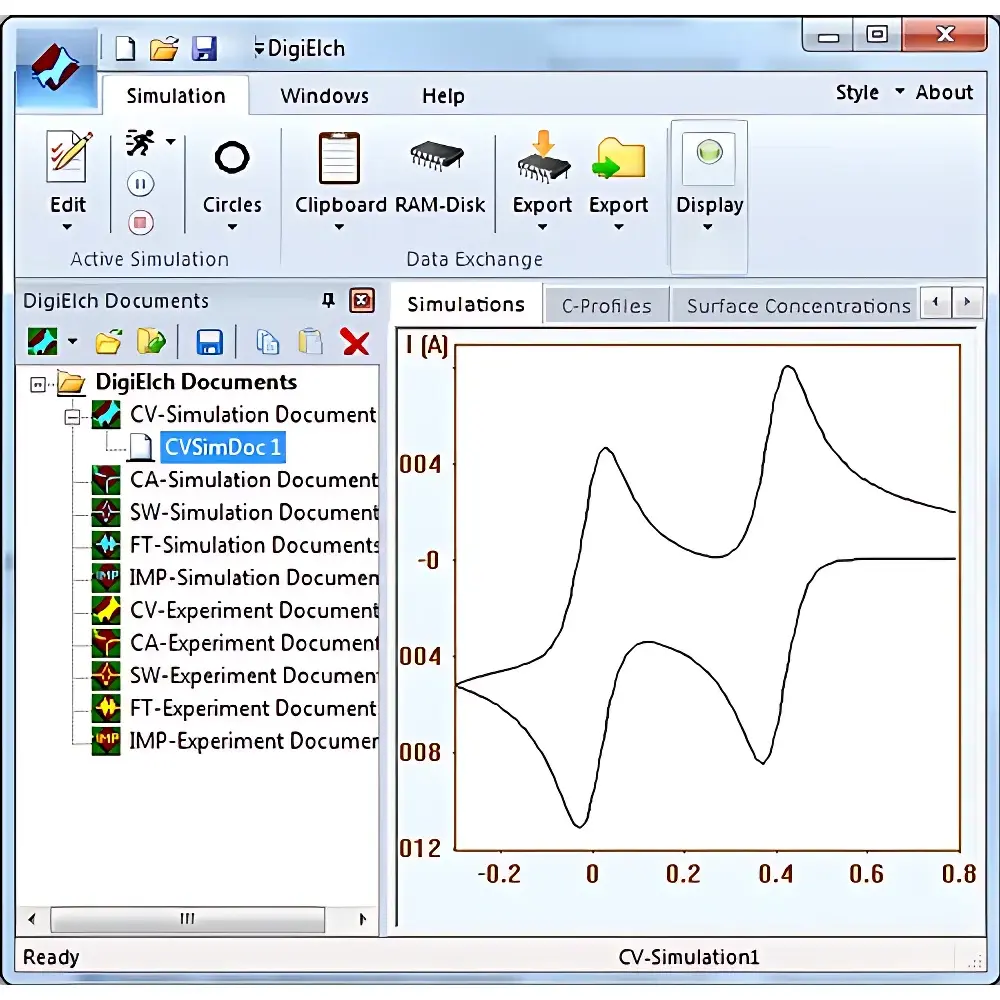
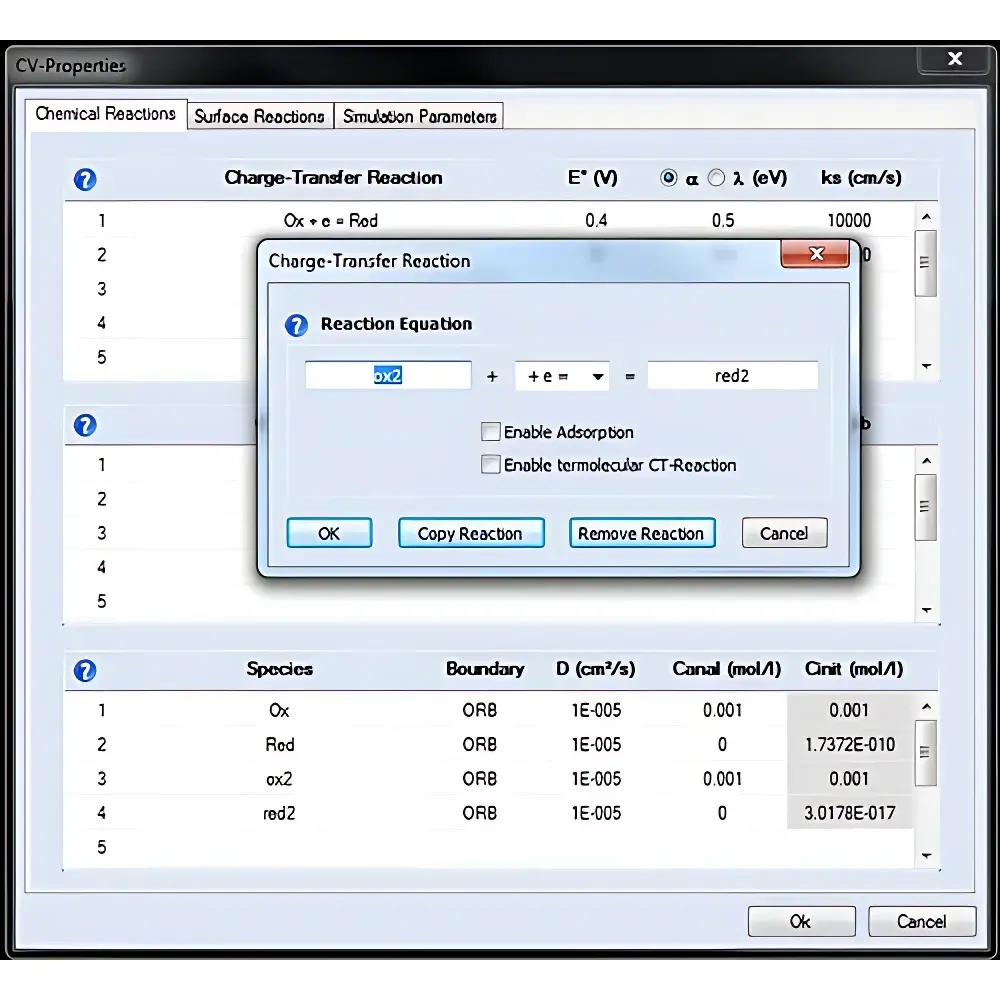
Gamry DigiElch™ is a rigorously validated, physics-based electrochemical simulation platform engineered for quantitative modeling of transient and steady-state current responses in solution-phase electrochemical systems. Built upon finite-difference and adaptive-grid numerical methods, it solves the coupled partial differential equations governing mass transport (Fick’s laws), charge transfer kinetics (Butler–Volmer formalism), double-layer charging, uncompensated solution resistance (iRu drop), and homogeneous chemical reaction networks—including ECE, EC2, DISP1, and proton-coupled electron transfer (PCET) mechanisms. Unlike heuristic or curve-fitting tools, DigiElch operates from first principles, enabling predictive simulation across one-dimensional (semi-infinite/finite diffusion) and true two-dimensional geometries—including band, disk, and thin-layer electrodes—without geometric simplification assumptions.
Key Features
- Multi-dimensional simulation engine supporting 1D finite/semi-infinite diffusion and rigorous 2D modeling of microband and microdisk electrodes
- Comprehensive treatment of non-ideal experimental effects: uncompensated resistance (iRu), double-layer capacitance transients, and uncompensated capacitive currents
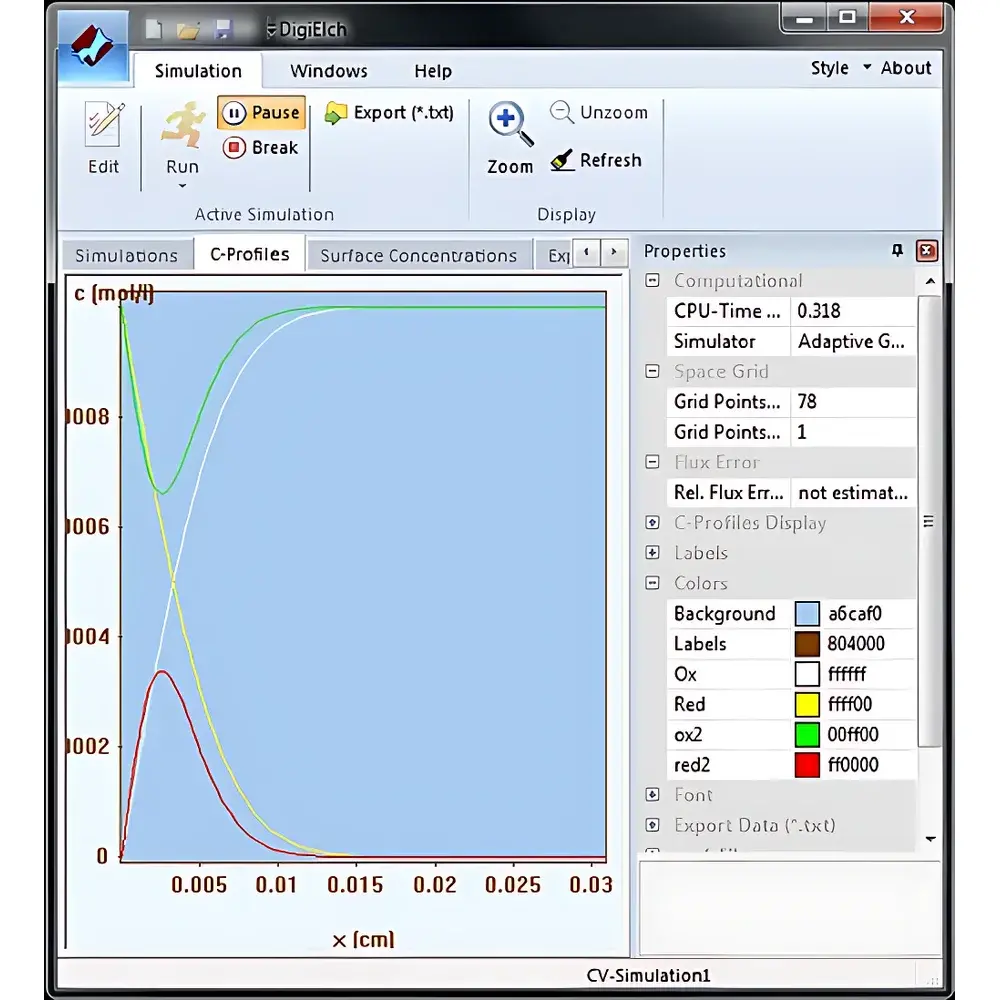
- Dual solver architecture: high-speed fixed-grid simulator for rapid parameter screening and adaptive-grid simulator for high-fidelity resolution of steep concentration gradients near electrode surfaces
- Explicit surface adsorption modeling with Langmuir-type isotherms and surface-confined redox catalysis (e.g., enzyme-modified electrodes, SAM-based sensors)
- Mercury amalgam formation kinetics module for polarographic and stripping analysis simulation
- Native support for major electrochemical techniques: cyclic voltammetry (CV), chronoamperometry (CA), square-wave voltammetry (SWV), and electrochemical impedance spectroscopy (EIS) time-domain response generation
- Parallelized computation engine leveraging multi-core CPU architectures to reduce simulation runtime without compromising numerical stability
- Export of current-time/potential-time transients and spatial concentration profiles in ASCII format; screen output exportable as Windows Metafile (WMF) for publication-ready figures
Sample Compatibility & Compliance
DigiElch does not interface directly with physical samples but serves as a computational counterpart to experimental electrochemistry. Its parameterization framework aligns with internationally accepted conventions defined in ASTM E1394 (Standard Guide for Electrochemical Kinetic Analysis), ISO 13485 (for software used in regulated medical device development), and IUPAC recommendations on electrode kinetics nomenclature. The Professional Edition’s nonlinear regression module supports weighted least-squares fitting under Gaussian error assumptions, producing statistically robust estimates of rate constants (k), formal potentials (E°′), diffusion coefficients (D), and adsorption equilibrium constants (Kads). All simulation inputs and outputs are fully traceable, satisfying GLP/GMP documentation requirements for method development and validation workflows.
Software & Data Management
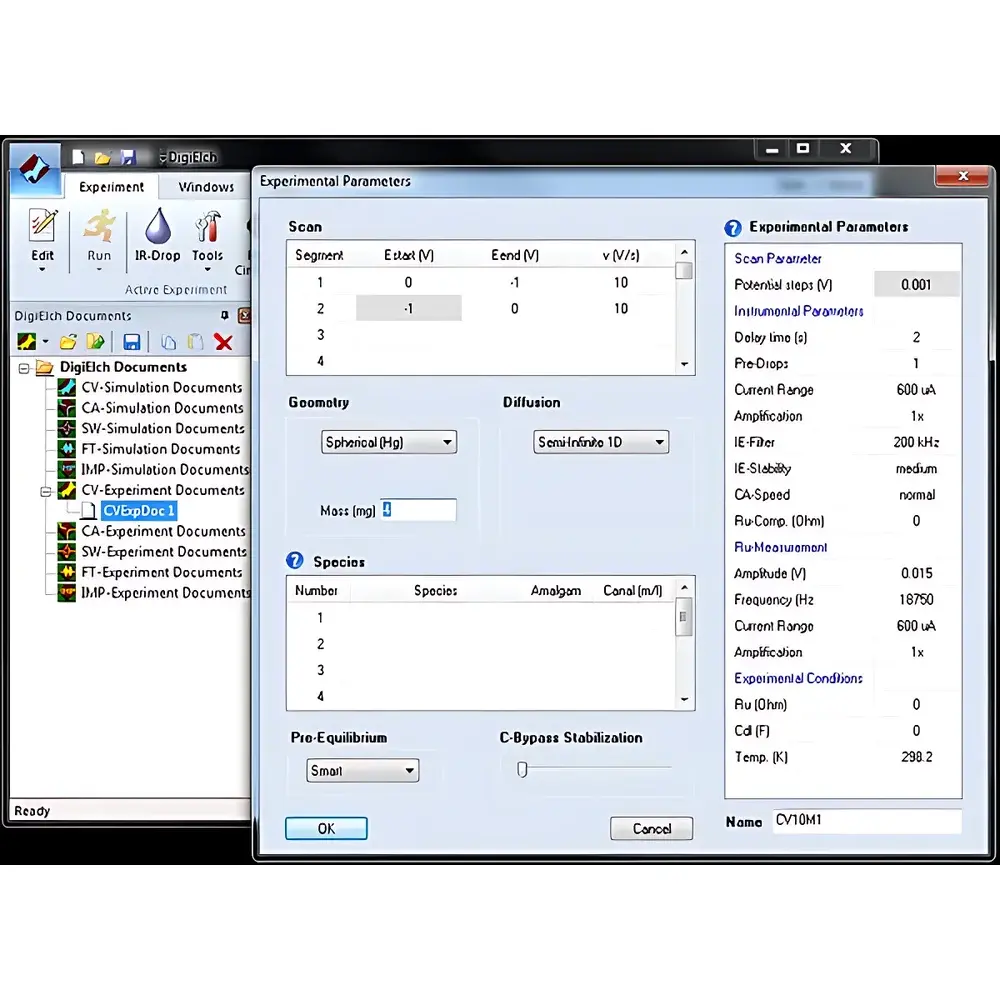
DigiElch runs natively on Microsoft Windows (64-bit, Windows 10/11) and integrates seamlessly with Gamry Framework™ data acquisition software. The Professional Edition enables batch processing of multiple experimental datasets against a single kinetic model, automating global parameter optimization. The optional Reference 600 Hardware Integration Module extends DigiElch into closed-loop operation: users define full experimental protocols—including potentiostat settings (current range, analog filter cutoff, control amplifier bandwidth), electrode configuration, and solution composition—within the simulation environment; these parameters are then exported directly to Gamry Framework for hardware execution. Acquired data retain metadata linking raw current transients to their corresponding simulation conditions, ensuring full auditability per FDA 21 CFR Part 11 requirements for electronic records and signatures.
Applications
- Pre-experimental design of voltammetric protocols for sensor development and mechanistic studies
- Deconvolution of overlapping Faradaic processes in complex redox systems (e.g., metalloenzyme catalysis, battery electrode interfaces)
- Quantitative assessment of uncompensated resistance effects in low-conductivity media (e.g., organic electrolytes, ionic liquids)
- Validation of kinetic models prior to publication or regulatory submission
- Teaching advanced electrochemical kinetics and mass transport theory in graduate-level laboratory courses
- Supporting QbD (Quality by Design) initiatives in pharmaceutical electroanalytical method development
FAQ
Does DigiElch require a Gamry potentiostat to operate?
No. DigiElch is a standalone simulation and analysis package. The Reference 600 Module is optional and only required for direct hardware control.
Can DigiElch simulate rotating disk electrode (RDE) hydrodynamics?
No. DigiElch does not solve Navier–Stokes equations. It assumes well-defined diffusion-controlled or migration-influenced boundary conditions consistent with static electrode configurations.
Is source code available for customization?
No. DigiElch is a compiled commercial application. Users may define custom reaction mechanisms via its built-in kinetic editor but cannot modify core numerical solvers.
What file formats does DigiElch accept for experimental data import?
ASCII text files with tab- or space-delimited columns (time, potential, current); compatible with output from Gamry Framework, CH Instruments, BioLogic, and other common potentiostats when saved in plain-text mode.
How is uncertainty quantified in the Professional Edition’s nonlinear regression?
Covariance matrix estimation is performed using the Levenberg–Marquardt algorithm; confidence intervals for fitted parameters are derived from standard errors assuming normally distributed residuals and sufficient degrees of freedom.




