
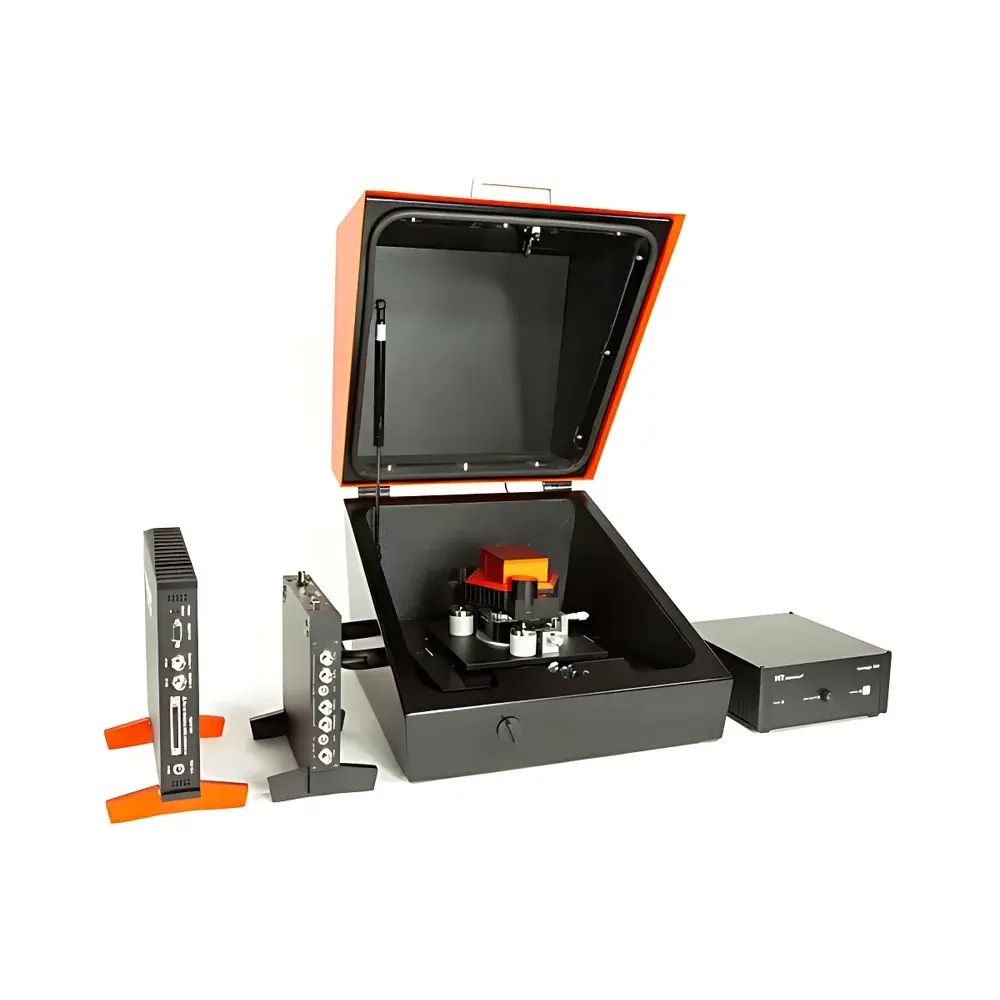
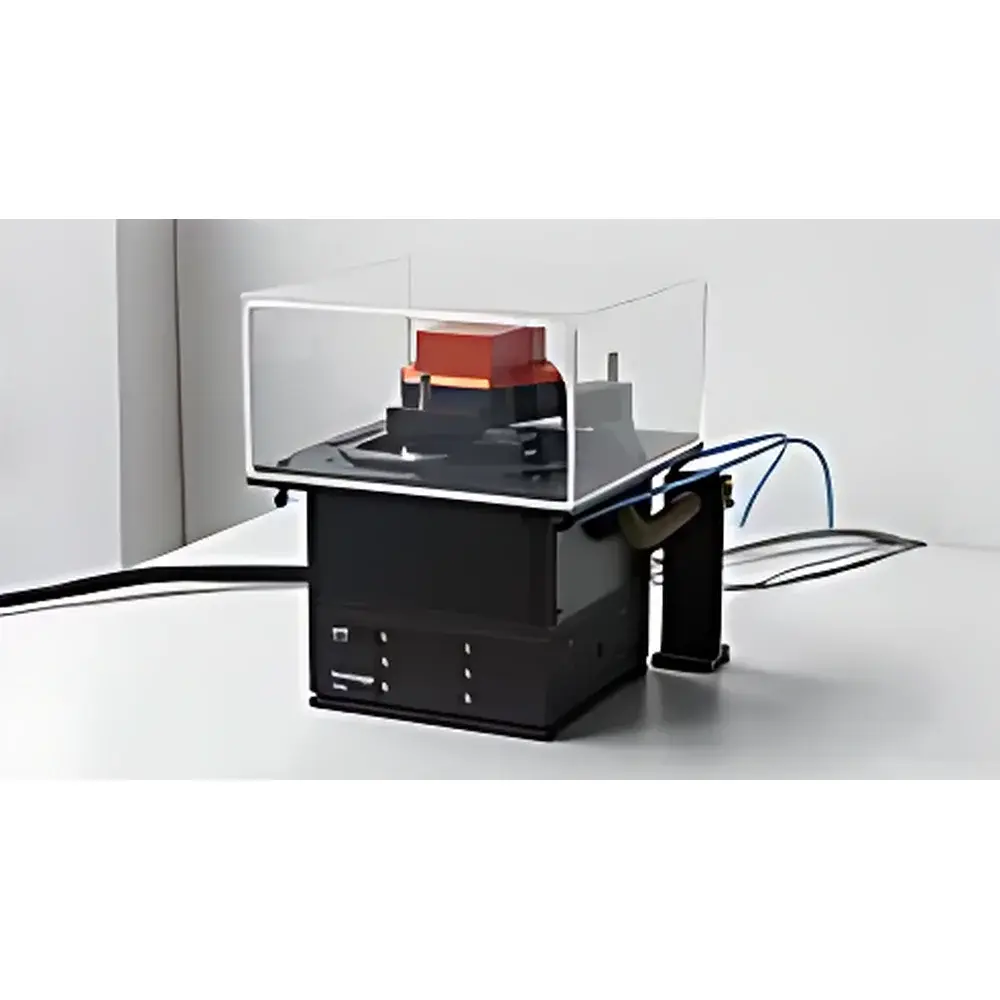
Nanosurf FLEX-AFM Atomic Force Microscope
| Brand | Nanosurf |
|---|---|
| Origin | Switzerland |
| Model | FLEX-AFM |
| Instrument Type | Atomic Force Microscope |
| XY Positioning Noise | ≤ 0.15 nm (RMS, in air & liquid) |
| Sample Dimensions | Ø ≤ 100 mm, Thickness ≤ 5 mm |
| Sample Stage Travel Range | 300 mm × 300 mm |
| Scan Range | 100 µm × 100 µm × 10 µm (XY × Z) |
| XY Drive Resolution | 0.152 nm |
| Z Drive Resolution | 0.046 nm |
| Minimum Z Noise Floor | 0.15 nm (RMS, closed-loop) |
| Compatible Environments | Ambient air, liquid, controlled atmosphere (e.g., inert gas, low-oxygen), temperature-controlled stages |
| Controller | C3000 (24-bit, dual-channel lock-in amplifiers, digital feedback) |
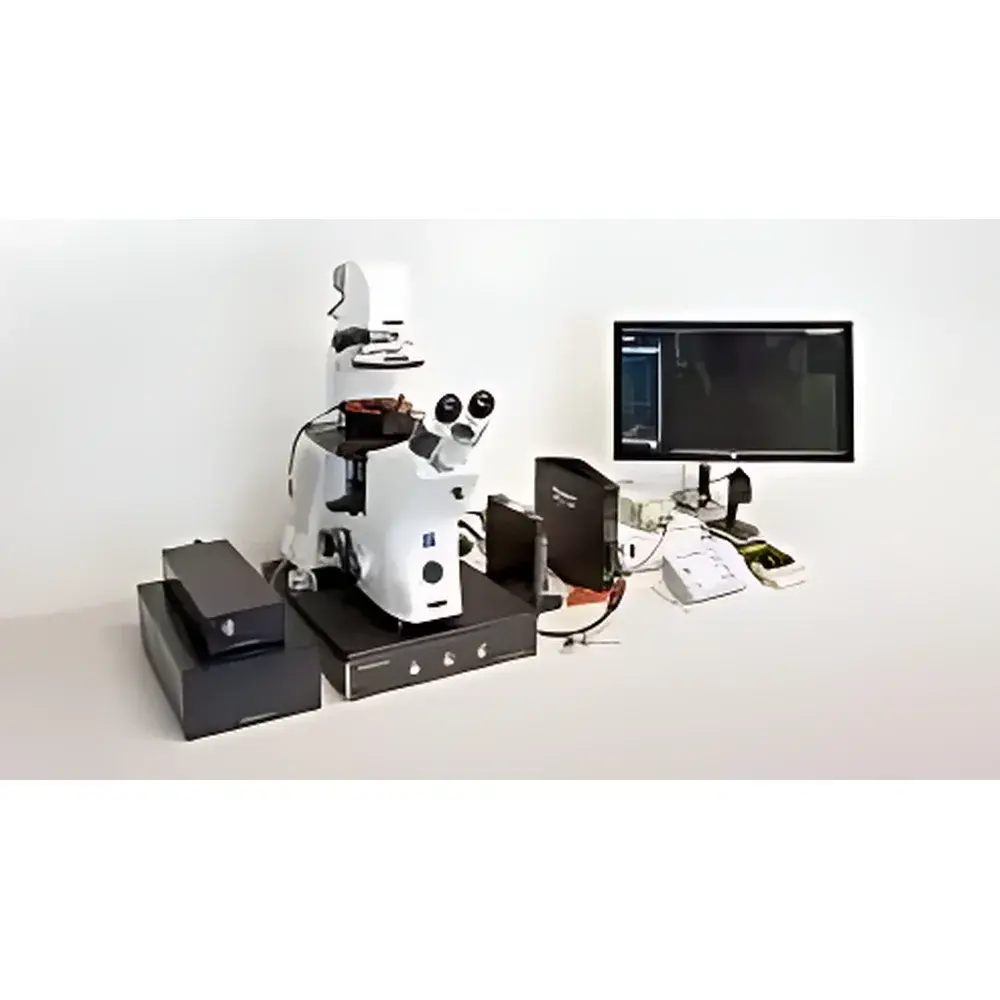
| Optical Integration | Fully compatible with inverted optical microscopes |
| Modular Add-ons | ECS 204 electrochemical stage, ATS 204 automated translation stage, Isostage active vibration isolation, acoustic enclosure, glovebox integration kit |
Overview
The Nanosurf FLEX-AFM Atomic Force Microscope is a high-precision, modular scanning probe microscope engineered for quantitative nanoscale characterization across diverse operational environments — including ambient air, aqueous solutions, controlled atmospheres, and temperature-regulated conditions. Built upon Nanosurf’s proprietary electromagnetic XY scanner and closed-loop piezoelectric Z actuator architecture, the FLEX-AFM implements true contact, non-contact, tapping, and advanced dynamic modes (e.g., frequency modulation, amplitude modulation) with sub-nanometer spatial resolution and picometer-level force sensitivity. Its core measurement principle relies on detecting cantilever deflection via an optical beam deflection (OBD) system coupled with real-time digital feedback control. Unlike conventional AFMs requiring manual laser alignment when transitioning between air and liquid, the FLEX-AFM integrates the patented SureAlign™ optical path — a fixed-alignment, immersion-optimized laser delivery system that maintains optimal photodiode signal integrity without user intervention. This enables reproducible, artifact-free imaging and spectroscopy under physiologically relevant or electrochemically active conditions — critical for materials science, soft matter physics, battery interface research, and life science applications.
Key Features
- Electromagnetic XY scanner with <0.1% linearity error over full 100 µm range, delivering distortion-free topography and vector-based nanolithography
- Closed-loop Z piezo actuator with integrated position sensor, enabling high-speed, hysteresis-corrected vertical motion up to 10 µm travel with 0.046 nm step resolution
- SureAlign™ optical system: eliminates laser re-alignment between air and liquid environments; ensures stable, high signal-to-noise ratio (SNR) detection at all times
- Dual-view optical module (top + side) with motorized focus and integrated cameras for rapid region-of-interest navigation and automated tip approach
- Modular probe holder design with precision alignment grooves: enables repeatable, sub-micrometer probe positioning and zero-laser-realignment probe swaps
- C3000 controller platform: 24-bit ADC/DAC, dual independent lock-in amplifiers, real-time digital PID feedback, and native support for STM, KPFM, MFM, EFM, SThM, and conductive AFM
- Expandable mechanical architecture: supports integration with inverted optical microscopes, electrochemical cells (ECS 204), automated translation stages (ATS 204), and active vibration isolation (Isostage)
Sample Compatibility & Compliance
The FLEX-AFM accommodates samples up to 100 mm in diameter and 5 mm in thickness, mounted on a motorized 300 mm × 300 mm XYZ sample stage — enabling large-area mapping, multi-site correlation, and hybrid workflows (e.g., optical pre-screening followed by localized AFM). Its environmental flexibility meets ASTM E2537-22 (standard practice for AFM calibration in liquid), ISO/IEC 17025-compliant metrology frameworks, and GLP/GMP-aligned experimental traceability when paired with C3000’s audit-log-enabled software. Optional accessories — including the ECS 204 electrochemical cell, glovebox integration kit, and low-oxygen chamber — allow operation under ICH Q5C-relevant stability conditions or U.S. FDA 21 CFR Part 11–compliant data acquisition when configured with timestamped, user-authenticated session logging.
Software & Data Management
Acquisition and analysis are performed using Nanosurf’s open-architecture easyScan 2 software suite, built on a deterministic real-time kernel and compliant with HDF5-based data storage (ISO/IEC 15836-2). All raw sensor streams — deflection, photodiode quadrant signals, Z-piezo voltage, lock-in outputs — are recorded synchronously at up to 2 MHz sampling rate with metadata tagging (user ID, timestamp, environmental parameters, calibration constants). The software supports batch processing, scripting via Python API, and export to industry-standard formats (Gwyddion, SPIP, ImageJ-compatible TIFF stacks). For regulated environments, optional electronic signature modules enforce role-based access control, change tracking, and immutable audit trails aligned with 21 CFR Part 11 Annex 11 requirements.
Applications
- Surface topography and roughness quantification per ISO 25178-2, including areal Sa, Sq, and functional parameters (Sk, Spk, Svk)
- Nanoscale mechanical property mapping: modulus, adhesion, dissipation via force-distance spectroscopy and PeakForce Tapping®-compatible modes
- Electrostatic and surface potential imaging (KPFM) on semiconductor heterostructures, per ASTM D7899-21
- Magnetic domain visualization (MFM) of thin-film spintronic devices and exchange-biased multilayers
- In situ electrochemical AFM of electrode/electrolyte interfaces during battery cycling (Li-ion, solid-state)
- Biological imaging in buffer: membrane protein distribution, DNA conformation, extracellular matrix fibril mechanics
- Nanolithography and nanomanipulation: site-specific oxidation, dip-pen patterning, and single-molecule force spectroscopy
FAQ
Does the FLEX-AFM require recalibration when switching from air to liquid imaging?
No. The SureAlign™ optical system maintains consistent laser alignment and photodiode signal optimization across all media without manual adjustment.
Can the FLEX-AFM be integrated with an inverted optical microscope?
Yes. Its compact, low-profile head design and dual optical viewport geometry enable seamless coupling with standard inverted optical platforms for correlative microscopy.
What level of environmental control is supported?
The system supports dry nitrogen purging, low-oxygen (<1 ppm O₂) chambers, temperature-controlled stages (−30 °C to +200 °C), and full glovebox integration (including feedthroughs for electrical and fluid lines).
Is the C3000 controller compatible with third-party sensors or custom electronics?
Yes. It provides analog I/O expansion ports, TTL synchronization triggers, and programmable GPIOs — facilitating integration with external potentiostats, cryostats, or custom AFM accessories.
How is data integrity ensured in regulated laboratories?
When configured with the optional compliance package, the system enforces electronic signatures, immutable audit logs, and encrypted HDF5 archives meeting 21 CFR Part 11 and EU Annex 11 requirements.



