
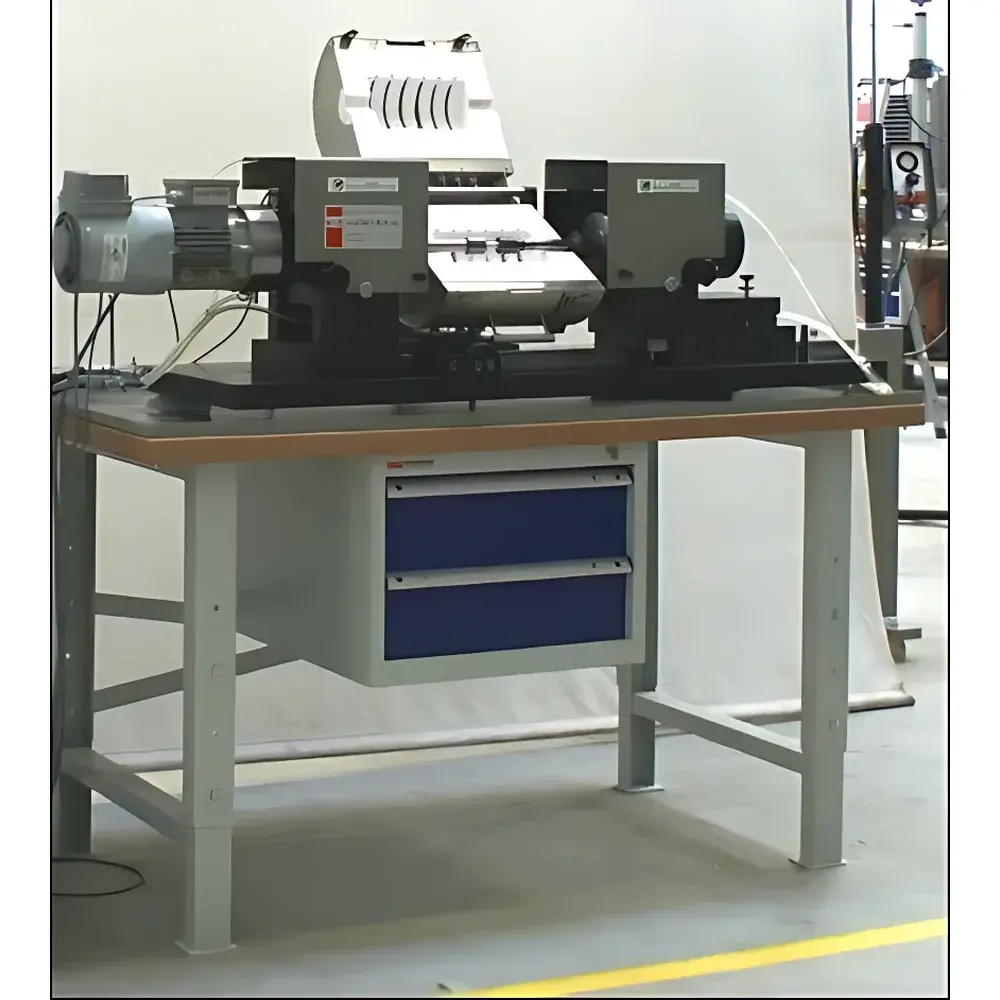
W+B UBM Series Rotational Bending Fatigue Testing Machine
| Brand | W+B |
|---|---|
| Origin | Switzerland |
| Model | UBM |
| Torque Range | 0.1–500 N·m |
| Drive | 2-phase AC motor |
| Max Speed | 6000 rpm (optional) |
| Bearing System | Adjustable spherical bearings for axial & radial guidance |
| Clamping Systems | ER25 (1–16 mm), ER32 (1–20 mm), F48 (1–42 mm / 2–30 mm / 2–36 mm) |
| High-Temperature Furnace Compatibility | STE5 series, 100–1000 °C, with X/Y-adjustable furnace support and triple-zone digital LRA controller |
| Power Supply | 380/400 V, 3-phase + N + E, 0.75 kW (2 kW with furnace) |
| Safety Compliance | Low-voltage heating elements (<25 V), VDE-certified control cabinet, EN/IEC 61000-6-2/-4 EMC compliance |
Overview
The W+B UBM Series Rotational Bending Fatigue Testing Machine is an engineered solution for high-precision, long-duration fatigue evaluation of metallic rods and shafts under controlled rotating bending stress. Based on the classical cantilever beam principle—where a static bending moment is generated via calibrated dead weights acting at fixed lever arms (e.g., L = 400 mm)—the system subjects specimens to fully reversed sinusoidal bending strain without torsional or axial components. This configuration strictly adheres to DIN 50113 for rotating bending fatigue testing, ensuring traceable, reproducible results required in metallurgical R&D, bearing component validation, and aerospace material qualification. The desktop-integrated architecture supports modular integration with high-temperature furnaces (up to 1000 °C), enabling thermo-mechanical fatigue characterization under simulated service conditions.
Key Features
- Modular torque range selection: Five standard configurations (0.1–20 N·m, 0.5–60 N·m, 2–100 N·m, 5–200 N·m, 10–500 N·m) accommodate diverse specimen geometries and strength classes.
- High-accuracy clamping systems: ER25 and ER32 collet chucks fabricated from specially hardened spring steel deliver ≤ 2 µm total indicated runout (T.I.R.), ensuring concentricity critical for fatigue life repeatability; F48 hydraulic/pneumatic chucks support diameters up to 42 mm with interchangeable jaw profiles (flat, serrated, custom grooved).
- Thermally stable high-temperature integration: STE5 furnace series features triple-zone resistive heating, low-voltage (<25 V) ceramic-sheathed heating elements, and reflective thermal insulation to minimize axial temperature gradients; furnace alignment is maintained via micrometer-adjustable X/Y support brackets.
- Digital process control: LRA-based multi-zone temperature regulator enables independent setpoint programming and real-time monitoring for zones 1–3; optional 19-inch rack-mountable controllers support synchronized operation across multiple furnaces or test stations.
- Robust mechanical architecture: Precision-ground spherical bearings with adjustable clearance provide stable radial and axial guidance over extended duty cycles; integrated lubrication and cooling circuits maintain bearing integrity during high-speed (up to 6000 rpm) or elevated-temperature operation.
Sample Compatibility & Compliance
The UBM platform accommodates cylindrical specimens with diameters from 1 mm to 12 mm and minimum lengths as short as 80 mm—enabling efficient use of precious alloy samples. Clamping versatility extends to non-circular cross-sections via custom jaw inserts. All configurations comply with DIN 50113 for rotating bending fatigue testing methodology. Optional temperature measurement systems (thermocouple insertion for Ø ≥ 3 mm specimens) support ASTM E220 and ISO 8061 traceability. Electrical safety conforms to EN 61000-6-2 (immunity) and EN 61000-6-4 (emission); control cabinets are VDE-certified and rated for industrial environments per IEC 60529 IP54.
Software & Data Management
While the base UBM operates via analog torque calibration and manual parameter setup, optional digital interfaces support integration with third-party data acquisition platforms (e.g., National Instruments DAQmx, LabVIEW). Temperature profiles, rotational speed, and cycle counts are logged via RS-485 or Ethernet-enabled LRA controllers. For regulated environments—including GLP laboratories and GMP-compliant material release workflows—the system supports audit-trail-capable logging when paired with compliant SCADA software. All firmware updates undergo functional safety verification per IEC 61508 SIL1 requirements.
Applications
- Rotating bending fatigue life assessment of bearing steels (e.g., AISI 52100, M50), titanium alloys (Ti-6Al-4V), and nickel-based superalloys (Inconel 718) under ambient and elevated temperatures.
- Validation of surface treatments (carburizing, nitriding, shot peening) by quantifying endurance limit shifts in S–N curve analysis.
- Comparative testing of microstructure-sensitive fatigue behavior across heat treatment variants (quench & temper, austempering).
- Supporting ASTM E466 and ISO 1099 standard-compliant constant-amplitude fatigue testing protocols.
- Research into crack initiation mechanisms at stress concentrations using in-situ optical monitoring (compatible with external high-speed cameras).
FAQ
What standards does the UBM series comply with?
DIN 50113 is the primary reference standard; supplementary compliance includes ASTM E466 (for force-controlled fatigue), ISO 1099 (metallic materials — fatigue testing), and ISO 8061 (temperature measurement in furnace applications).
Can the UBM operate without a high-temperature furnace?
Yes — all UBM models function independently at ambient temperature; furnace integration is a field-installable option requiring mechanical alignment and electrical interface configuration.
Is remote monitoring supported?
Standard configurations include analog outputs for speed and temperature; full remote supervision requires optional LRA controller with Modbus TCP or OPC UA communication modules.
What maintenance intervals are recommended for the ER25/ER32 chucks?
W+B recommends inspection every 500 operational hours; T.I.R. verification and lubrication of collet springs should be performed per manufacturer’s technical bulletin TB-UBM-CLAMP-2023.
Does the system meet FDA 21 CFR Part 11 requirements?
The base hardware does not include electronic signature or audit trail functionality; however, when integrated with validated third-party LIMS or ELN platforms supporting Part 11, full compliance is achievable through documented configuration and procedural controls.



