
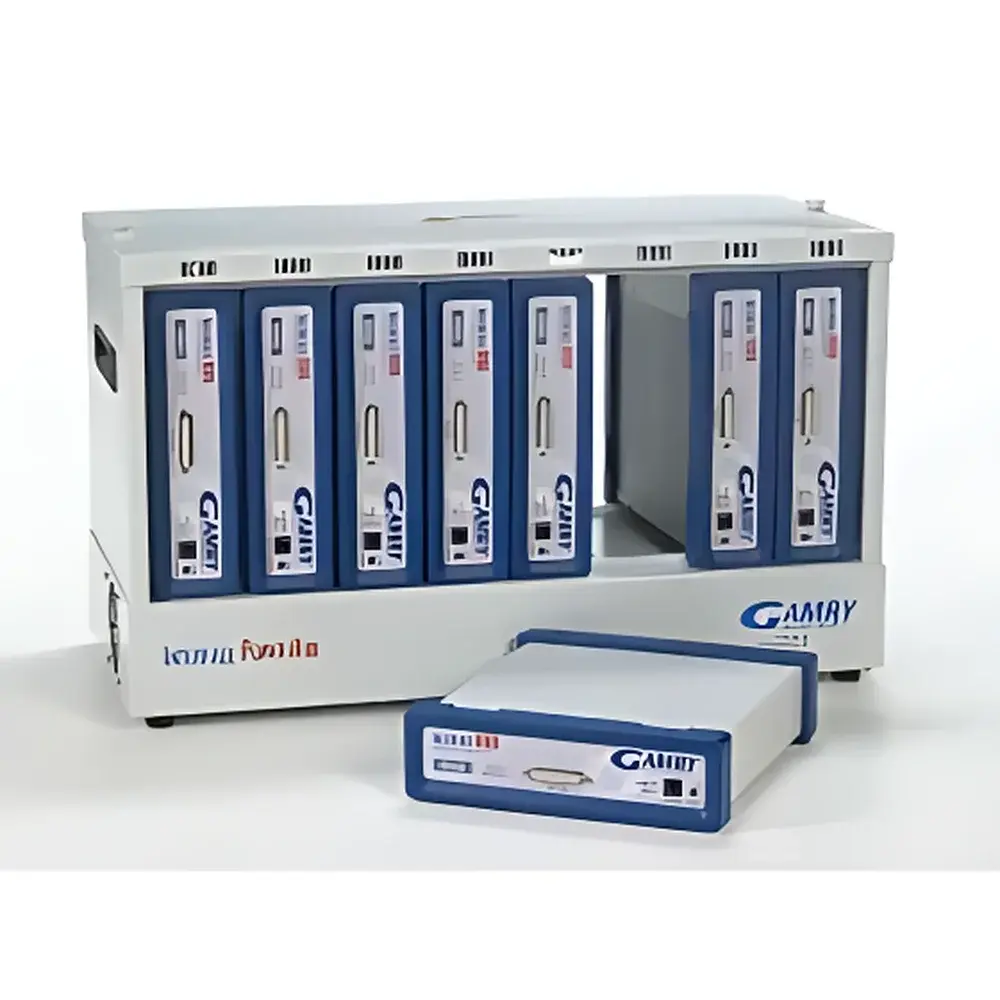
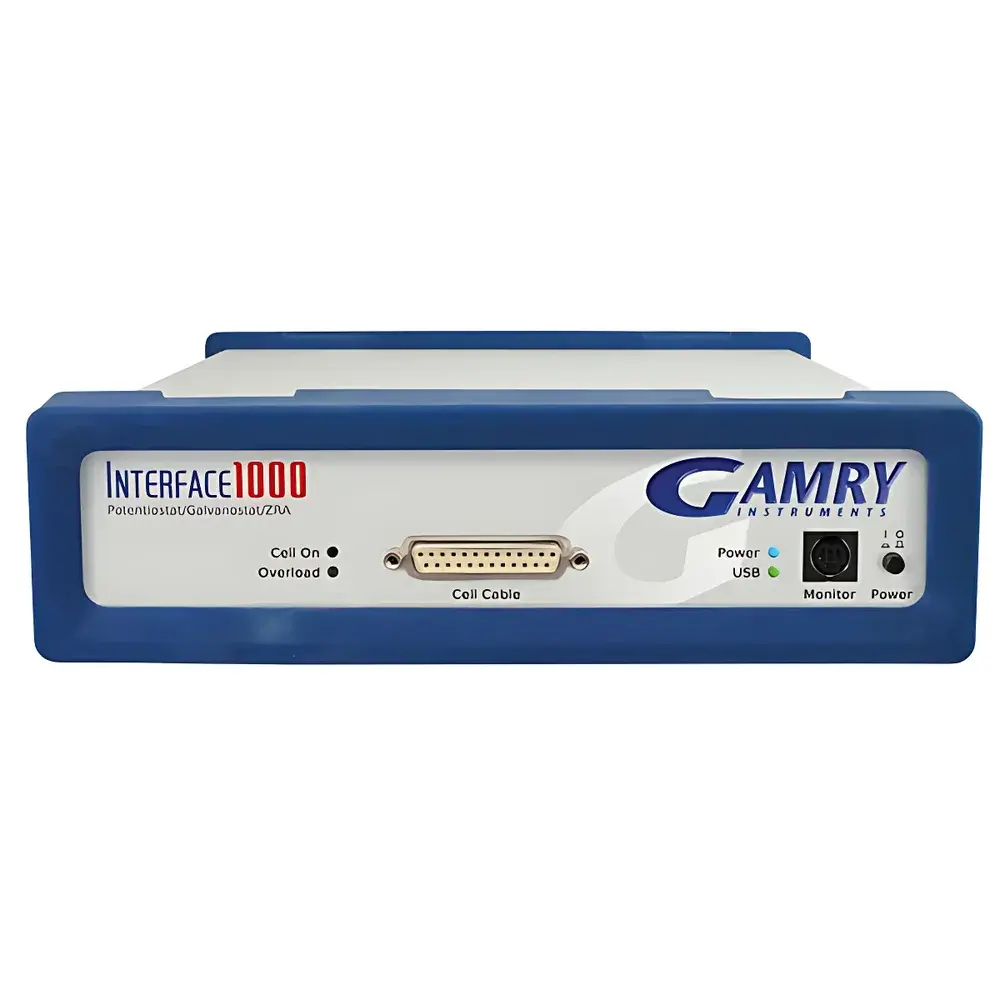
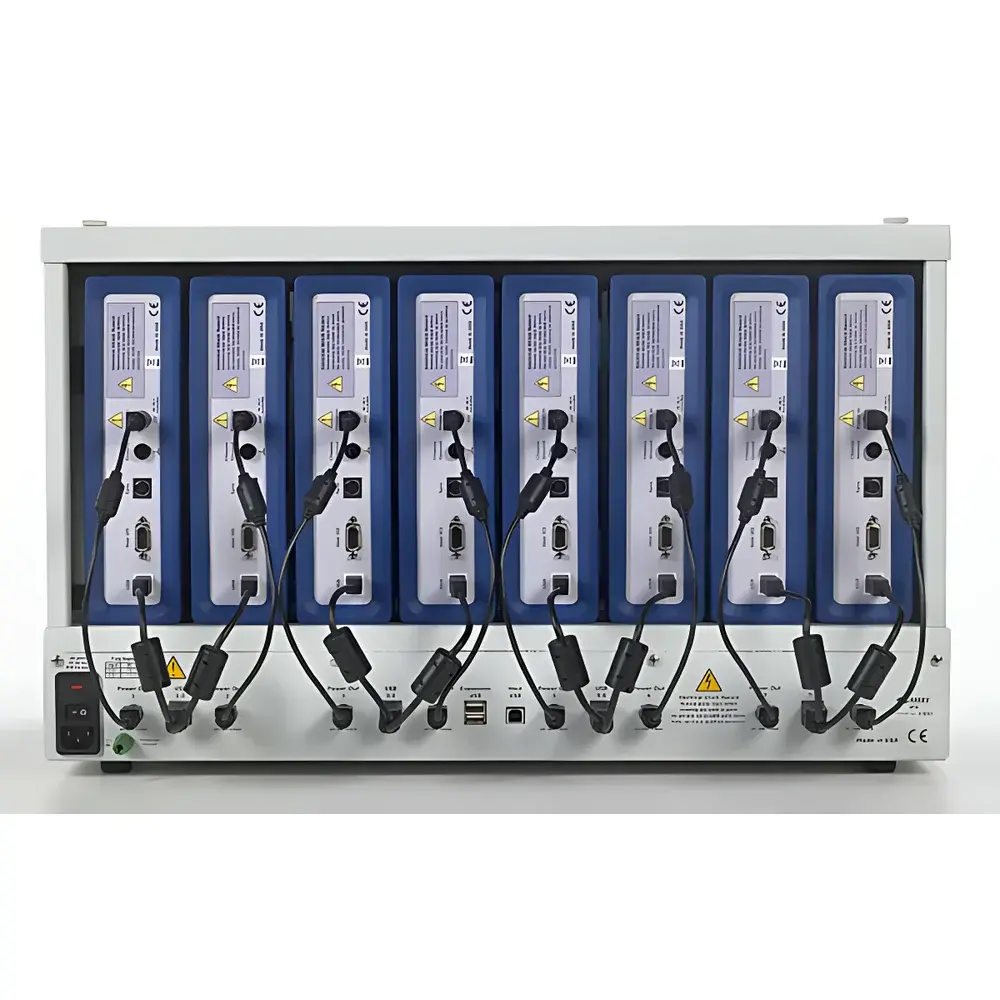
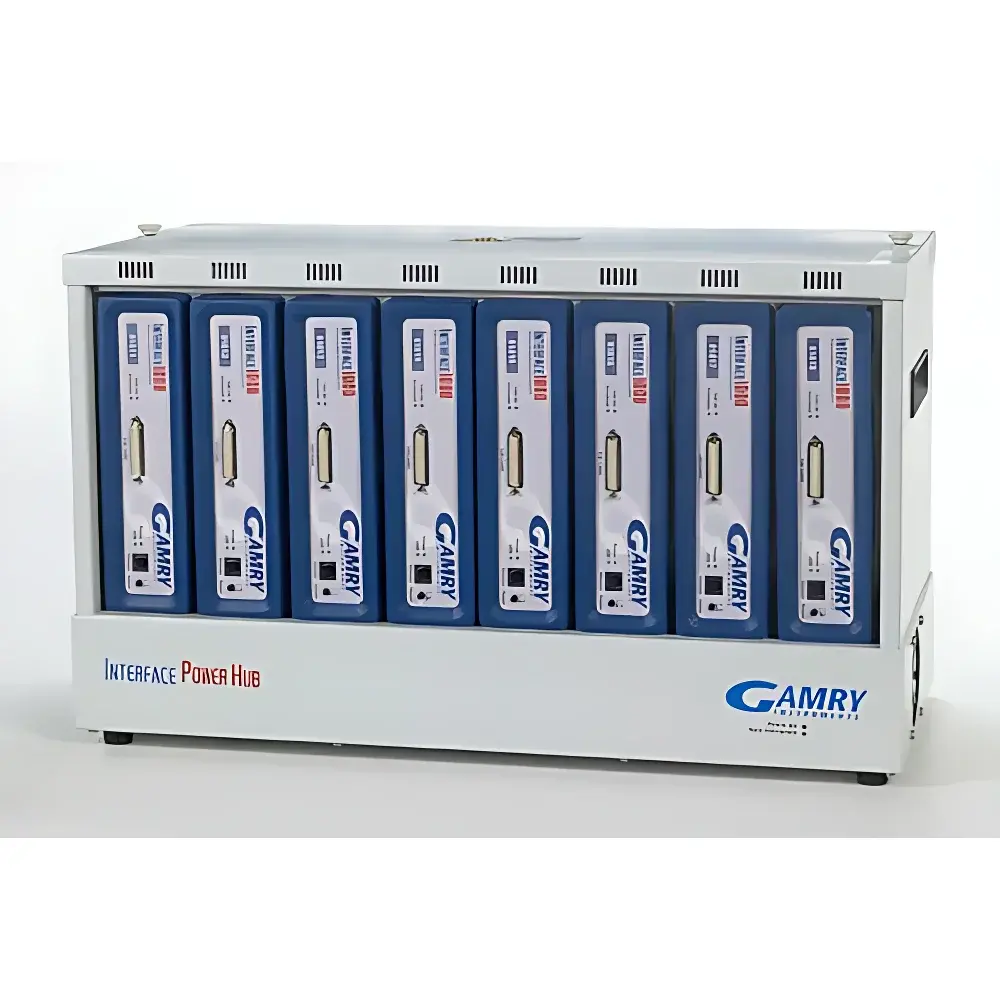
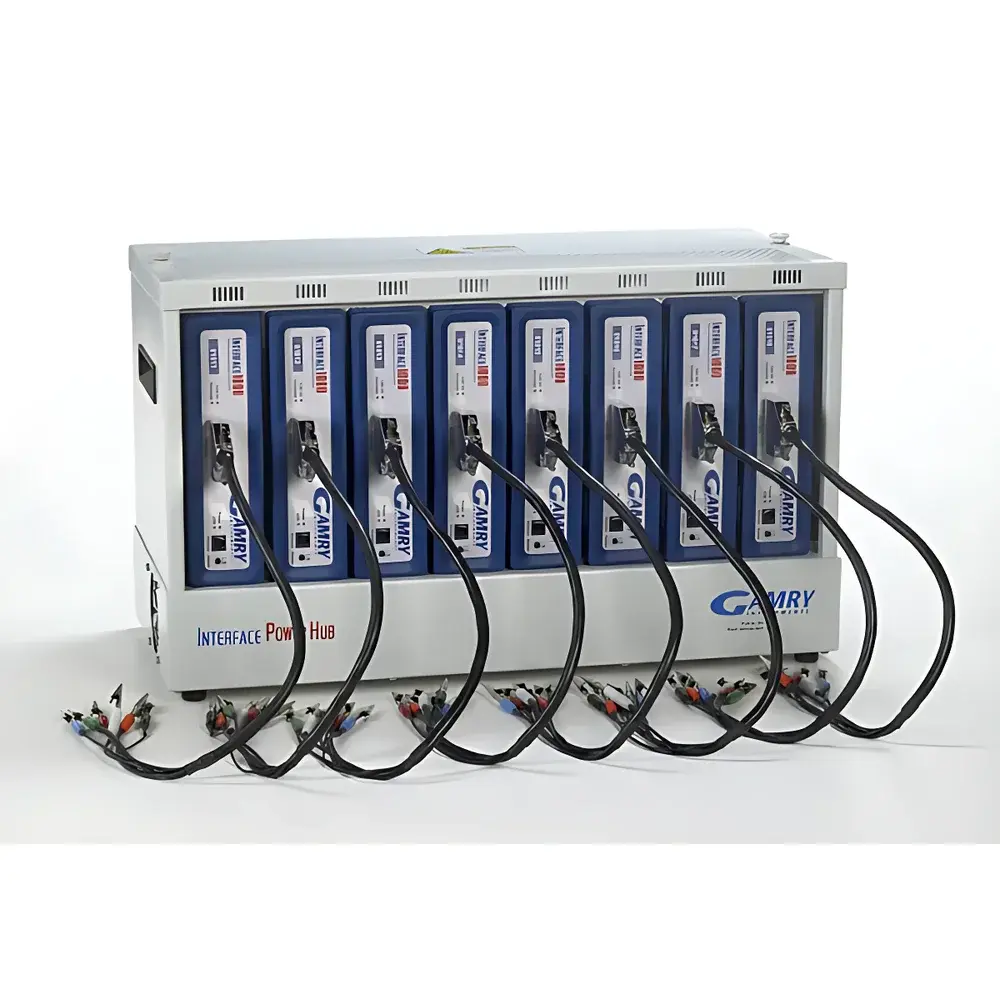
Gamry Interface Multi-Channel Electrochemical Workstation
| Brand | Gamry |
|---|---|
| Origin | USA |
| Manufacturer Type | Authorized Distributor |
| Origin Category | Imported |
| Model | Interface |
| Instrument Type | Electrochemical Workstation |
| Number of Channels | Up to 16 Independent Channels |
| Current Range | 100 pA – 1 A (extendable to 5 A) |
| Current Accuracy | ±0.2% of reading or ±5 pA (whichever is greater) |
| Potential Accuracy | ±0.2% of full scale |
| Potentiostatic Range | ±12 V (±22 V with external booster) |
| Potential Resolution | 1 µV |
| Current Resolution | 3.3 fA |
| EIS Frequency Range | 10 µHz – 1 MHz |
| Floating Ground Architecture | Yes |
| Software Suite | PWR800, Echem Analyst, Framework™ (with GLP-compliant audit trail and 21 CFR Part 11 support) |
Overview
The Gamry Interface Multi-Channel Electrochemical Workstation is a research-grade, modular potentiostat/galvanostat system engineered for high-fidelity electrochemical characterization across multiple independent working electrodes simultaneously. Based on Gamry’s proven bipotentiostatic architecture and low-noise current measurement design, the Interface platform implements true galvanic isolation between channels via floating ground technology—enabling accurate measurements in grounded, high-impedance, or multi-phase environments (e.g., corrosion in soil/seawater, high-temperature/pressure autoclaves, or in situ TEM cells). Each channel operates as a fully functional, standalone instrument—supporting potentiodynamic, potentiostatic, galvanostatic, and electrochemical impedance spectroscopy (EIS) modes—with identical specifications to Gamry’s single-channel Reference 3000 or Interface 1000 systems. The system scales from 2 to 16 synchronized channels within a single chassis or distributed configuration, maintaining sub-femtoampere resolution (3.3 fA), microvolt potential control, and phase-stable EIS down to 10 µHz—critical for battery relaxation studies, slow corrosion kinetics, and interfacial charge-transfer analysis.
Key Features
- Fully isolated, floating-ground channels—eliminates ground-loop interference and enables direct measurement on grounded samples (e.g., pipelines, reinforced concrete, fuel cell stacks)
- Modular scalability: Add or remove channels without recalibration; individual channels can be detached and operated standalone—even inside inert-atmosphere gloveboxes
- Simultaneous multi-electrode operation: Execute identical or independent protocols across all channels (e.g., parallel battery cycling, electrode array screening, combinatorial catalyst testing)
- High-precision low-current capability: 100 pA–1 A range with 3.3 fA resolution and ±0.2% accuracy—validated per ASTM E2797 and ISO 17475 for corrosion monitoring applications
- Extended EIS performance: 10 µHz–1 MHz frequency coverage with <0.1° phase error at 10 mHz—supports diffusion-controlled modeling, SEI growth quantification, and dielectric relaxation analysis
- Integrated hardware expandability: Compatible with Reference 30K Booster (±30 V, ±3 A), IMPS/IMVS modules, and dual-potentiostat configurations for rotating ring-disk electrode (RRDE) studies
Sample Compatibility & Compliance
The Interface workstation supports diverse sample geometries and environmental interfaces—including coated metals, battery coin cells, flow-through electrolyzers, microbial fuel cells, printed sensor arrays, and thin-film electrocatalysts. Its floating architecture meets IEC 61000-4-8 (power-frequency magnetic field immunity) and complies with CE, FCC Class A, and RoHS directives. For regulated environments, Framework™ software provides full 21 CFR Part 11 compliance—including electronic signatures, role-based access control, immutable audit trails, and automated backup—satisfying FDA, ISO 17025, and GLP/GMP documentation requirements. All EIS and polarization data adhere to ASTM G102 (standard practice for calculating corrosion rates) and ASTM D1141 (synthetic seawater formulation for accelerated testing).
Software & Data Management
Control and analysis are unified under Gamry’s Framework™ software platform—a Windows-native application supporting scripting (VBScript, Python API), sequence programming, real-time visualization, and batch processing. Preconfigured application packages include PWR800 for battery/capacitor cycling (with pulse, CV, GITT, and hybrid protocols), CorrWare® for long-term corrosion monitoring, and Echem Analyst for equivalent circuit modeling (ZView-compatible). Raw data export is native to ASCII, Excel, and MATLAB formats; metadata tagging follows ISA-88/ISA-95 conventions. Software updates are provided free of charge for the instrument’s lifetime, with version-controlled release notes and validation reports available upon request.
Applications
- Battery R&D: Parallel cycling of Li-ion, Na-ion, and solid-state cells; SEI evolution tracking via low-frequency EIS
- Corrosion science: In-field monitoring of rebar in concrete, offshore platform weldments, or cathodic protection efficiency
- Electrocatalysis: High-throughput screening of catalyst libraries using electrode arrays and chronoamperometric fingerprinting
- Energy storage devices: Impedance mapping of supercapacitor aging, flow battery membrane resistance, and redox flow uniformity
- Biointerfaces: Microbial fuel cell voltage-clamp experiments and biofilm electron transfer kinetics
- Coatings & inhibitors: EIS-based barrier property assessment per ISO 12944-6 and ASTM D5268
- Electroanalytical chemistry: Ultra-trace metal detection (anodic stripping), enzyme kinetics, and mediated electron transfer studies
FAQ
Can the Interface system operate individual channels in different modes simultaneously? (e.g., one channel doing EIS while another performs galvanostatic charge/discharge)
Yes. Each channel is functionally autonomous and may execute distinct techniques—including mixed-mode protocols—with independent timing, sampling rates, and parameter sets.
Is hardware calibration required when adding or removing channels?
No. The system uses factory-calibrated, plug-and-play modules; channel insertion/removal does not affect baseline calibration or require user recalibration.
Does the system support third-party data acquisition or integration with LabVIEW or Python?
Yes. Gamry provides a documented COM interface and Python SDK (gamrytools), enabling direct control, real-time streaming, and custom automation workflows.
What is the minimum measurable solution resistance using the Interface’s positive feedback iR compensation?
With appropriate cell geometry and high-bandwidth current measurement, uncompensated resistance (Ru) as low as 10 mΩ can be resolved—validated using ASTM G102 four-terminal sensing methodology.
Can EIS data acquired on the Interface be imported into commercial equivalent circuit modeling tools?
Yes. All impedance spectra are exported in standard .z, .csv, or .txt formats compatible with ZView®, EC-Lab®, Thales, and MATLAB-based fitting toolboxes.





