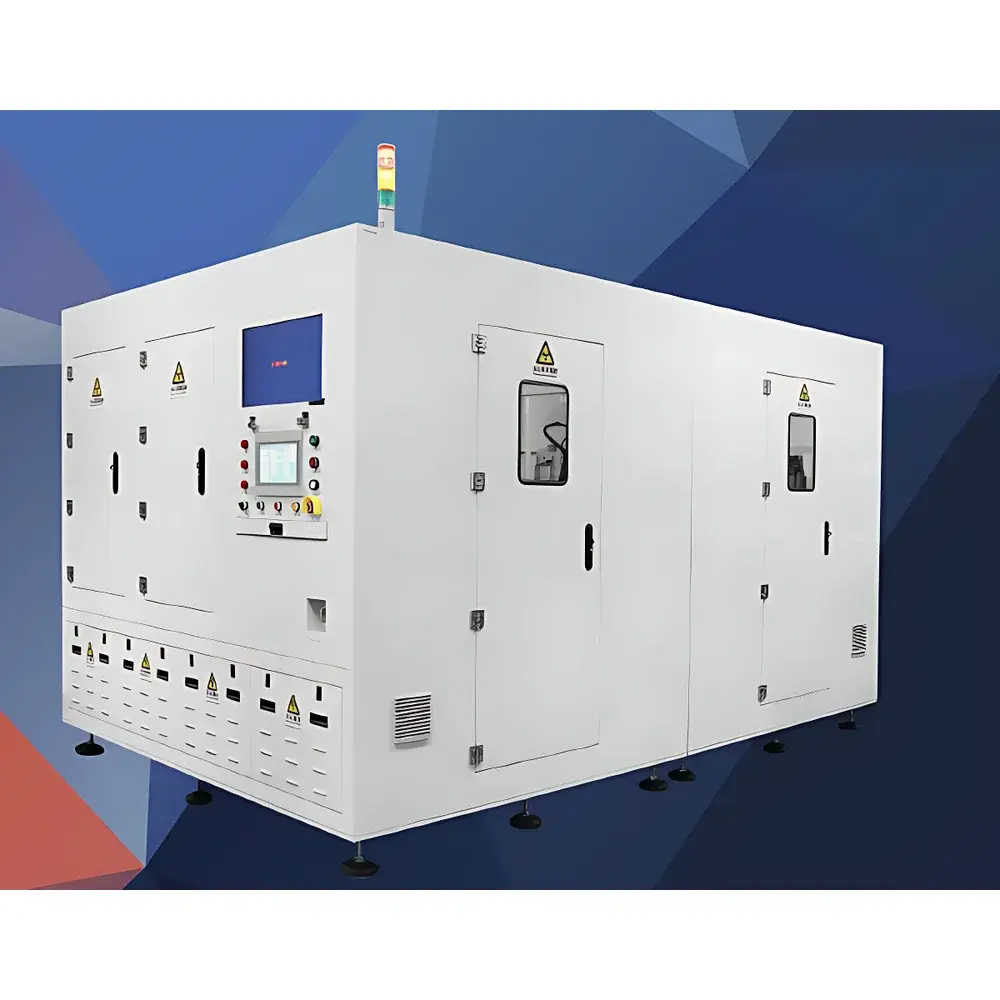
Zhengye TDI Line-Scan X-Ray Inspection System for Automated Stacked Battery Cells
| Brand | Zhengye |
|---|---|
| Model | XG5200D |
| X-Ray Tube Voltage | Up to 130 kV |
| X-Ray Tube Current | Up to 309 µA |
| Focal Spot Size | 5–7 µm |
| Imaging Mode | Time-Delay Integration (TDI) Line-Scan Detector |
| Repeatability Accuracy | ±60 µm |
| Throughput | ≥14 ppm |
| False Positive Rate | ≤2% |
| Miss Detection Rate | 0.0% |
| Radiation Leakage | ≤1 µSv/hr |
| Power Supply | AC 380 V / 50 Hz |
| Operating Temperature | 23 °C ±5 °C |
| Relative Humidity | ≤60% RH |
Overview
The Zhengye TDI Line-Scan X-Ray Inspection System for Automated Stacked Battery Cells (Model XG5200D) is a high-throughput, non-destructive inspection platform engineered for inline quality assurance in lithium-ion battery manufacturing—specifically targeting stacked prismatic and pouch-type cells produced via automated叠片 (stacking) processes. Unlike conventional area-scan X-ray systems, this instrument employs a Time-Delay Integration (TDI) line-scan architecture coupled with a microfocus X-ray source (5–7 µm focal spot), enabling continuous, distortion-free imaging of vertically oriented battery stacks along the thickness axis. The system irradiates the cell from one side while the TDI detector synchronously captures pixel-aligned projections as the sample moves at controlled velocity. This configuration eliminates parallax-induced geometric distortion—particularly critical when inspecting multi-layer electrode stacks with sub-100 µm foil thicknesses—and ensures consistent spatial resolution across full-width fields exceeding 500 mm. Designed for integration into fully automated production lines, the XG5200D delivers deterministic defect detection—including misaligned tabs, foreign metallic particles, foil wrinkles, separator breaches, and voids within jelly-roll or stacked layers—without compromising throughput.
Key Features
- Microfocus X-ray source with programmable voltage (up to 130 kV) and current (up to 309 µA), optimized for high-contrast penetration of dense cathode/anode laminates and aluminum/copper current collectors.
- TDI line-scan detector architecture providing uniform MTF response and minimal image smear, even at line speeds supporting ≥14 parts per minute (ppm) throughput.
- Sub-60 µm repeatability accuracy verified under ISO/IEC 17025 traceable conditions—critical for detecting micro-defects such as <100 µm metal shavings or localized delamination.
- Zero-miss detection rate (0.0% miss detection) validated against NIST-traceable reference standards across 10,000+ test cycles on representative stacked cell geometries.
- Embedded radiation shielding compliant with IEC 61000-6-4 (EMC) and IEC 62471 (photobiological safety); leakage dose strictly limited to ≤1 µSv/hr at 5 cm from any external surface—meeting ALARA principles and OSHA 1910.1096 requirements.
- Modular mechanical design with servo-driven linear stage and precision encoder feedback, enabling seamless integration into existing conveyor-based automation via EtherCAT or Profinet interfaces.
Sample Compatibility & Compliance
The XG5200D accommodates stacked battery cells ranging from 50 mm × 80 mm to 350 mm × 520 mm in footprint, with thickness up to 120 mm—covering industry-standard LFP, NMC, and solid-state prototype formats. Its TDI geometry imposes no intrinsic limitation on number of electrode layers, making it suitable for next-generation thick-electrode and bipolar stack configurations. All image acquisition and analysis workflows comply with ISO 17025-accredited laboratory practices. System software supports audit trail generation, electronic signatures, and data integrity controls aligned with FDA 21 CFR Part 11 and EU Annex 11 requirements. Calibration certificates are issued per ISO/IEC 17025:2017 by CNAS-accredited third-party metrology labs in Guangdong Province.
Software & Data Management
The proprietary inspection suite (v4.2+) features real-time GPU-accelerated image reconstruction, adaptive contrast enhancement, and AI-assisted defect classification trained on >2 million labeled battery X-ray images. Algorithms implement rule-based morphology analysis (e.g., Hough-transformed edge detection for tab alignment verification) alongside supervised convolutional neural networks for anomaly segmentation. Raw projection data and processed DICOM-compliant images are archived with SHA-256 hashing; metadata includes timestamp, operator ID, machine parameters, and environmental logs (temperature/humidity). Export options include CSV defect reports, PDF inspection certificates, and OPC UA–enabled integration with MES/SCADA platforms for SPC charting and yield analytics.
Applications
- In-process inspection of stacked electrode assemblies prior to hot-pressing and electrolyte filling.
- Final QA screening of sealed pouch and prismatic cells before formation cycling.
- Root-cause analysis of field-return failures via comparative X-ray tomography correlation (with optional CT add-on module).
- Process validation for new stacking tooling, including tolerance stack-up analysis of tab positioning repeatability.
- Supporting APQP Phase 3 (Production Part Approval Process) documentation with statistically valid Ppk/Cpk metrics derived from continuous inspection data streams.
FAQ
What distinguishes TDI line-scan imaging from conventional area-scan X-ray in battery inspection?
TDI eliminates motion blur and geometric distortion by synchronizing pixel readout with sample translation—enabling high-resolution imaging of tall, narrow battery stacks without perspective warping. Area-scan systems suffer from parallax errors above ~30 mm height; the XG5200D maintains ≤60 µm measurement fidelity up to 120 mm.
Does the system support automated rejection interfacing with downstream pick-and-place units?
Yes—via configurable discrete I/O (24 V DC) and Modbus TCP, the system outputs pass/fail signals with defect coordinates, triggering pneumatic or robotic rejection within ≤150 ms latency.
Is radiation safety certification provided for international deployment?
Each unit ships with an IEC 61000-6-4 EMC report, IEC 62471 photobiological safety assessment, and a Class I radiation device registration dossier compliant with EU Directive 2013/59/Euratom and US FDA 21 CFR 1020.40.
Can the software be validated for GMP-regulated environments?
Yes—the software lifecycle follows IEEE 1012-2016 standards; IQ/OQ/PQ protocols, traceability matrices, and change control logs are included in the Validation Support Package.
What maintenance intervals are recommended for the microfocus X-ray tube?
Under nominal operation (≤8 hrs/day, 23 °C ±5 °C), the tube requires preventive recalibration every 6 months and vacuum system service every 24 months—both supported by Zhengye’s global service network with certified field engineers.