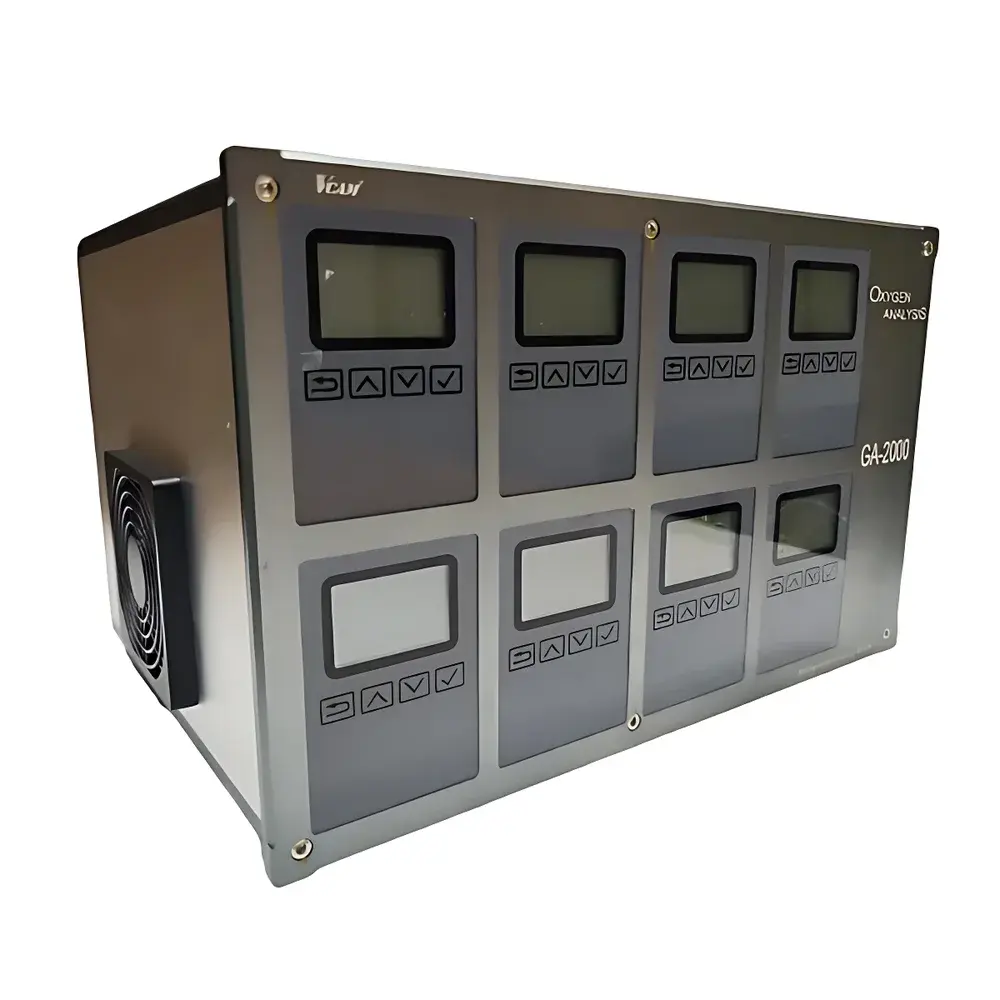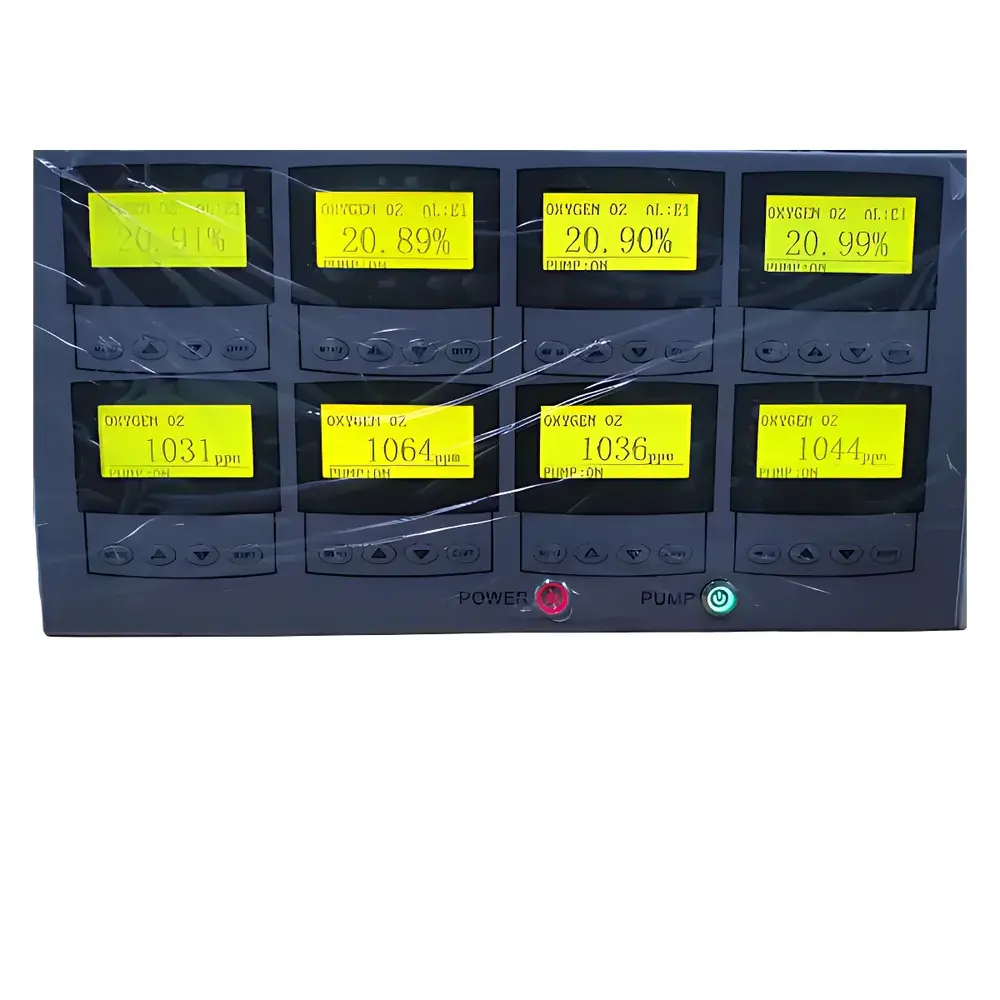
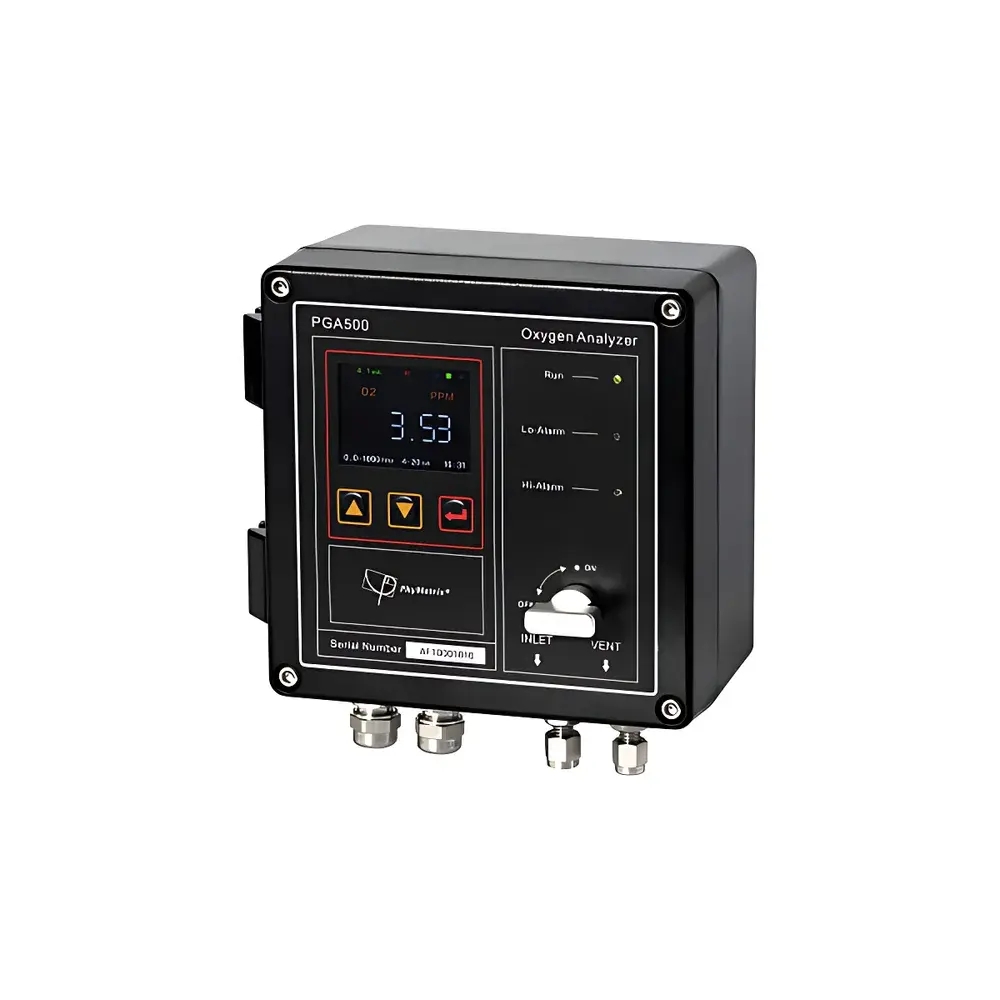
PhyMetrix PGA500 In-Line Trace Oxygen Analyzer
| Brand | PhyMetrix |
|---|---|
| Origin | USA |
| Manufacturer Type | Authorized Distributor |
| Product Origin | Imported |
| Model | PGA500 |
| Sensor Type | Electrochemical |
| Measurement Accuracy | ±1% FS (@20°C) |
| Response Time | T90 < 15 s, T95 < 25 s |
| Resolution | 0.01 ppm |
| Measurement Ranges | 0–10 ppm, 0–100 ppm, 0–1000 ppm, 0–1% vol (auto-ranging) |
| Interface | 1/8" Swagelok compression fitting |
| Operating Temperature | 0–45°C with full-range temperature compensation |
| Power Supply | 110–220 VAC or 12–36 VDC |
| Dimensions | 200 mm (H) × 80 mm (W) × 102 mm (D) |
| Weight | 1.85 kg |
| Pressure Rating | 1 MPa (integrated needle valve) |
| Enclosure Rating | IP67 |
| Output Signal | 4–20 mA analog |
Overview
The PhyMetrix PGA500 In-Line Trace Oxygen Analyzer is an industrial-grade electrochemical analyzer engineered for continuous, real-time monitoring of trace-level oxygen concentrations in process gas streams. It operates on the principle of galvanic or polarographic electrochemical sensing—where molecular oxygen diffuses through a selective membrane and undergoes a controlled redox reaction at the working electrode, generating a current linearly proportional to O₂ partial pressure. This fundamental measurement architecture ensures high specificity for oxygen in complex gas matrices, with minimal cross-sensitivity to CO₂, N₂, H₂, Ar, He, or hydrocarbons commonly encountered in high-purity and reactive process environments. Designed for permanent installation in hazardous or non-hazardous classified areas, the PGA500 delivers stable, low-drift performance across its four auto-ranging spans (0–10 ppm, 0–100 ppm, 0–1000 ppm, and 0–1% vol), enabling seamless transition between ultra-trace and low-percent oxygen detection without manual recalibration.
Key Features
- Integrated electrochemical sensor module with built-in zero-air isolation valve—enables safe, tool-free sensor maintenance without exposing the sensing element to ambient air, thereby preserving sensor lifespan and calibration integrity.
- Monolithic sampling cell design featuring optimized diffusion path geometry and low-volume internal flow channel—achieves T90 response time <15 seconds and T95 <25 seconds, critical for dynamic process control loops.
- True-color backlit LCD display supporting simultaneous visualization of primary concentration (ppm), running average, deviation from setpoint, and live 4–20 mA output value—eliminating need for external HART communicators during commissioning or troubleshooting.
- Full-range temperature compensation algorithm validated from 0°C to +45°C—ensures metrological consistency across seasonal ambient fluctuations and unheated skid-mounted installations.
- Dual-power architecture accepting either 110–220 VAC (50/60 Hz) or 12–36 VDC inputs—facilitates deployment in distributed control system (DCS) cabinets, mobile analyser shelters, or battery-backed backup configurations.
- IP67-rated aluminum enclosure with integrated 1 MPa-rated stainless-steel needle valve and 1/8″ Swagelok inlet/outlet ports—meets mechanical robustness requirements for refinery, semiconductor fab, and hydrogen production environments.
Sample Compatibility & Compliance
The PGA500 is compatible with dry, non-corrosive, non-condensing process gases including nitrogen, argon, helium, hydrogen, synthetic air, and purified natural gas. It is not intended for use with acidic, solvent-saturated, or particulate-laden streams without upstream conditioning (e.g., coalescing filters, desiccant dryers, or catalytic scrubbers). The analyzer complies with IEC 61000-6-2 (immunity) and IEC 61000-6-4 (emissions) for industrial electromagnetic environments. Its analog 4–20 mA output meets NAMUR NE43 fault signaling standards. While not intrinsically safe certified, its IP67 enclosure and low-power operation allow safe use in Zone 2/Class I Div 2 areas when installed per ISA-12.12.01 guidelines. Documentation supports audit readiness for ISO 9001, ISO 14644 (cleanroom gas purity), and USP (pharmaceutical inert gas qualification).
Software & Data Management
The PGA500 operates as a standalone field instrument with no embedded firmware update capability or Ethernet connectivity. All configuration—including range selection, damping factor, alarm thresholds, and current output scaling—is performed locally via the front-panel interface using intuitive menu navigation. Calibration data (zero/span date, gas standard ID, operator initials) is stored in non-volatile memory with timestamping. Though it lacks native digital communication protocols (e.g., Modbus RTU or HART), its 4–20 mA output is fully compatible with PLCs, DCS historians, and SCADA systems equipped with analog input cards. For compliance-driven applications requiring electronic recordkeeping, integration with third-party asset management platforms (e.g., Emerson DeltaV AMS, Honeywell Experion PHD) is achievable via analog signal digitization and metadata tagging at the I/O level—supporting basic GLP/GMP traceability where 21 CFR Part 11 requirements are met by the host system.
Applications
- Purified hydrogen stream monitoring in PEM electrolyzer output lines and fuel cell feed gas conditioning skids.
- Inert gas blanketing verification in pharmaceutical lyophilization chambers and API synthesis reactors.
- Final purity verification of bulk industrial gases (N₂, Ar, He) prior to cylinder filling or pipeline injection.
- Leak detection and purge validation in semiconductor process tools utilizing ultra-high-purity (UHP) nitrogen or argon.
- Oxygen ingress monitoring in LNG vaporization systems and cryogenic storage dewars.
- Quality assurance of modified atmosphere packaging (MAP) gas mixtures in food processing facilities.
FAQ
What is the recommended calibration frequency for the PGA500?
Calibration interval depends on application severity and regulatory requirements; typical practice is quarterly for critical pharmaceutical or semiconductor processes, and semi-annually for general industrial use. Zero calibration with certified nitrogen (99.999% N₂) and span calibration with certified oxygen-in-nitrogen standard (e.g., 10 ppm O₂/N₂) are required.
Can the PGA500 measure oxygen in hydrogen-rich streams?
Yes—the electrochemical sensor exhibits negligible interference from H₂ within its specified operating range. However, exposure to >5% H₂ at elevated temperatures (>40°C) may accelerate electrolyte depletion; consult PhyMetrix Application Note AN-023 for hydrogen-specific derating guidance.
Is the sensor replaceable in the field?
Yes. The sensor cartridge is user-replaceable without soldering or special tools. Each replacement includes factory pre-calibration and a unique serial-numbered certificate of conformance traceable to NIST standards.
Does the PGA500 support remote diagnostics?
No. Diagnostics are limited to local LED status indicators (power, fault, calibration mode) and analog output signal interpretation. Remote health monitoring requires integration with a higher-level control system that interprets the 4–20 mA signal and associated fault codes.
Related Products