
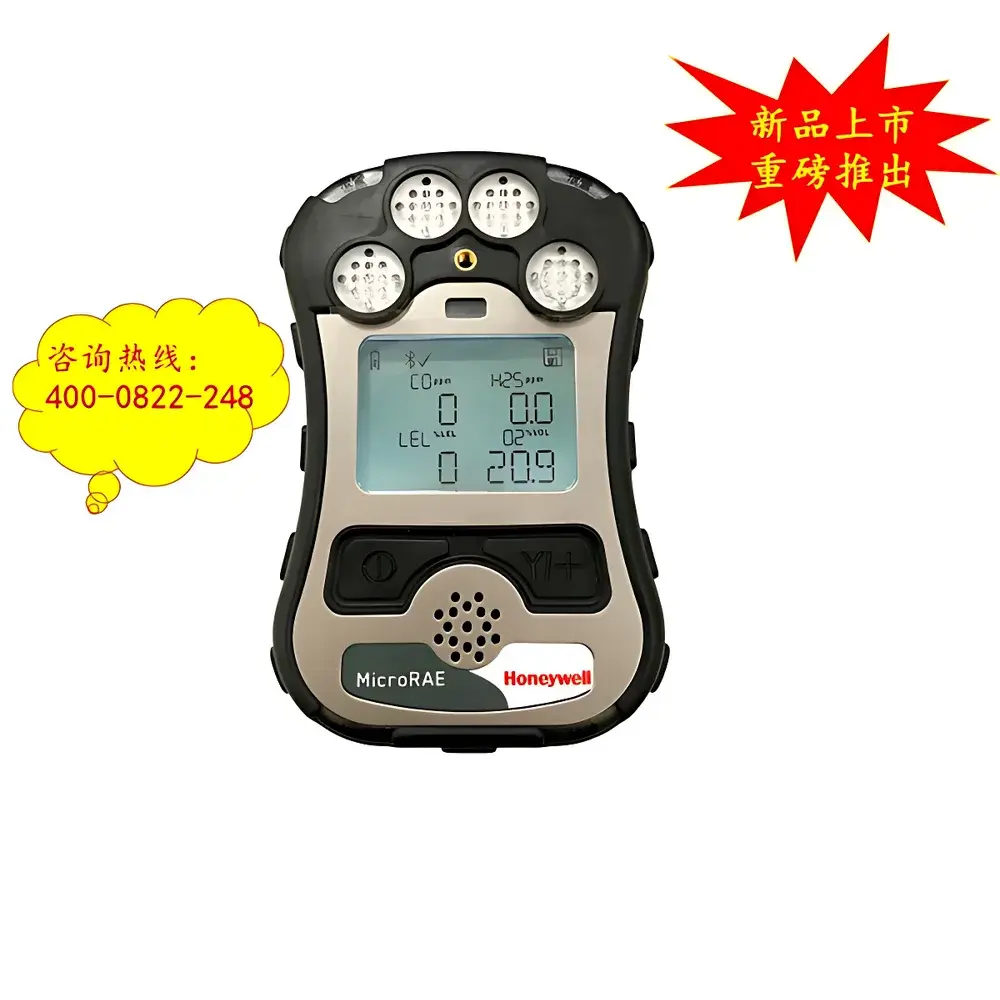
RAE Systems MicroRAE Wireless 4-Gas Monitor
| Brand | RAE Systems Inc. (USA) |
|---|---|
| Origin | USA |
| Model | MicroRAE |
| Detection Principle | Electrochemical (CO, H₂S), Catalytic Bead (LEL), Galvanic Cell (O₂) |
| Form Factor | Portable |
| Response Time (T₉₀) | ≤30 s |
| Repeatability | ±2% of reading (O₂, LEL, CO, H₂S) |
| IP Rating | IP67 |
| Operating Temperature | −40 °C to +70 °C (2 h at extremes) |
| Battery Life | 15 h (non-wireless), 11 h (wireless enabled, 20 °C) |
| Wireless Protocols | Proprietary RAE Mesh (up to 200 m), Bluetooth Low Energy (up to 5 m) |
| Certifications | IECEx Ex ia d IIIC T4 Gb, China Ex d ia IIIC T4 Gb, CMC, CCCF |
| Sensor Configuration | O₂ (0–30.0% vol, 0.1% vol res.), LEL (0–100% LEL, 1% LEL res.), CO (0–1000 ppm, dual-range: 0–250 ppm @ 1 ppm |
| 250–1000 ppm @ 3 ppm), H₂S (0–100 ppm, dual-range | 0–50 ppm @ 0.1 ppm |
| Data Logging | Continuous 6-month storage (1-min interval, 4 sensors) |
| Alarm Types | Audible (100 dB @ 30 cm, multi-tone), visual (tricolor LED, monochrome display with dual-color backlight), vibratory, remote (via ConneXt Plus/Pro/Loneworker, Safety Communicator), fall detection with pre-alarm and real-time transmission |
| Calibration | Two-point (manual or AutoRAE 2 automated) |
| Dimensions | 117 × 76 × 24 mm (H×W×D) |
| Weight | 206 g (incl. Li-ion battery & belt clip) |
Overview
The RAE Systems MicroRAE Wireless 4-Gas Monitor is a certified intrinsically safe, portable multi-gas detection instrument engineered for continuous real-time monitoring of oxygen (O₂), combustible gases (LEL), carbon monoxide (CO), and hydrogen sulfide (H₂S) in hazardous industrial environments. Built upon a dual-sensing architecture—catalytic bead for LEL, electrochemical cells for CO and H₂S, and galvanic oxygen sensor—the MicroRAE delivers high reproducibility and stable baseline performance under variable thermal and humidity conditions. Its design adheres to the fundamental requirements of occupational exposure monitoring per OSHA 29 CFR 1910.120 and NIOSH criteria for confined space entry, while its intrinsic safety certification (IECEx Ex ia d IIIC T4 Gb) ensures operational integrity in Zone 0/1 explosive atmospheres. The device operates as a node within Honeywell’s ConneXt ecosystem, enabling seamless integration into enterprise-wide safety telemetry infrastructure without requiring proprietary gateways.
Key Features
- Intrinsically safe architecture compliant with IECEx, China Ex, CMC, and CCCF standards for use in Class I, Division 1 and ATEX Zone 0/1 locations.
- IP67-rated enclosure providing full dust ingress protection and temporary submersion resistance (1 m for 30 min), validated across −40 °C to +70 °C operating envelope.
- Tri-color status LED (green/amber/red) synchronized with monochrome graphical display (44 × 33 mm, dual-color backlight) for immediate situational awareness under low-light or high-glare conditions.
- Fall detection algorithm with pre-alarm vibration and confirmed impact-triggered wireless alert transmission via RAE Mesh or Bluetooth to central safety platforms.
- Low-power Bluetooth LE module enabling secure configuration, data upload, and firmware updates directly from iOS/Android mobile devices using RAE’s official application suite.
- “Glimpse Mode” allows users to verify sensor status, alarm history, and battery level without powering on the main system—reducing unnecessary battery drain during routine checks.
- Anti-poisoning catalytic bead LEL sensor with optional hydrophobic and sulfur-resistant filter kits for extended service life in petrochemical or wastewater treatment applications.
- Integrated GPS module (optional) provides geotagged event logging and location-aware alarm routing compatible with Honeywell Safety Communicator and ConneXt Pro dashboards.
Sample Compatibility & Compliance
The MicroRAE is validated for direct ambient air sampling without sample conditioning or dilution. Its sensor suite meets the analytical specificity requirements defined in ASTM D5402-18 (for CO/H₂S interference testing) and ISO 20366:2017 (portable gas detector performance criteria). All calibration and bump test procedures align with ANSI/ISA-12.13.01-2022 for electrochemical and catalytic sensor verification. Device firmware supports audit-trail-enabled calibration logs compliant with GLP and internal QA protocols. Full traceability—including operator ID, date/time stamp, span gas concentration, and pass/fail result—is retained onboard and exportable via USB or wireless sync. Regulatory documentation includes EU Declaration of Conformity (2004/108/EC EMC Directive), RoHS 2011/65/EU compliance, and FCC Part 15 Subpart C certification for integrated RF modules.
Software & Data Management
Data acquisition and device management are supported through three interoperable software layers: AutoRAE 2 (PC-based automated calibration and functional testing station), ConneXt Desktop (centralized fleet configuration and alarm rule engine), and ConneXt Cloud (SaaS-hosted dashboard with role-based access control). Raw sensor readings—including instantaneous values, STEL/TWA calculations, peak hold, and minimum tracking—are time-stamped with microsecond precision and stored in non-volatile memory. Six months of continuous 1-minute interval logging (four channels) is retained locally; users may configure logging intervals from 1 second to 1 hour. Export formats include CSV, PDF summary reports, and XML for ERP/MES integration. All wireless transmissions employ AES-128 encryption; firmware updates undergo SHA-256 signature validation prior to installation.
Applications
The MicroRAE serves as a primary personal monitoring solution across industries governed by strict exposure limit enforcement and lone-worker safety mandates. It is routinely deployed in upstream oil & gas operations for hydrocarbon leak screening near flare stacks and manways; in municipal wastewater facilities for H₂S and CH₄ hazard mapping in lift stations and digesters; in steelmaking plants for CO monitoring in blast furnace galleries and coke oven batteries; and in chemical manufacturing for routine perimeter monitoring around VOC storage tanks and loading docks. Its fall-detection capability and GPS option make it particularly suited for rail yard inspectors, pipeline right-of-way surveyors, and utility field technicians operating outside line-of-sight supervision. The device also fulfills OSHA 1910.146(k)(1)(i) requirements for atmospheric testing prior to confined space entry.
FAQ
What wireless protocols does the MicroRAE support?
It operates on RAE’s proprietary self-healing mesh network (up to 200 m range) and Bluetooth Low Energy (up to 5 m), both supporting encrypted bidirectional communication with Honeywell ConneXt infrastructure.
Can the MicroRAE be calibrated without a PC?
Yes—manual zero/span calibration is possible using certified calibration gases and the onboard two-button interface; however, AutoRAE 2 is required for automated functional tests, sensor diagnostics, and regulatory-compliant calibration logging.
Is the GPS module standard or optional?
GPS is an optional hardware add-on; units shipped without GPS retain full core gas detection functionality and wireless telemetry via Mesh/Bluetooth.
How is data integrity ensured during wireless transmission?
All transmitted packets include CRC-32 checksums and sequence numbers; missed or corrupted frames trigger automatic retransmission. End-to-end encryption uses TLS 1.2 for cloud-bound data and AES-128 for local Mesh traffic.
Does the MicroRAE meet FDA 21 CFR Part 11 requirements?
While not a regulated medical device, its audit-trail-capable calibration and event logging subsystem satisfies electronic record/electronic signature (ER/ES) principles outlined in Part 11 when deployed in pharmaceutical manufacturing or biotech cleanroom support roles under client-defined SOPs.







