
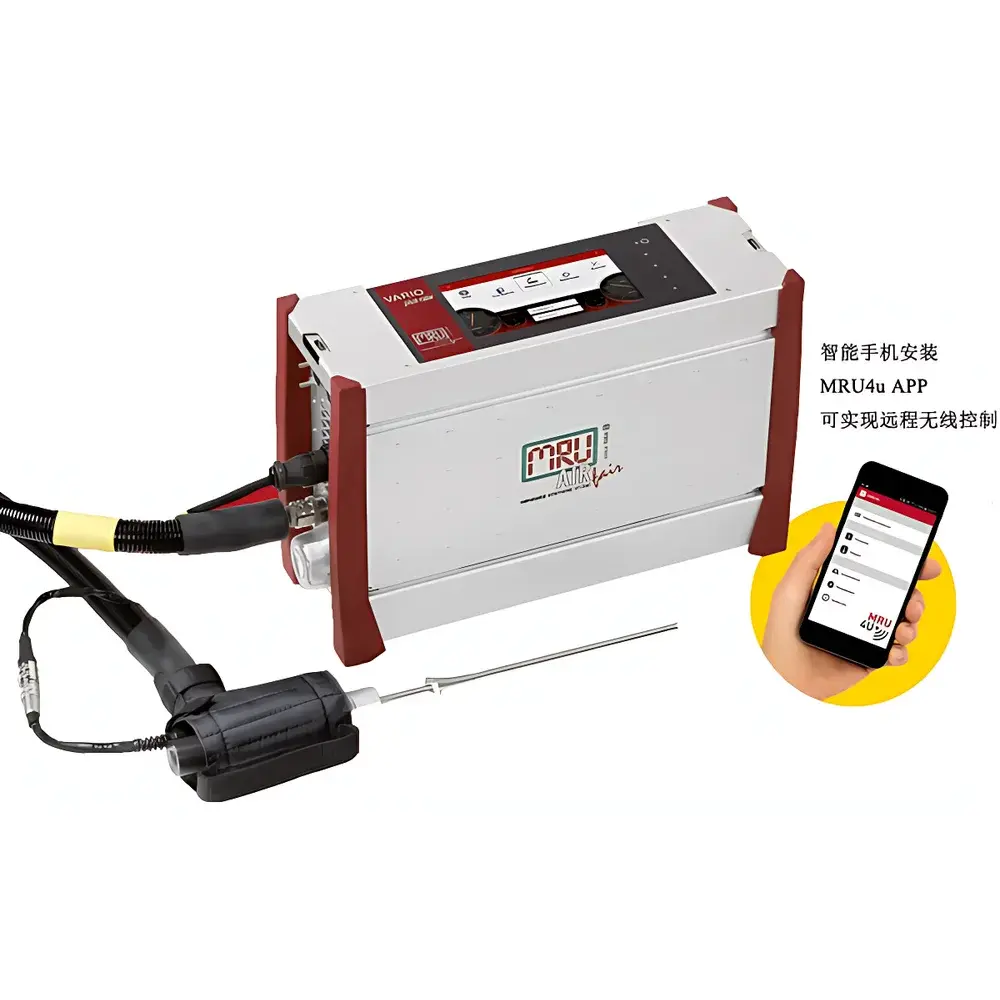
MRU VARIO plus-new Enhanced Flue Gas Analyzer
| Brand | MRU (Germany) |
|---|---|
| Origin | Germany |
| Model | VARIO plus-new |
| Instrument Type | Portable Flue Gas Analyzer |
| Measurement Principle | Dual-mode — NDIR (CO₂, CO, NO, SO₂, NO₂, HC) + Electrochemical (O₂, CO, NO, SO₂, NO₂, H₂) |
| Accuracy | ≤ ±5% FS |
| Repeatability | ≤ 1% FS |
| Response Time (T₉₀) | ≤ 20 s |
| Drift Stability (24 h) | ≤ 1% FS |
| Measured Gases | O₂, CO₂, CO, NO, SO₂, NO₂, HC (as C₃H₈), H₂ |
| Operating System | Embedded Linux |
| Display | 7″ TFT color touchscreen (800 × 480 px) |
| Data Interfaces | Ethernet, WLAN (802.11 b/g/n), Bluetooth 4.0, USB 2.0, RS485, 8 × 4–20 mA analog outputs, 4 × 4–20 mA analog inputs, AUX port (K-type thermocouple, 0–10 V, 4–20 mA, RS485) |
| Power | Rechargeable 48 Wh Li-ion battery (typ. 6 h operation) |
| Condensate Management | Integrated Peltier cooler + automatic peristaltic condensate pump |
| Auto-Calibration | Scheduled zero calibration during continuous operation |
| Data Export | CSV/PDF reports via USB or network |
| Compliance | EN 50379-1/-2, EN 15267-3, MCERTS (UK), EPA Method 6C/7E/10, ISO 12039, ISO 10849, DIN 33430, GLP-compliant data logging with audit trail capability |
Overview
The MRU VARIO plus-new Enhanced Flue Gas Analyzer is a high-integrity, dual-principle portable emissions monitoring system engineered for precision, long-term stability, and regulatory compliance in industrial combustion diagnostics. It integrates non-dispersive infrared (NDIR) spectroscopy for CO₂, CO, NO, SO₂, NO₂, and hydrocarbons (HC, reported as propane-equivalent), alongside electrochemical sensors for O₂, CO, NO, SO₂, NO₂, and H₂ — enabling simultaneous, cross-validated measurement of up to eight gas components in flue streams. Designed for continuous on-site deployment at power plants, cogeneration units, large-scale boilers, gas turbines, reciprocating engines, and industrial heating systems, the analyzer delivers trace-level detection sensitivity and robust performance under variable temperature, humidity, and particulate load conditions. Its embedded Linux operating system ensures deterministic real-time control, memory-resident firmware integrity, and secure over-the-air updates — distinguishing it from legacy Windows CE–based platforms.
Key Features
- Dual-sensor architecture: NDIR cells with temperature- and pressure-compensated optical path length ensure stable calibration across ambient shifts; electrochemical sensors feature extended-life electrolyte formulations and integrated thermal stabilization.
- Active condensate management: Integrated Peltier thermoelectric cooler maintains sample gas dew point below 4 °C, coupled with a programmable peristaltic pump for autonomous condensate removal — eliminating manual drainage and preventing sensor saturation.
- Intuitive human-machine interface: 7-inch capacitive touchscreen (800 × 480 resolution) supports gesture-based navigation, multi-language UI (including English, German, French, Spanish, Chinese), and context-aware soft-key menus aligned with ISO 9241 ergonomic guidelines.
- Comprehensive combustion calculation engine: Real-time computation of λ (excess air ratio), CO₂ max, efficiency (η), NOₓ conversion (ppm @ 3% O₂), and thermal loss — supported by a built-in fuel database covering 32 standard fuels (natural gas, diesel, coal grades, biomass blends) plus user-defined stoichiometric profiles.
- Modular I/O architecture: Eight isolated 4–20 mA analog outputs support integration into DCS/SCADA systems; four analog inputs accept external temperature, pressure, or flow signals; AUX port enables direct connection of K-type thermocouples and third-party transmitters with 0–10 V / 4–20 mA / RS485 outputs.
- Battery-operated field autonomy: 48 Wh lithium-ion pack sustains ≥6 hours of continuous sampling at 1.5 L/min flow rate; smart charging circuitry prevents overcharge and deep discharge; hot-swappable design allows uninterrupted operation during battery exchange.
Sample Compatibility & Compliance
The VARIO plus-new is validated for use with dry or wet flue gases containing particulate concentrations up to 100 mg/m³ (ISO 16911-1 compliant sampling). It meets the essential requirements of EN 50379-1 (portable gas analyzers) and EN 50379-2 (performance criteria), and is type-approved under EN 15267-3 for continuous emission monitoring systems (CEMS) applications. For regulatory reporting, it satisfies EPA Methods 6C (SO₂), 7E (NOₓ), and 10 (O₂/CO), as well as ISO 12039 (CO/CO₂/SO₂), ISO 10849 (NO/NO₂), and DIN 33430 (data integrity). All measurement data are timestamped, digitally signed, and stored with full audit trail metadata — supporting GLP and ISO/IEC 17025 laboratory accreditation requirements. Optional 21 CFR Part 11–compliant firmware enables electronic signatures and role-based access control for QA/QC workflows.
Software & Data Management
Data acquisition and visualization are managed through MRU’s proprietary firmware and the MRU4u ecosystem. The onboard web server enables real-time instrument status monitoring, live trend graphs, and historical data retrieval via any modern browser — no client software required. Measurement logs (CSV, PDF, XML) can be exported manually via USB or automatically scheduled over Ethernet/WLAN. The MRU4u mobile application (iOS/Android) provides remote start/stop, alarm configuration, and push notifications for out-of-spec events. All firmware updates are cryptographically signed and verified before installation. Internal storage retains ≥10,000 measurement records with cyclic overwrite protection; external NAS or cloud storage integration is supported via configurable SFTP or HTTP POST endpoints.
Applications
- Combustion optimization of industrial boilers and fired heaters to minimize fuel consumption and reduce NOₓ/SO₂ formation.
- Regulatory stack testing for compliance with EU IED (Industrial Emissions Directive), U.S. NSPS, and China’s GB 13223–2011.
- Performance verification of selective catalytic reduction (SCR) and flue gas desulfurization (FGD) systems.
- R&D validation of low-carbon fuels (hydrogen blends, ammonia co-firing, biofuels) under transient load conditions.
- Pre-commissioning and periodic maintenance checks of gas turbines and reciprocating engines per ISO 8501-1 and API RP 1173 protocols.
- Academic and municipal air quality monitoring campaigns requiring trace gas speciation and temporal correlation analysis.
FAQ
What gas detection principles does the VARIO plus-new employ?
It combines NDIR spectroscopy for CO₂, CO, NO, SO₂, NO₂, and HC with electrochemical sensors for O₂, CO, NO, SO₂, NO₂, and H₂ — ensuring redundancy, cross-sensitivity correction, and extended dynamic range.
Does the analyzer support automatic zero calibration during unattended operation?
Yes — users can schedule zero-point calibration at defined intervals (e.g., every 2, 4, or 8 hours) using built-in reference air or external zero gas, with full event logging and deviation alerts.
Can raw sensor signals be accessed for custom algorithm development?
Yes — the RS485 and Ethernet interfaces provide Modbus RTU/TCP register access to raw ADC values, temperature-compensated sensor outputs, and diagnostic flags; developers may deploy containerized Python or Lua scripts via the Linux shell.
Is the device certified for hazardous area use (ATEX/IECEx)?
No — the VARIO plus-new is rated for Zone 2/Class I Div 2 environments only; intrinsic safety requires external barrier kits and is not factory-certified.
How is data integrity ensured for regulatory submissions?
All measurements include ISO 8601 timestamps, firmware version stamps, sensor serial IDs, and cryptographic hash signatures; audit trails record operator logins, configuration changes, and calibration events — fully compliant with GLP and ISO/IEC 17025 Annex A.5 requirements.
Related Products







