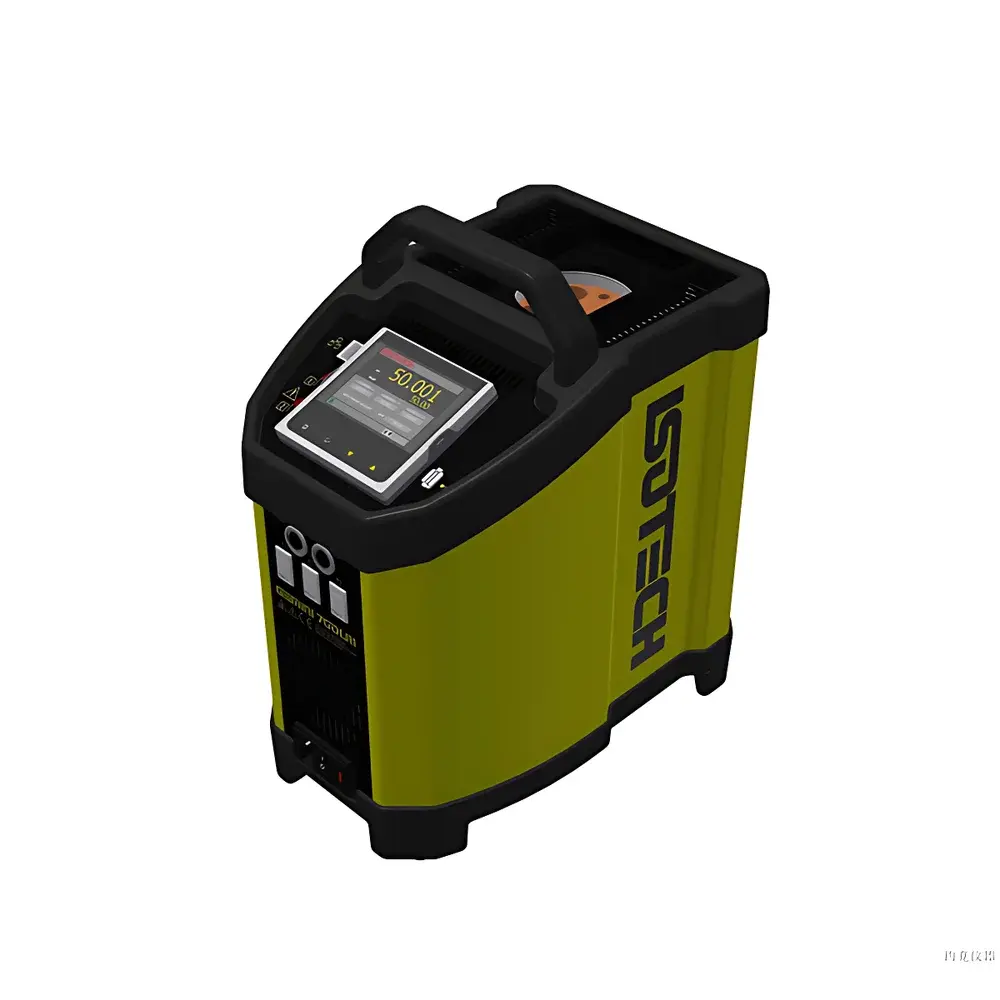
ISOTECH Gemini4857-550/700 Dual-Range Dry-Block Calibrator
| Brand | ISOTECH |
|---|---|
| Origin | United Kingdom |
| Model | Gemini4857-550/700 |
| Temperature Range | 35°C to 550°C / 50°C to 700°C |
| Stability | ±0.01°C @ 100°C, ±0.015°C @ 300°C, ±0.03°C @ 550°C |
| Temperature Resolution | 0.01°C |
| Heating Time (30°C → 550°C) | 35 min (standard), 60 min (LRIN) |
| (50°C → 700°C) | 110 min (standard), 120 min (LRIN) |
| Cooling Time (550°C → 275°C) | 35 min (standard), 132 min (LRIN) |
| (550°C → 60°C) | 345 min (standard), 420 min (LRIN) |
| Calibration Well Dimensions | Ø64 mm × 160 mm depth |
| External Dimensions (D×W×H) | 312 mm × 212 mm × 384 mm |
| Weight | 8.5 kg (standard), 14 kg (LRIN) |
Overview
The ISOTECH Gemini4857-550/700 is a high-precision, dual-range dry-block calibrator engineered for metrological-grade temperature verification and calibration of contact sensors in laboratory, manufacturing, and field service environments. Operating on the principle of conductive heat transfer within a thermally homogeneous metal block, the Gemini4857 leverages advanced PID-controlled heating elements and optimized thermal mass distribution to achieve exceptional short-term stability and spatial uniformity across its calibration well. Its dual operating ranges—35°C to 550°C and 50°C to 700°C—enable seamless transition between medium- and high-temperature calibration tasks without hardware reconfiguration. The unit features an integrated, independently referenced three-channel temperature indicator with real-time comparison of reference probe, DUT (Device Under Test), and block temperature—ensuring traceable, uncertainty-aware calibration workflows compliant with ISO/IEC 17025 requirements.
Key Features
- Dual-range operation: Selectable 35–550°C or 50–700°C modes via front-panel interface or remote command; optimized thermal architecture minimizes thermal stress during range switching.
- High-stability calibration well: Ø64 mm × 160 mm deep bore with precision-machined inserts accommodating probes up to Ø19.5 mm; uniformity better than ±0.02°C over central 60 mm depth at 300°C.
- Reference-grade stability: ±0.01°C @ 100°C, ±0.015°C @ 300°C, ±0.03°C @ 550°C (1-hour dwell, 30-minute averaging window), verified per ASTM E2877-22 Annex A2 protocols.
- Triple-sensor monitoring system: Simultaneous readout of reference RTD, DUT input, and auxiliary block sensor—enabling real-time deviation tracking and automated pass/fail evaluation.
- Modular insert design: Standard fixed-insert block includes four 8 mm and four 19.5 mm diameter bores (160 mm depth); optional custom inserts available for non-standard probe geometries.
- Built-in Ethernet and USB interfaces support remote control, data logging, and integration into automated calibration management systems compliant with FDA 21 CFR Part 11 and EU Annex 11 requirements.
Sample Compatibility & Compliance
The Gemini4857-550/700 accommodates a broad spectrum of temperature sensors including PRTs (Pt100, Pt1000), thermistors (10 kΩ, 100 kΩ), thermocouples (Types E, J, K, N, R, S, T), and 4–20 mA loop-powered transmitters. Its large-diameter well enables simultaneous calibration of multiple small-diameter probes (e.g., 1–3 mm sheathed thermocouples) or single large-diameter industrial sensors (e.g., Ø12 mm armored RTDs). All electrical inputs meet IEC 61000-4-2 (ESD) and IEC 61000-4-3 (RF immunity) standards. Calibration procedures align with ISO 17025:2017 Clause 6.4 (Equipment), EURAMET cg-18 (Guideline on Dry-Block Calibrators), and NIST SP 250-98 (Temperature Calibration Best Practices). Traceability is maintained through factory-certified reference probes with individual CoC (Certificate of Calibration) issued to UKAS-accredited standards.
Software & Data Management
ISOTECH CalSoft™ v4.2 (included) provides full B/S architecture—accessible via any modern web browser on desktop, tablet, or mobile device—eliminating local software installation. The platform supports automated calibration sequences, configurable tolerance limits, digital signature capture, and audit-trail-enabled data storage meeting GLP/GMP documentation requirements. Raw measurement data (time-stamped temperature readings, deviations, environmental conditions) is exportable in CSV, PDF, and XML formats. Optional IQ/OQ/PQ validation packages are available for regulated industries, including protocol templates compliant with ASTM E2500 and GAMP 5. All firmware updates are delivered over-the-air via secure HTTPS, with version history and change logs retained in the embedded database.
Applications
- Primary and secondary calibration of temperature sensors in pharmaceutical cleanrooms (ISO 14644-1 Class A–D) and bioreactor monitoring systems.
- Factory acceptance testing (FAT) and periodic verification of process thermometers used in food processing, petrochemical refining, and aerospace component heat treatment.
- Supporting ISO/IEC 17025-accredited calibration laboratories requiring documented uncertainty budgets and inter-laboratory comparison readiness.
- Field service calibration of handheld thermometers, infrared reference sources, and HVAC system sensors under ANSI/ASHRAE Standard 110.
- Educational and research applications requiring stable, reproducible thermal environments for material property characterization (e.g., coefficient of thermal expansion studies).
FAQ
What reference standards are compatible with the Gemini4857?
The unit accepts standard 4-wire PT100 reference probes (IEC 60751 Class AA) with M8 or ¼” NPT mounting; ISOTECH recommends the TR-120 series for optimal stability and traceability.
Does the Gemini4857 support automated calibration reporting per ISO 17025?
Yes—CalSoft™ generates fully compliant reports including uncertainty budgets, environmental conditions, equipment IDs, operator signatures, and revision-controlled metadata.
Can the unit be used for thermocouple calibration at sub-zero temperatures?
No—the minimum operating temperature is +35°C (Gemini4857-550) or +50°C (Gemini4857-700); sub-zero calibration requires a separate low-temperature dry-well or liquid-bath system.
Is the LRIN (Low-Rise Insertion Nozzle) option required for all applications?
LRIN is recommended for applications demanding ultra-low thermal gradient profiles (e.g., aerospace sensor qualification); standard configuration suffices for routine industrial calibration.
How is traceability maintained during firmware updates?
Each firmware release undergoes metrological validation against NPL-traceable references; update logs include calibration verification timestamps and checksums stored in non-volatile memory.