
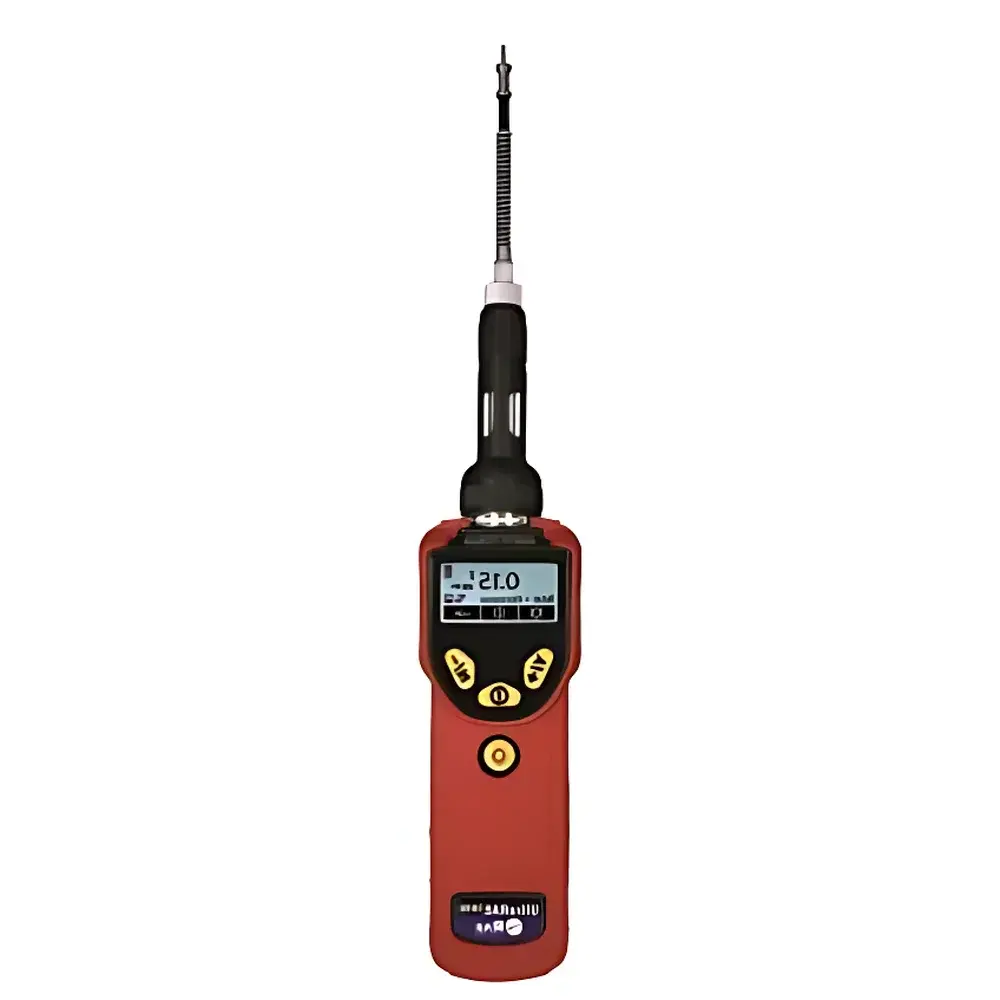
RAE Systems UltraRAE 3000 Portable VOC Detector with RAE-SEP Separation Technology
| Brand | RAE Systems Inc. |
|---|---|
| Origin | USA |
| Instrument Type | Portable VOC Detector |
| Detection Principle | Photoionization Detection (PID) with 9.8 eV or 10.6 eV UV Lamp |
| Detection Range | 0.05–5000 ppm, 0.05–9999 ppm, 0.05–2000 ppm, 0.05–200 ppm |
| Resolution | 0.05 ppm, 0.1 ppm, 1 ppm, 0.05 ppm |
| Accuracy | ±3% of reading |
| Response Time | <3 s |
| Built-in Sampling Pump | Yes |
| IP Rating | IP67 |
| Compliance | ATEX II 2G Ex ib IIB T4 Gb, IECEx ib IIB T4 Gb, UL 913 Class I, Division 1, Groups B, C, D, CSA Class I, Division 1, Groups B, C, D |
Overview
The RAE Systems UltraRAE 3000 is a high-performance, intrinsically safe, portable volatile organic compound (VOC) detector engineered for precision field analysis in demanding industrial and environmental applications. Unlike conventional PID-based instruments, the UltraRAE 3000 integrates a third-generation PID platform with configurable 9.8 eV or 10.6 eV ultraviolet lamps and proprietary RAE-SEP gas separation technology. This architecture enables selective detection of individual VOC species—such as benzene, toluene, xylene, styrene, or chlorinated hydrocarbons—by physically isolating target analytes prior to ionization. When operated without the separation tube, it functions as a broad-spectrum TVOC monitor, delivering real-time total VOC concentration with sub-part-per-trillion sensitivity. The instrument operates on the fundamental principle of photoionization: VOC molecules are exposed to high-energy UV photons; those with ionization potentials below the lamp’s photon energy are ionized, generating a current proportional to concentration. This physical measurement principle ensures rapid, non-destructive, and highly reproducible quantification across thousands of compounds without chemical consumables or calibration gases.
Key Features
- Intrinsically safe design certified to ATEX, IECEx, UL 913, and CSA standards for use in hazardous locations (Class I, Div 1, Groups B–D)
- Dual-lamp compatibility: Interchangeable 9.8 eV (optimized for aromatic and unsaturated compounds) and 10.6 eV (extended coverage including aldehydes, ketones, and chlorinated solvents) UV sources
- RAE-SEP modular separation tubes: Chemically inert, thermally stable capillary columns enabling compound-specific identification and quantification—eliminating cross-sensitivity from complex mixtures
- Self-cleaning UV lamp system: Automated periodic lamp surface decontamination maintains consistent photon output and extends lamp service life beyond 12,000 hours
- Integrated high-flow sampling pump with 30 m extended sampling capability via heated, conductive tubing—preserving sample integrity under variable ambient conditions
- Real-time environmental compensation: Onboard temperature, relative humidity, and barometric pressure sensors feed adaptive algorithms that correct for density, diffusion, and ion recombination effects
- Bluetooth 5.0 + optional Wi-Fi module: Enables continuous streaming of time-stamped concentration data, alarm events, and instrument diagnostics to cloud-hosted dashboards or local SCADA systems
- IP67-rated enclosure: Fully dust-tight and water-resistant to temporary immersion—suitable for outdoor deployment, confined space entry, and emergency response scenarios
Sample Compatibility & Compliance
The UltraRAE 3000 detects over 3,000 VOCs listed in its embedded library—including EPA Method TO-15 and ASTM D5502 analytes—with detection limits as low as 0.05 ppm for key compounds such as benzene and formaldehyde. Its RAE-SEP configuration supports method-defined selectivity aligned with OSHA 29 CFR 1910.120 (HAZWOPER), NIOSH Manual of Analytical Methods (NMAM) Chapter 2541, and ISO 16000-6 for indoor air quality monitoring. Data logging meets GLP/GMP requirements: all measurements include embedded timestamps, operator ID, GPS coordinates (when enabled), and audit-trail metadata compliant with FDA 21 CFR Part 11 for electronic records and signatures. Calibration verification reports are exportable in CSV and PDF formats, supporting regulatory submissions under EPA 40 CFR Part 63 and EU REACH Annex XVII reporting obligations.
Software & Data Management
The UltraRAE 3000 interfaces natively with ProRAE Studio II desktop software and the ProRAE Mobile application. These platforms provide full lifecycle management: remote firmware updates, customizable alarm thresholds (TWA, STEL, ceiling), multi-point calibration validation, and spectral trend analysis across sequential sampling events. All raw sensor outputs—including lamp intensity, pump vacuum, and environmental parameters—are logged at 1-second intervals. Data exports support ISO/IEC 17025 traceability protocols, including uncertainty budgets derived from NIST-traceable calibration standards. Cloud integration via RAE Connect allows role-based access control, automated compliance reporting, and AI-assisted anomaly detection for predictive maintenance scheduling.
Applications
- Industrial hygiene monitoring during maintenance turnarounds, tank cleaning, or solvent degreasing operations
- Environmental site assessments: soil vapor intrusion screening, landfill perimeter monitoring, and remediation endpoint verification
- Confined space entry pre-testing per OSHA 1910.146 and ANSI Z117.1 standards
- Emergency response for chemical spills, railcar leaks, or illicit lab investigations
- Pharmaceutical manufacturing: residual solvent testing in cleanrooms and lyophilizer exhaust streams
- Refinery flare stack emissions verification and fugitive emission surveys per EPA LDAR protocols
FAQ
What VOCs can the UltraRAE 3000 detect with RAE-SEP tubes?
RAE-SEP tubes are available for targeted analysis of >40 priority VOCs—including benzene, ethylbenzene, xylenes, styrene, trichloroethylene, tetrachloroethylene, vinyl chloride, and acetaldehyde—each validated against reference standards per ISO 17025-accredited methods.
Does the instrument require daily bump testing?
Yes. Per manufacturer recommendations and OSHA guidance, bump testing with a certified challenge gas (e.g., 100 ppm isobutylene) must be performed before each day’s use to verify sensor response and alarm functionality.
Can the UltraRAE 3000 be used for quantitative leak detection per EPA Method 21?
When configured with the 10.6 eV lamp and calibrated for methane or propane, it meets Method 21 sensitivity requirements (≥0.1 ppm) for VOC leak detection—though users must document calibration traceability and environmental correction factors per section 4.3 of the method.
Is firmware upgrade supported over-the-air?
Firmware updates require connection to ProRAE Studio II via USB or Bluetooth; no OTA capability is provided due to functional safety requirements for hazardous-area devices.







