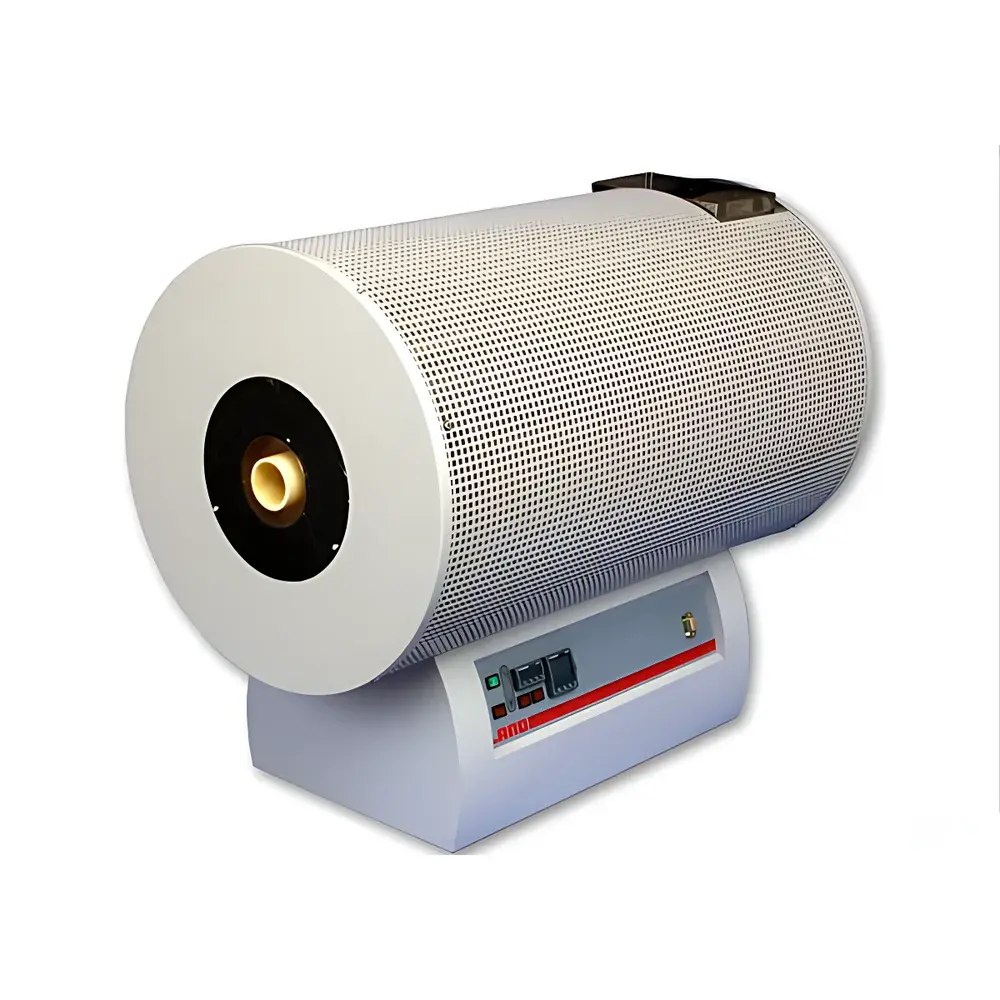
LAND P1600B2 High-Temperature Blackbody Radiation Source
| Brand | LAND |
|---|---|
| Origin | United Kingdom |
| Model | P1600B2 |
| Temperature Range | 500–1550 °C |
| Emissivity | 0.998 |
| Stability | ±0.2 °C per 60 min |
| Uniformity | < ±0.15% of setpoint over central 40 mm of 50 mm-diameter cavity |
| Cavity Dimensions | Ø50 mm × 400 mm |
| Temperature Resolution | 1 °C |
| Heating Time | 90 min to 1400 °C |
| Cooling Time | 180 min to 200 °C |
| Ambient Operating Conditions | 10–40 °C |
| Controller | Eurotherm PID with Type R Thermocouple |
| Power Supply | 220–240 V, 50–60 Hz |
Overview
The LAND P1600B2 is a high-temperature fixed-point blackbody radiation source engineered for primary and secondary calibration of infrared thermometers, thermal imagers, and radiation pyrometers in metrology laboratories and industrial calibration facilities. Operating on the fundamental principle of Planck’s law of blackbody radiation, the P1600B2 generates spectrally well-defined, spatially uniform thermal radiation within a precision-machined cylindrical cavity. Its cavity—measuring Ø50 mm × 400 mm—is lined with high-emissivity refractory material and optimized for near-ideal radiative behavior, achieving an experimentally verified spectral emissivity of 0.998 across the 500–1550 °C range. This performance meets or exceeds the requirements specified in ISO/IEC 17025:2017 for reference sources used in accredited temperature calibration services, and supports traceability to national standards (e.g., NPL, PTB, NIST) via documented uncertainty budgets.
Key Features
- Stable, high-temperature operation from 500 °C to 1550 °C—suitable for calibrating high-range industrial pyrometers used in metallurgy, glass manufacturing, and aerospace component testing.
- Exceptional temperature stability of ±0.2 °C over any 60-minute interval, verified under steady-state conditions per ASTM E2847 and IEC 61232 procedures.
- High spatial uniformity: temperature gradient within the central 40 mm segment of the 50 mm-diameter cavity remains below ±0.15% of the setpoint temperature—critical for minimizing aperture-dependent measurement bias during collimated beam calibration.
- Integrated Eurotherm PID temperature controller with dual-loop feedback, utilizing a calibrated Type R thermocouple embedded in the cavity wall for robust, drift-compensated control.
- Thermally insulated furnace architecture with multi-zone heating elements ensures repeatable thermal profiles and minimizes external thermal load influence.
- Designed for compliance with electromagnetic compatibility (EMC) directive 2014/30/EU and low-voltage directive 2014/35/EU; CE-marked and RoHS-compliant.
Sample Compatibility & Compliance
The P1600B2 is not intended for sample heating or material processing. It serves exclusively as a reference radiation source for optical radiation thermometry. Its cavity geometry and emissivity profile are validated for use with detectors operating in the 0.8–5.0 µm spectral band—covering common InGaAs, Si, and InSb photodetectors. Calibration protocols performed using this source align with international standards including ISO 18434-1 (condition monitoring — infrared thermography), ASTM E1256 (test methods for radiation thermometers), and EURAMET cg-18 (guideline on calibration of radiation thermometers). The system supports GLP-compliant documentation workflows and is compatible with audit-ready calibration records required under ISO/IEC 17025 and FDA 21 CFR Part 11 when paired with validated data acquisition software.
Software & Data Management
While the P1600B2 operates as a standalone hardware reference source, it integrates seamlessly with third-party calibration management platforms (e.g., MET/CAL, Beamex MC6, or custom LabVIEW-based systems) via analog 4–20 mA or digital RS-485 Modbus RTU output. Real-time cavity temperature, controller status, and alarm flags are accessible for logging and traceability. All calibration events—including soak duration, stabilization verification timestamps, and operator ID—can be captured in structured CSV or XML formats. Firmware updates and configuration backups are supported through the Eurotherm iTools suite, which maintains full revision history and change logs compliant with GMP Annex 11 requirements.
Applications
- Primary calibration of transfer standards at national metrology institutes (NMIs) and regional calibration centers.
- Periodic verification and adjustment of online infrared sensors deployed in continuous casting, hot rolling, and annealing lines.
- Validation of thermal imaging systems used in predictive maintenance programs across power generation and petrochemical facilities.
- Uncertainty analysis for radiation thermometer calibration according to GUM (JCGM 100:2008) and EURAMET Technical Report 141.
- Research-grade characterization of detector linearity, spectral responsivity, and non-uniformity correction algorithms.
FAQ
What is the recommended warm-up time before initiating calibration procedures?
A minimum 90-minute stabilization period at the target temperature is required after reaching setpoint, followed by verification of thermal equilibrium using the built-in stability monitor.
Can the P1600B2 be used for calibration below 500 °C?
No—the lower operational limit is strictly 500 °C due to cavity material limitations and emissivity degradation at reduced temperatures.
Is the cavity emissivity certified and traceable?
Yes—each unit ships with a factory-issued calibration certificate reporting measured emissivity (0.998 ± 0.0005) at three representative temperatures (700 °C, 1000 °C, 1300 °C), traceable to NPL reference standards.
What maintenance intervals are recommended for long-term accuracy?
Annual verification of cavity emissivity and temperature uniformity is advised; replacement of the Type R thermocouple every 24 months or after 500 thermal cycles above 1200 °C is strongly recommended.
Does the system support automated calibration sequences?
Yes—when interfaced with external programmable logic controllers (PLCs) or calibration software via Modbus, multi-point ramp-and-soak sequences can be fully automated with configurable dwell times and pass/fail criteria.