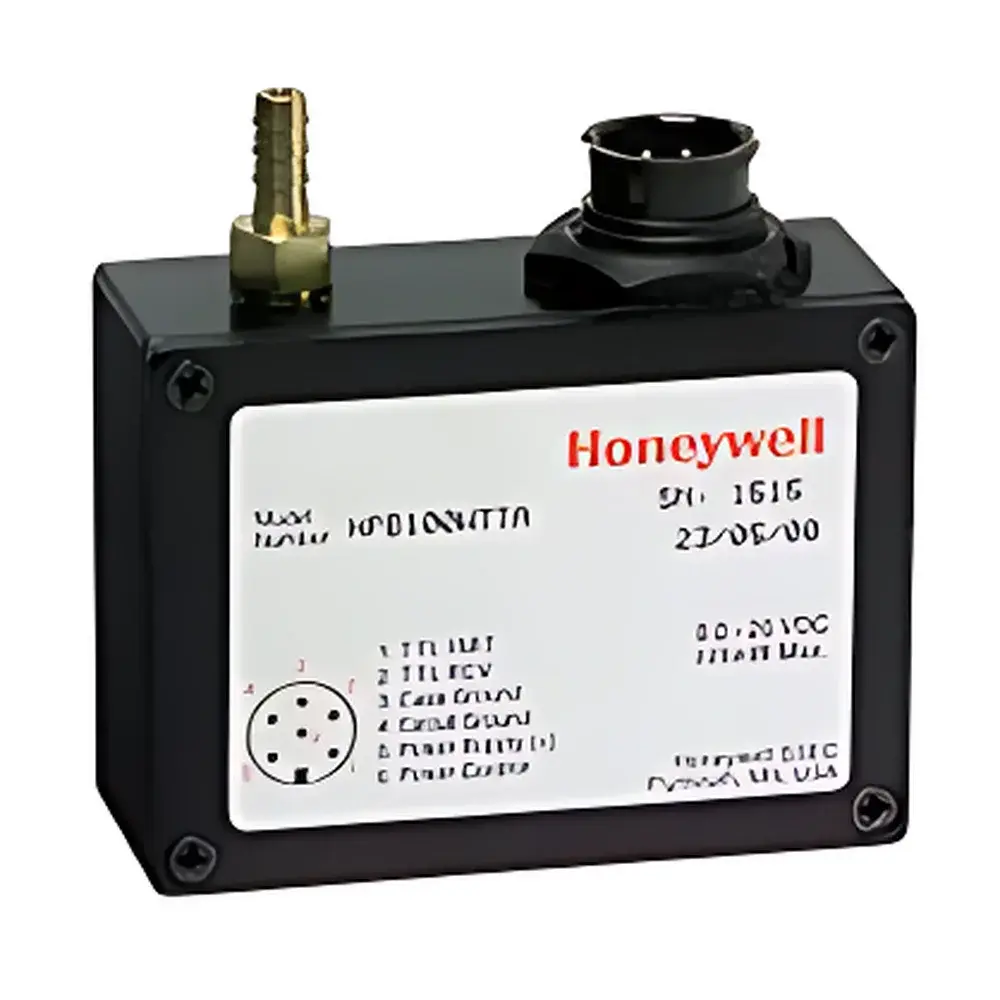
Honeywell HPB Precision Barometer
| Brand | Honeywell |
|---|---|
| Model | HPB |
| Measurement Range | 500–1200 hPa |
| Operating Temperature | −40 °C to +85 °C |
| Accuracy | ±0.4 hPa or ±0.8 hPa (typ.) |
| Long-Term Drift | ≤0.25 hPa/year |
| Output Interface | TTL-compatible digital output |
| Power Consumption | Low-power design |
| Form Factor | Compact and lightweight |
| Origin | USA |
| Supply Chain Status | Imported via authorized distributor |
Overview
The Honeywell HPB Precision Barometer is an engineered atmospheric pressure sensing module designed for integration into mission-critical environmental monitoring systems where long-term stability, wide thermal tolerance, and deterministic digital output are essential. Based on silicon MEMS piezoresistive transduction technology, the HPB delivers absolute barometric pressure measurements traceable to NIST-calibrated references. Its core operational principle relies on temperature-compensated strain gauge response within a hermetically sealed reference cavity, enabling high-fidelity pressure-to-digital conversion across extreme ambient conditions. Unlike analog-output barometers requiring external signal conditioning, the HPB integrates on-chip ADC, digital compensation algorithms, and TTL-level serial output—reducing system-level BOM count and PCB footprint while preserving metrological integrity. It is not a standalone display instrument but a calibrated OEM sensor module intended for embedded deployment in weather stations, oceanographic data buoys, unmanned aerial platforms, and automated environmental logging networks.
Key Features
- Stable absolute pressure measurement across 500–1200 hPa range—covering sea-level to high-altitude tropospheric conditions
- Extended operational envelope: functional from −40 °C to +85 °C with internal temperature compensation active across full span
- High accuracy performance: ±0.4 hPa typical error at 25 °C; ±0.8 hPa maximum total error including linearity, hysteresis, repeatability, and temperature effects over full operating range
- Low temporal drift: ≤0.25 hPa/year typical long-term zero and span shift under continuous operation—validated per IEC 61262 accelerated aging protocols
- TTL-compatible digital output interface simplifies microcontroller integration without level-shifting circuitry or external ADCs
- Ultra-low power consumption architecture supports battery-operated deployments with duty-cycled acquisition strategies
- Compact SMT package (12.7 × 12.7 × 5.1 mm) with lightweight ceramic substrate construction—optimized for space-constrained enclosures and UAV payloads
- Hermetic MEMS die packaging ensures immunity to humidity ingress and long-term corrosion in coastal/marine environments
Sample Compatibility & Compliance
The HPB is compatible with standard PCB assembly processes including reflow soldering (JEDEC J-STD-020 compliant), and exhibits no performance degradation when mounted adjacent to RF modules, DC-DC converters, or high-current traces—provided layout guidelines in the manufacturer’s design-in manual are followed. It complies with RoHS Directive 2011/65/EU and REACH Regulation (EC) No. 1907/2006. While not certified as intrinsically safe, its low-energy output and absence of hazardous voltage levels permit use in Class I, Division 2 hazardous locations when installed per NEC Article 500 requirements. The device supports GLP-aligned calibration documentation and traceability to NIST SRM 2133 pressure standards through Honeywell’s certified calibration lab (ISO/IEC 17025 accredited). It is commonly deployed in systems undergoing FDA 21 CFR Part 11-compliant validation for environmental parameter logging in pharmaceutical stability chambers.
Software & Data Management
The HPB does not include proprietary firmware or host software; instead, it operates as a self-contained sensor node with fixed protocol framing (8-N-1 UART at 9600 baud). Integration requires minimal driver development—typically fewer than 200 lines of C code for ARM Cortex-M or RISC-V microcontrollers. Raw pressure and temperature readings are delivered as 16-bit integers, allowing users to implement custom compensation models or align with ISO 2533:2022 standard atmospheric modeling. For regulatory environments, timestamped output can be routed through audit-trail-enabled data loggers meeting IEC 62304 Class B software safety requirements. Honeywell provides comprehensive application notes covering EMI mitigation, thermal gradient management, and mounting-induced stress compensation—critical for achieving stated accuracy in field-deployed systems.
Applications
- Automated meteorological stations (WMO-compliant Class II and III installations)
- Oceanographic data buoys performing real-time sea-level pressure correction for tidal modeling
- Unmanned aerial vehicles (UAVs) requiring altitude hold and vertical velocity estimation
- Environmental monitoring networks tracking barometric trends for air quality modeling (e.g., PM₂.₅ dispersion forecasting)
- Industrial HVAC control systems implementing demand-controlled ventilation based on outdoor static pressure differentials
- Calibration transfer standards for field verification of portable barometers in metrology labs
FAQ
Is the HPB suitable for altimetry applications?
Yes—when paired with a validated atmospheric model (e.g., ISA or US Standard Atmosphere), its ±0.4 hPa accuracy translates to ~3.5 m vertical resolution near sea level. However, it is not pre-configured for altitude output; users must implement conversion in host firmware.
Does the HPB require periodic recalibration?
Per Honeywell’s specification, annual verification against a traceable reference is recommended for applications demanding metrological continuity. Its ≤0.25 hPa/year drift enables extended calibration intervals in non-regulated settings.
Can the HPB operate in vacuum or sub-atmospheric industrial processes?
No—it is rated only for absolute pressures between 500 hPa and 1200 hPa. Operation below 500 hPa risks mechanical overstress of the MEMS diaphragm and invalidates compensation algorithms.
Is there an analog output option available?
No—the HPB is digital-only. For analog interface requirements, Honeywell offers complementary models (e.g., ABP series) with ratiometric or current-loop outputs.
What mechanical mounting constraints apply?
Avoid direct mechanical load on the package lid; use perimeter mounting with ≤0.5 N·cm torque on M2 screws. Thermal gradients across the sensor body exceeding 2 °C/cm must be mitigated via thermal isolation or symmetric heatsinking to maintain specified accuracy.