
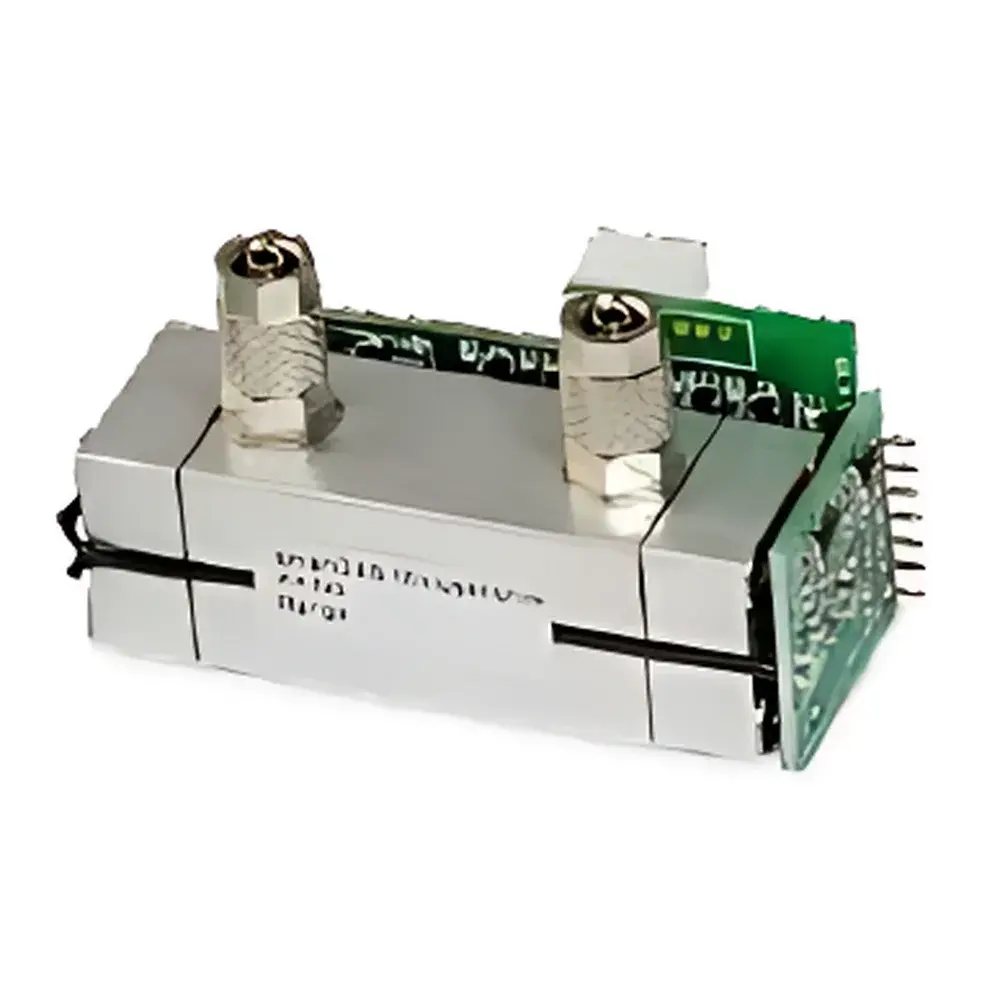
SmartGas沼气多组分红外气体传感器系统
No specifications available.
Overview
The SmartGas Biogas Multi-Component NDIR Gas Sensor System is an industrial-grade, dual-channel infrared (NDIR) gas detection platform engineered for continuous, simultaneous measurement of methane (CH4) and carbon dioxide (CO2) in biogas streams. Based on non-dispersive infrared absorption spectroscopy, the system leverages distinct, non-overlapping absorption bands—CH4 at 3.3 µm and CO2 at 4.26 µm—to ensure cross-interference-free quantification under real-world anaerobic digestion, landfill gas, or upgrading plant conditions. Designed and assembled in Germany, the sensor architecture integrates temperature-stabilized optical paths, dual-beam referencing, and factory-calibrated reference cells to maintain long-term baseline stability. With an operational lifetime exceeding 10 years under typical biogas exposure conditions (including trace H2S and moisture), the system meets the reliability requirements of continuous emissions monitoring systems (CEMS) and process control applications compliant with EN 15267 and ISO 14064-3 frameworks.
Key Features
- Dual independent NDIR channels—separate optical paths and detectors for CH4 and CO2, eliminating spectral cross-sensitivity
- Configurable measurement ranges: CH4 0–100% vol (standard) or 0–50% vol; CO2 0–100% vol (standard) or 0–50% vol—user-selectable via firmware
- Integrated temperature and pressure compensation (0–50 °C, 80–110 kPa) for accurate volumetric concentration reporting
- IP65-rated stainless steel housing with heated sample inlet port (optional) to prevent condensation in high-humidity biogas
- Auto-zero function with internal reference cell and periodic calibration verification capability per ISO 14644-1 recommended intervals
- RS-485 Modbus RTU and 4–20 mA analog outputs for seamless integration into SCADA, DCS, or PLC-based control systems
Sample Compatibility & Compliance
The sensor is validated for use in raw and conditioned biogas containing up to 1,000 ppm H2S, ≤60% relative humidity (non-condensing), and particulate loadings typical of post-scrubber gas streams. It complies with electromagnetic compatibility standards IEC 61326-1 (industrial environment) and safety requirements per ATEX Directive 2014/34/EU (Category 3G, Zone 2, II 3G Ex nA IIB T4 Gc). While not certified as a standalone safety device per IEC 61508 SIL-2, it is qualified for use in safety-related subsystems when integrated with certified logic solvers. Data integrity supports GLP/GMP-aligned workflows through optional audit-trail-enabled firmware (21 CFR Part 11 ready upon configuration).
Software & Data Management
The system interfaces with SmartGas Configuration Suite—a Windows-based commissioning and diagnostics tool supporting firmware updates, span calibration, zero drift tracking, and diagnostic log export (CSV/JSON). Real-time data can be logged locally via optional SD card module or streamed to cloud platforms using MQTT over Ethernet or cellular gateways. All measurement records include embedded timestamps, sensor status flags (e.g., “optical path degraded”, “temperature out-of-spec”), and calibration history metadata—enabling traceability required by environmental regulators including the U.S. EPA Method 2C and EU MRV Regulation (EU) 2015/757.
Applications
- Real-time biogas composition monitoring at anaerobic digesters, wastewater treatment plants, and agricultural co-digestion facilities
- Feedforward control of biogas upgrading units (e.g., amine scrubbing, membrane separation, PSA) based on CH4/CO2 ratio trends
- Landfill gas collection system optimization and fugitive emission quantification per GHG Protocol guidelines
- Validation of gas quality prior to CHP engine injection or grid injection (e.g., meeting EN 16723-1 specifications)
- Research-grade gas composition profiling in pilot-scale AD reactors and microbial ecology studies
FAQ
Does this sensor require periodic field calibration?
Yes—while designed for low drift, annual span calibration against certified gas standards (e.g., NIST-traceable CH4/CO2 in N2) is recommended per ISO 14064-3 verification protocols. Auto-zero cycles occur every 24 hours during normal operation.
Can it operate in explosive atmospheres?
The standard version is rated for Zone 2 (non-hazardous during normal operation); ATEX-certified variants with intrinsic safety barriers are available upon request.
Is moisture compensation built-in?
Yes—the system includes a capacitive humidity sensor and algorithmic correction for water vapor’s effect on IR transmission, validated across 10–95% RH at 25 °C.
What is the warm-up time to full accuracy?
Less than 15 minutes from cold start to meet stated repeatability specifications (±0.5% of reading for CH4, ±0.8% for CO2).
How is long-term stability verified?
Each unit ships with a Certificate of Conformance including initial zero/span test data, and optional annual verification reports can be generated using the onboard diagnostics interface.
Related Products







