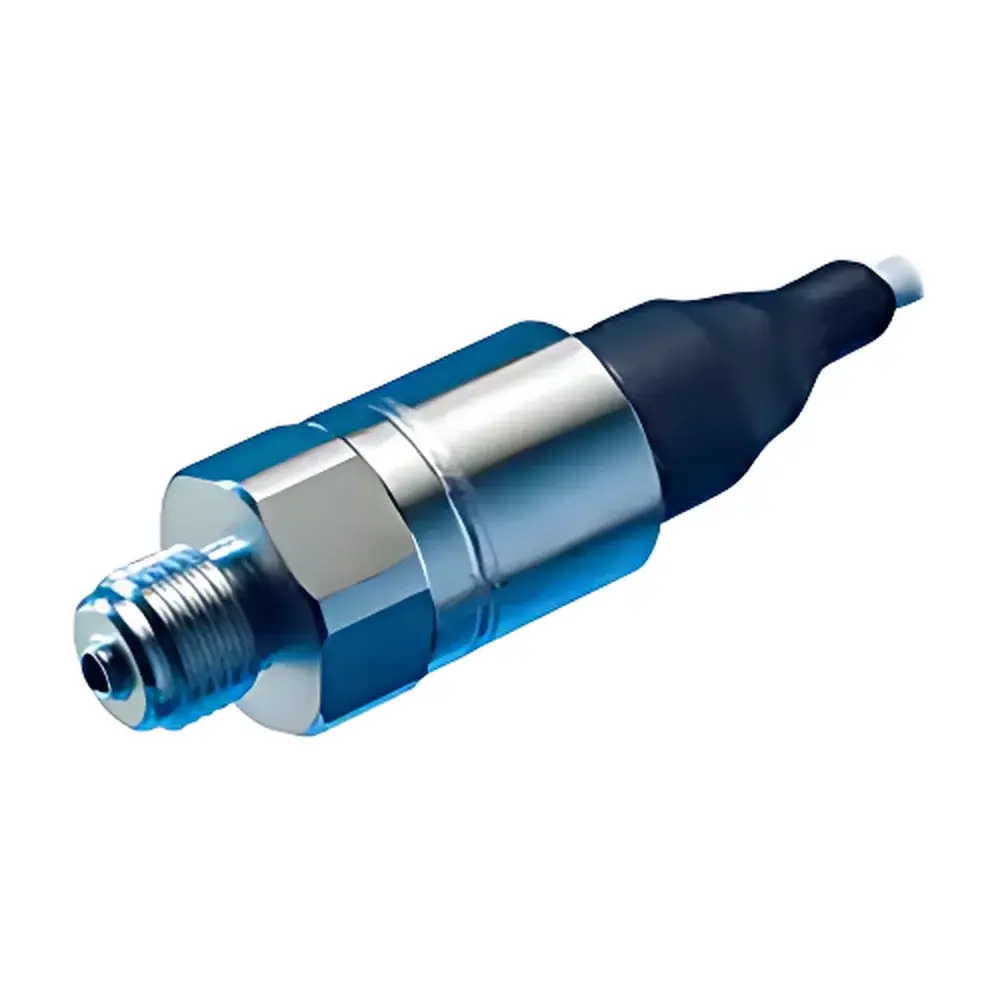
KULITE PHE127 / PHE167 / PHE224 / PHE227 / PHP164 / PHP167 High-Temperature & Corrosion-Resistant Pressure Sensors
| Origin | USA |
|---|---|
| Manufacturer Type | Authorized Distributor |
| Origin Category | Imported |
| Model Series | PHE127, PHE167, PHE224, PHE227, PHP164, PHP167 |
| Output | 0.5–6 VDC (ratiometric or fixed), 4-wire shielded |
| Pressure Ranges | 2–600 bar (absolute, gauge, sealed gauge) |
| Operating Temperature | −55 °C to +150 °C (peak +150 °C) |
| Diaphragm & Housing Material | Grade 5 Titanium (Ti-6Al-4V) or 17-4 PH Stainless Steel |
| Accuracy (Nonlinearity + Hysteresis) | ≤ ±0.25 %FS (standard), ≤ ±0.05 %FS (high-precision PGP variants) |
| Overpressure Limit | 150–300 %FS depending on range |
| Burst Pressure | 200–300 %FS |
| Response Time | ≤ 0.5 ms (PHE127/PHE167), 1–2 ms (PHE224/PHE227/PGP) |
| Electrical Connection | MIL-C-26482 circular connector (optional) or 1 m shielded Viton® cable (4-conductor) |
| IP Rating | IP65 (absolute/sealed gauge), IP50 (vented gauge) |
| Mounting Threads | M5×0.8, M10×1, M14×1.5, 1/4 NPT (male/female options) |
Overview
KULITE high-temperature and corrosion-resistant pressure sensors are engineered for extreme-environment measurement in aerospace propulsion, gas turbine monitoring, chemical process control, and high-pressure combustion research. Based on KULITE’s proprietary silicon-on-insulator (SOI) piezoresistive sensing technology, these transducers integrate a monocrystalline silicon diaphragm directly bonded to a thermally matched titanium or stainless-steel housing—eliminating epoxy or glass frit seals that degrade under thermal cycling or aggressive media. The SOI architecture delivers inherent stability across wide temperature gradients while maintaining high signal-to-noise ratio and long-term repeatability. Unlike conventional thin-film or strain-gauge designs, KULITE’s micromachined sensor elements operate with negligible hysteresis and near-zero creep, making them suitable for dynamic pressure acquisition in transient events such as detonation wave tracking, valve slam analysis, and pulse combustion diagnostics.
Key Features
- Hermetically sealed, all-titanium (Ti-6Al-4V) or 17-4 PH stainless-steel construction ensures compatibility with halogenated solvents, nitric acid, seawater, hydrogen sulfide, and high-purity process gases.
- Extended operating temperature range from −55 °C to +150 °C (with peak capability up to +150 °C for short durations), supported by multi-point thermal compensation algorithms embedded in the signal conditioning circuitry.
- Ratiometric or fixed-output analog interface (0.5–6 VDC) optimized for integration with industrial PLCs, data acquisition systems (e.g., National Instruments PXI), and flight test recorders meeting DO-160 environmental requirements.
- Sub-millisecond dynamic response (≤0.5 ms for PHE127/PHE167 models) enables capture of high-frequency pressure oscillations typical in acoustic resonance studies and unsteady flow phenomena.
- Robust mechanical design with calibrated overpressure and burst ratings—up to 300 %FS for low-range units (<60 bar) and 200 %FS for high-range configurations—ensures operational safety in unpredictable process excursions.
- EMI-hardened 4-wire shielded cabling (Viton® jacket, MIL-STD-202 compliant) and optional MIL-DTL-26482 connectors support deployment in electrically noisy environments including engine test cells and plasma reactors.
Sample Compatibility & Compliance
These sensors are validated for use with all media chemically compatible with Ti-6Al-4V or 17-4 PH stainless steel—including liquid oxygen (LOX), gaseous nitrogen tetroxide (N₂O₄), supercritical CO₂, molten salts, and high-temperature hydrocarbon fuels. Units configured for absolute or sealed-gauge operation meet IP65 ingress protection per IEC 60529, while vented-gauge variants comply with IP50. All models conform to RoHS Directive 2011/65/EU and REACH Regulation (EC) No. 1907/2006. For regulated industries, traceable calibration certificates (NIST-traceable) are available upon request. While not intrinsically safe certified, the low-power DC excitation (8–30 VDC) and absence of internal energy storage make these sensors suitable for Class I, Division 2 hazardous locations when installed per NEC Article 500 guidelines.
Software & Data Management
KULITE sensors interface seamlessly with standard industrial DAQ platforms via analog voltage input channels. Optional KULITE Signal Conditioning Modules (SCMs) provide built-in temperature compensation, linearization, and 24-bit sigma-delta digitization—outputting ASCII or binary data streams compatible with MATLAB, LabVIEW, Python (via PyDAQmx), and custom SCADA architectures. Firmware updates and configuration (e.g., zero offset trim, span adjustment, temperature compensation profile selection) are performed using KULITE’s Windows-based Sensor Configuration Utility (SCU), which supports audit trail logging per FDA 21 CFR Part 11 requirements when deployed in GMP-compliant pharmaceutical or biotech manufacturing environments.
Applications
- Aerospace: Combustion chamber pressure profiling in liquid rocket engines; turbine inlet/outlet monitoring; hypersonic boundary layer transition detection.
- Energy: Downhole pressure sensing in geothermal wells; real-time monitoring of supercritical water oxidation reactors; hydrogen compression system feedback control.
- Chemical & Petrochemical: Catalyst bed pressure drop measurement in exothermic reactors; high-temperature distillation column interface detection; corrosive gas custody transfer metering.
- Research: Shock tube experiments; laser-induced plasma pressure mapping; microfluidic device characterization under thermal stress.
- Automotive: Brake line pressure validation in EV thermal management systems; turbocharger boost dynamics under rapid throttle transients.
FAQ
What is the difference between sealed gauge, vented gauge, and absolute pressure configurations?
Sealed gauge references pressure against a fixed vacuum cavity; vented gauge uses ambient atmospheric pressure via a vent hole; absolute measures against perfect vacuum. Sealed gauge is preferred where atmospheric fluctuations must be excluded (e.g., high-altitude testing), while vented gauge suits open-system applications requiring true atmospheric reference.
Can these sensors be calibrated for non-standard pressure ranges or custom temperature compensation?
Yes—KULITE offers factory-customized calibration across user-specified ranges (e.g., −1 to +5 bar differential) and extended thermal compensation profiles (e.g., −40 °C to +125 °C full-span linearity). Custom calibrations include full uncertainty budgets per ISO/IEC 17025.
Are explosion-proof or ATEX-certified versions available?
Standard models are not ATEX-certified; however, they may be integrated into ATEX-compliant systems using approved intrinsic safety barriers (e.g., Pepperl+Fuchs KFD2-STC4-Ex1) due to their inherently low power consumption and passive output stage.
What is the recommended torque for thread installation to avoid diaphragm distortion?
M5×0.8: 1.5–2.0 N·m | M10×1: 8–10 N·m | M14×1.5: 18–22 N·m. Over-torquing compromises thermal zero stability and may induce permanent zero shift; use calibrated torque wrenches and thread-locking compound only if explicitly approved by KULITE engineering.
Do these sensors require external signal conditioning for basic readout?
No—each sensor includes integrated signal conditioning delivering stable, temperature-compensated voltage output. External amplification is unnecessary unless sub-mV resolution or digital fieldbus (e.g., CANopen, EtherCAT) integration is required—options available via KULITE SCM modules.