
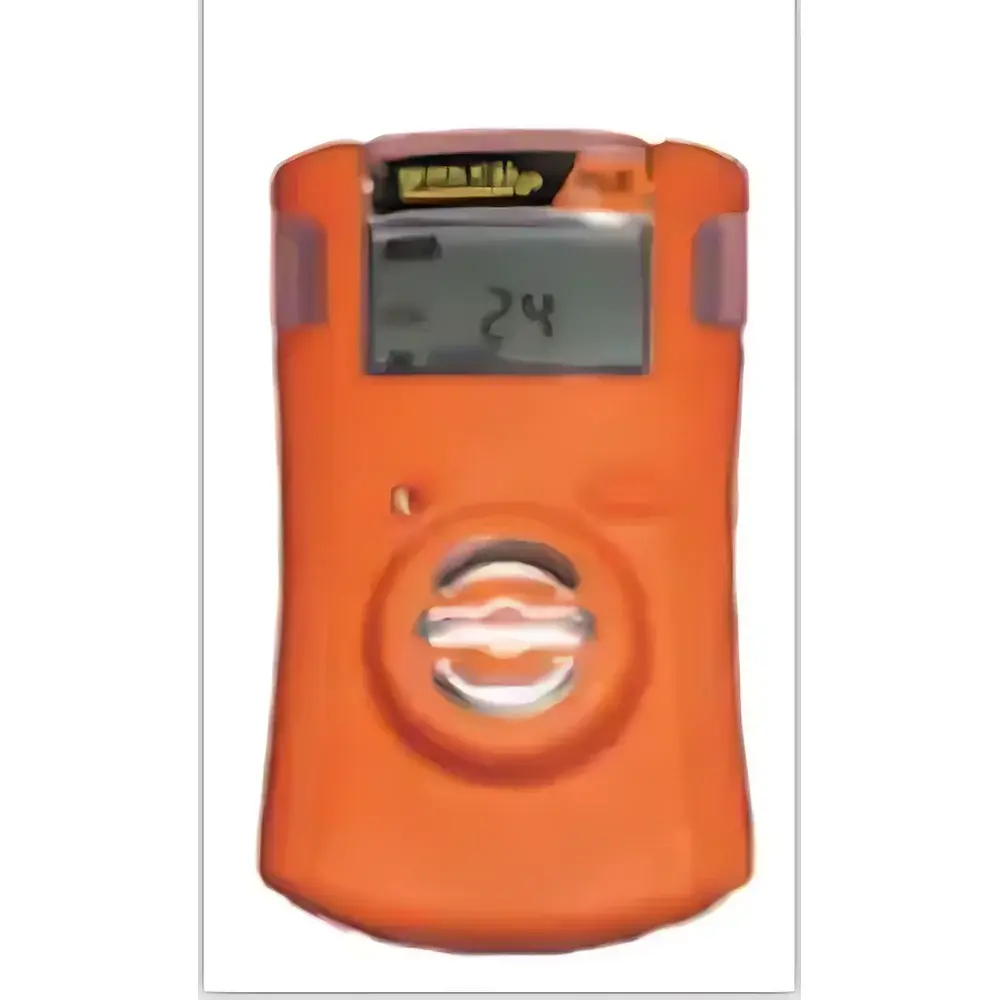
Honeywell PGM-2400 Single-Gas Detector
| Brand | Honeywell |
|---|---|
| Origin | USA |
| Manufacturer Type | Authorized Distributor |
| Origin Category | Imported |
| Model | PGM-2400 |
| Price Range | USD 700 – 1,400 (FOB) |
| Gas Options | H₂S, CO |
| Operating Life | ≥24 months (typical), up to 36 months under optimal conditions |
| Environmental Rating | IP67 |
| Operating Temperature Range | –20 °C to +50 °C |
| Display | Backlit LCD with real-time gas concentration, battery level, and status icons |
| Alarm Types | Visual (LED flash), Vibration, 95 dB audible |
| Calibration Interval | User-configurable |
| Communication | Infrared (IrDA) for event log download and configuration |
| Self-Test | Automatic daily bump test verification |
| Compliance | ATEX II 2G Ex ib IIC T4 Gb, IECEx ib IIC T4 Gb, UL 913 Class I, Div 1, Groups A–D, T4, CSA C22.2 No. 152 |
Overview
The Honeywell PGM-2400 is a certified intrinsically safe, portable single-gas detector engineered for continuous personal exposure monitoring in demanding industrial environments. It operates on electrochemical sensing principles—specifically optimized for hydrogen sulfide (H₂S) and carbon monoxide (CO)—with linear response characteristics traceable to NIST-certified reference standards. Unlike multi-sensor platforms, the PGM-2400 employs a dedicated, factory-calibrated sensor module per gas type, eliminating cross-sensitivity artifacts and ensuring measurement stability over extended deployment cycles. Its design adheres to the fundamental safety philosophy of “fail-safe by default”: all critical functions—including alarm activation, low-battery indication, and end-of-life signaling—are independently verified during power-up and at scheduled intervals via embedded firmware diagnostics. The unit meets international hazardous location requirements for Zone 1/Division 1 classification, enabling deployment across upstream oil & gas facilities, confined space entry operations, wastewater treatment plants, and utility infrastructure maintenance.
Key Features
- Intrinsically safe architecture certified to ATEX, IECEx, UL, and CSA standards for use in explosive atmospheres
- IP67-rated enclosure resistant to dust ingress and temporary submersion (up to 1 m for 30 min)
- Extended service life: nominal 24-month operational warranty with field-proven performance beyond 36 months under controlled storage and usage conditions
- Zero-maintenance operation: no user-serviceable parts; sealed sensor and battery modules eliminate routine calibration or component replacement during rated service life
- Integrated self-test suite including automated daily bump test verification and manual C-Test mode for functional validation against known gas challenges
- Real-time display of gas concentration (ppm), remaining battery capacity (%), operational status, and alarm history indicators
- Infrared (IrDA) interface compliant with IrDA 1.1 specification for secure, cable-free download of event logs, calibration records, and configuration parameters
- Configurable alarm thresholds aligned with OSHA PELs, ACGIH TLVs®, and regional regulatory limits (e.g., EU Directive 2017/164/EU)
Sample Compatibility & Compliance
The PGM-2400 is validated exclusively for H₂S (0–100 ppm range, ±5% reading accuracy) and CO (0–500 ppm range, ±5% reading accuracy) detection. Sensor response time (T90) is ≤30 seconds under standard test conditions (23 °C, 50% RH). Device firmware supports region-specific alarm setpoints—including dual-level alarms (TLV-based warning and STEL-based danger thresholds)—and complies with ISO 4074:2021 (gas detection instrument performance requirements), EN 45544-1:2017 (electrochemical sensors), and IEC 60079-29-1:2016 (gas detector functional safety). All units ship with full traceability documentation, including factory calibration certificates referencing NIST-traceable gas standards and batch-specific sensor characterization data.
Software & Data Management
Data retrieval and device management are performed via Honeywell’s proprietary IRLink software (v3.2+), compatible with Windows 10/11 systems. The infrared interface enables read-only access to time-stamped event logs—including alarm activations, low-battery events, self-test results, and calibration history—with automatic UTC timestamping and audit trail generation. Software enforces role-based access control and supports export to CSV and PDF formats for integration into enterprise EHS management systems. Configuration changes—including alarm thresholds, language selection, and auto-shutdown timing—are restricted to authenticated users with administrative privileges. All firmware updates undergo cryptographic signature verification to ensure integrity and prevent unauthorized modification—supporting compliance with FDA 21 CFR Part 11 electronic record requirements where applicable.
Applications
The PGM-2400 serves as a primary personal monitoring solution in applications requiring reliable, low-intervention gas hazard detection: offshore platform crew monitoring, refinery turnaround support, municipal sewer inspection teams, pipeline right-of-way patrols, and emergency response incident command staging. Its compact form factor (115 × 65 × 32 mm) and clip-on mounting system enable hands-free operation without compromising ergonomics. Field validation studies conducted across North American petrochemical sites demonstrate >99.2% uptime over 18-month deployments, with zero reported false-negative incidents during H₂S exposure events exceeding 10 ppm.
FAQ
What gases does the PGM-2400 detect?
The PGM-2400 is configured for either hydrogen sulfide (H₂S) or carbon monoxide (CO), selected at time of order. Dual-gas capability is not supported.
Is the device suitable for use in freezing temperatures?
Yes—it operates continuously from –20 °C to +50 °C and has been validated for startup functionality at –25 °C following short-term exposure.
Does the PGM-2400 require periodic calibration?
While designed for zero-user-maintenance operation, Honeywell recommends functional verification using a certified bump gas every 30 days in active service environments; full calibration is required only if bump test fails or after sensor exposure to poisoning agents.
How is data retrieved from the instrument?
Via infrared (IrDA) communication using Honeywell IRLink software—no physical connectors or proprietary cables required.
Can the alarm thresholds be customized?
Yes—thresholds are programmable within regulatory limits via IRLink software to align with site-specific safety protocols or jurisdictional exposure limits.
Related Products







