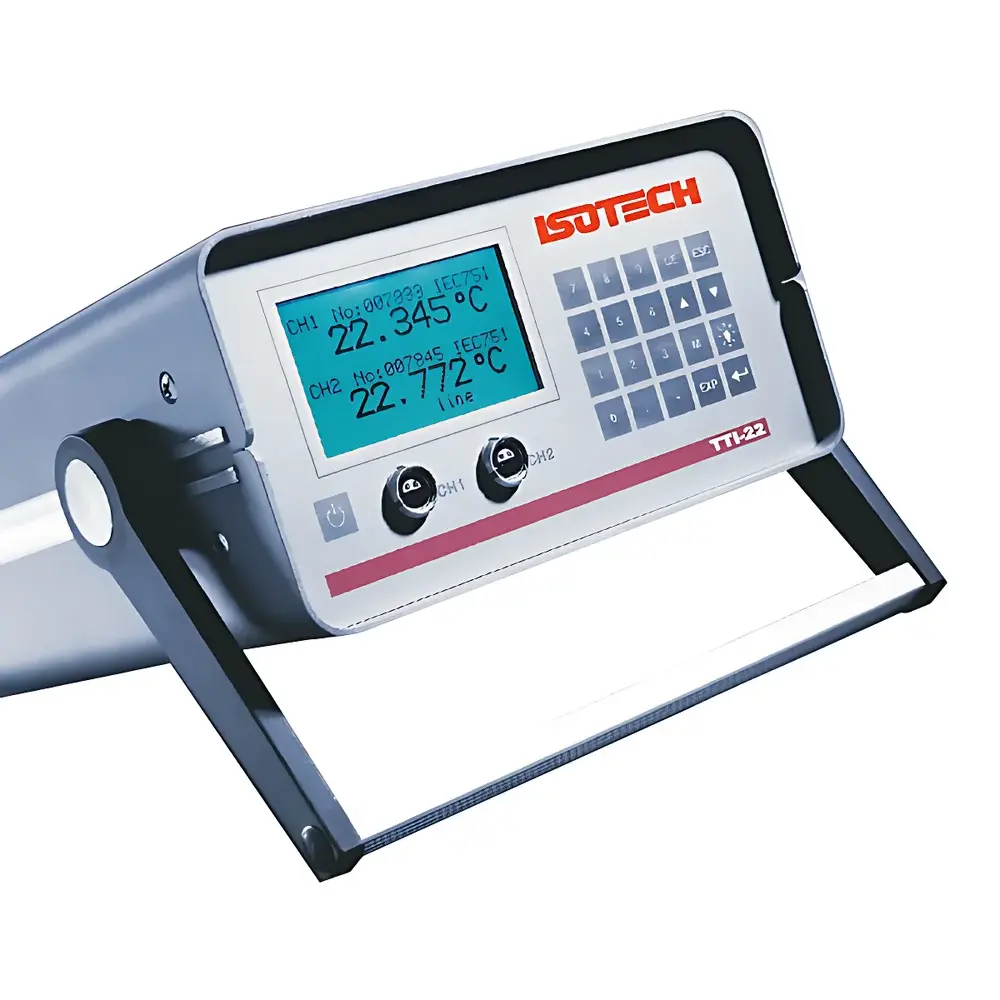
ISOTECH TTI-22 High-Precision Temperature Indicator
| Brand | ISOTECH |
|---|---|
| Origin | United Kingdom |
| Model | TTI-22 |
| Temperature Range | −250 °C to 960 °C |
| Measurement Uncertainty | ≤1 mK (0.001 °C) |
| Resolution | 0.0001 °C |
| Operating Ambient Temperature | 10 °C to 30 °C |
| Power Supply | 1 × AC mains input (100–240 V, 50/60 Hz) |
| Dimensions (W×H×D) | 190 mm × 112 mm × 240 mm |
| Weight | 1.8 kg |
| Sensor Compatibility | Pt25.5, Pt100 (industrial & standard), 4-wire configuration |
| Calibration Storage Capacity | Up to 30 sensor-specific calibration tables |
| Interface | RS232 serial port, Ethernet (TCP/IP), embedded web server |
| Compliance | ITS-90 (for SPRTs), DIN EN 60751 (for industrial Pt100), GLP/GMP-ready data logging with timestamped audit trail |
Overview
The ISOTECH TTI-22 High-Precision Temperature Indicator is a laboratory-grade digital thermometer engineered for metrological traceability and primary-standard-level thermal measurement. Designed around the principles of resistance thermometry, it functions as a precision bridgeless ohmmeter optimized for low-noise, high-stability measurement of platinum resistance temperature detectors (PRTs). Its core architecture supports both industrial Pt100 sensors (per DIN EN 60751) and standard platinum resistance thermometers (SPRTs), including Pt25.5 and Pt100 types referenced to the International Temperature Scale of 1990 (ITS-90). When used with certified SPRTs and appropriate calibration data, the system achieves a total measurement uncertainty of ≤1 mK — meeting requirements for secondary standard laboratories, national metrology institutes (NMIs), and ISO/IEC 17025-accredited calibration facilities. The TTI-22 operates on a four-wire Kelvin sensing principle to eliminate lead resistance errors, and incorporates built-in self-heating compensation via programmable current reversal testing — a critical feature for minimizing measurement bias in low-power PRT applications.
Key Features
- Sub-millikelvin resolution (0.0001 °C) and verified uncertainty of ≤1 mK when paired with calibrated SPRTs
- Dual-channel capability enabling simultaneous monitoring and comparative analysis of two independent temperature sensors
- Integrated self-heating test function with automatic current reversal to quantify and correct for Joule heating effects in PRT elements
- On-device storage for up to 30 unique sensor calibration tables, each supporting polynomial coefficients (ITS-90 or Callendar-Van Dusen) and user-defined metadata
- Intuitive menu-driven interface with real-time display of instantaneous reading, running average, and statistical deviation (standard deviation over 5–50 sample windows)
- Automatic calibration expiry alert based on user-configurable date stamps and traceable certificate lifetimes
- Rugged desktop enclosure (1.8 kg, 190 × 112 × 240 mm) designed for benchtop stability and ESD-safe operation in controlled environments
Sample Compatibility & Compliance
The TTI-22 accepts four-wire PRT inputs exclusively via LEMO FGG.0B.304.CLAD connectors — ensuring mechanical integrity and low-thermal-EMF contact performance. Optional ISOTECH 956 adapter enables compatibility with standard banana, BNC, or spade-terminal sensor leads. It natively interprets resistance-to-temperature conversion using either ITS-90 reference functions (for SPRTs) or DIN EN 60751 coefficients (for industrial Pt100s). All stored calibration data includes full coefficient sets, uncertainty budgets, and traceability documentation per ISO/IEC 17025 Clause 6.5. The instrument supports GLP and GMP workflows through time-stamped, non-editable measurement logs with configurable retention policies — fully compliant with FDA 21 CFR Part 11 requirements when deployed with network authentication and electronic signature modules.
Software & Data Management
Equipped with an embedded TCP/IP stack and HTTP-based web server, the TTI-22 delivers live measurement streams and historical records directly to any standards-compliant browser — eliminating proprietary software dependencies. RS232 output provides ASCII-formatted data packets at user-selectable baud rates (up to 115.2 kbaud) for integration into SCADA, LabVIEW, or custom Python-based acquisition systems. Logged datasets include absolute timestamps (NTP-synchronized via Ethernet), sensor ID, calibration status flag, and raw resistance values — all exportable as CSV or XML. Audit trails record operator login events, parameter changes, calibration uploads, and firmware updates, satisfying ISO 17025 clause 7.10 and EU Annex 11 validation prerequisites.
Applications
- Primary and secondary temperature calibration laboratories performing accredited calibrations of PRTs, thermistors, and thermocouples
- Thermal validation of environmental chambers, autoclaves, and stability incubators per ISO 14644, USP <1033>, and ICH Q5C
- Research metrology involving cryogenic (−250 °C) and high-temperature (up to 960 °C) fixed-point cell characterization
- Process validation and qualification studies requiring documented thermal uniformity mapping with statistical process control (SPC)
- Reference thermometer monitoring in national metrology institute (NMI) intercomparisons and key comparison exercises (KCDB)
FAQ
What types of platinum resistance thermometers does the TTI-22 support?
It supports both standard platinum resistance thermometers (SPRTs) such as Pt25.5 and Pt100, as well as industrial Pt100 sensors conforming to DIN EN 60751 — with automatic selection of ITS-90 or Callendar-Van Dusen algorithms.
How is measurement uncertainty minimized in the TTI-22?
Through four-wire Kelvin sensing, programmable excitation current reversal for self-heating correction, low-drift analog front-end design, and NIST-traceable internal reference resistors calibrated at multiple temperatures.
Can the TTI-22 be integrated into automated calibration management systems?
Yes — via its native Ethernet interface and RESTful web API, it supports direct integration with LIMS, MES, and calibration management platforms compliant with ISO/IEC 17025 and ASTM E2655.
Is the device suitable for use in cleanroom or regulated pharmaceutical environments?
Yes — its firmware supports electronic signatures, audit trails, and role-based access control; when configured with TLS 1.2 encryption and domain-authenticated login, it meets FDA 21 CFR Part 11 and EU GMP Annex 11 requirements.
What accessories are required to connect common laboratory PRTs?
The standard LEMO interface requires the ISOTECH 956 four-wire adapter kit for compatibility with standard banana or spade-terminal PRT leads — included upon request for accredited calibration service contracts.