
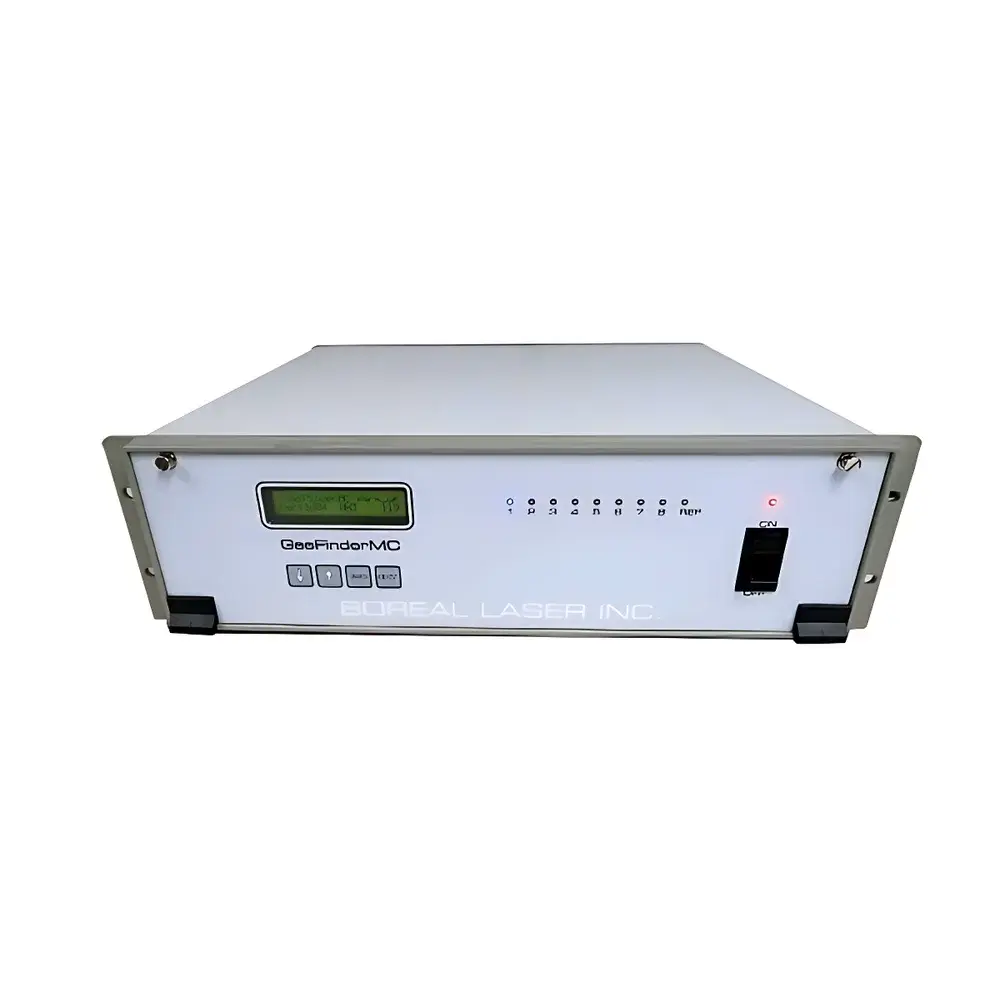
Boreal Laser GasFinderMC Multi-Channel Tunable Diode Laser Absorption Spectroscopy (TDLAS) Gas Analyzer
| Brand | Boreal Laser |
|---|---|
| Origin | Canada |
| Model | GasFinderMC |
| Detection Principle | Tunable Diode Laser Absorption Spectroscopy (TDLAS) |
| Channels | Up to 8 independent optical paths |
| Path Length Range | 1 m to >1000 m (gas-dependent) |
| Laser Safety Class | I or IIIa (ANSI Z136.1, FDA/CDRH compliant) |
| Environmental Rating | IP65 (transmitters), NEMA 4X equivalent |
| Hazardous Area Certification | Class I, Div 1, Groups A/B/C/D |
| Response Time | ≤1 s (typical, configurable) |
| Dynamic Range | 4 decades (10⁴) |
| Output Interfaces | RS-232, RS-485, Modbus RTU, 4–20 mA (optional), dry-contact relays (optional) |
| Operating Temperature | Control Unit: 0°C to 50°C |
| Transmitters | –45°C to +80°C |
| Process-Temperature Tolerance | up to 300°C (probe variants) |
| Power | <1 A @ 110 VAC |
| Weight | Control Unit — 12 kg |
| Dimensions (Control Unit) | 44 cm × 38 cm × 13 cm |
| Dimensions (Open-Path Tx) | 35 cm × 10 cm (L × Ø) |
| Dimensions (Pipe Tx) | 45 cm × 12 cm (L × Ø) |
| Dimensions (Stack Probe) | 25 cm × 12 cm (L × Ø) |
Overview
The Boreal Laser GasFinderMC is a field-deployable, multi-channel tunable diode laser absorption spectroscopy (TDLAS) gas analyzer engineered for continuous, real-time, in-situ monitoring of trace and major gas species across diverse industrial environments. Unlike extractive sampling systems, the GasFinderMC employs direct optical path interrogation—either via open-path, in-stack, or in-pipe configurations—eliminating sample conditioning artifacts, transport delays, and calibration drift associated with gas handling hardware. Its core measurement principle relies on high-resolution, wavelength-modulated absorption spectroscopy at near-infrared (NIR) or mid-infrared (MIR) transitions unique to target analytes (e.g., CH₄, CO, CO₂, NH₃, H₂S, O₂, H₂O, HF). Each channel operates independently with dedicated laser sources, photodetectors, and signal processing firmware, enabling simultaneous quantification of up to eight distinct gas pathways without cross-talk or time-division multiplexing compromises.
Key Features
- True parallel multi-channel architecture: Eight optically isolated measurement paths operate concurrently—no shared optics or sequential scanning.
- Flexible deployment options: Supports open-path (line-of-sight), in-situ pipe-mounted, and hot-stack probe configurations—all rated for harsh ambient and process conditions.
- Hazardous area compliance: Certified for Class I, Div 1, Groups A/B/C/D (UL/cUL) and ATEX/IECEx Zone 1 operation when integrated with optional intrinsically safe isolation barriers.
- Robust environmental resilience: Transmitters rated IP65, with operational capability from –45°C to +80°C ambient; stack probes withstand process temperatures up to 300°C.
- High-fidelity signal integrity: Wavelength modulation spectroscopy (WMS) with second-harmonic detection ensures immunity to dust, fog, window fouling, and background light interference.
- Configurable response dynamics: Default 1-second response time (T₉₀), adjustable down to sub-second for fast transient monitoring or extended averaging for ultra-low detection limits.
- Comprehensive I/O ecosystem: Native support for RS-232, RS-485, Modbus RTU, 4–20 mA analog outputs, and programmable dry-contact relays for alarm or control integration.
Sample Compatibility & Compliance
The GasFinderMC is designed for direct optical sensing—not sample extraction—making it inherently compatible with corrosive, particulate-laden, high-temperature, or high-humidity process streams where traditional extractive analyzers fail. It meets applicable requirements for continuous emissions monitoring (CEM) and safety-critical leak detection under international regulatory frameworks, including EPA Method 21 (VOC leak detection), ISO 14064-1 (GHG verification), and IEC 61511 (functional safety for SIS). All laser modules comply with ANSI Z136.1 and FDA/CDRH Class I or IIIa safety standards. The system supports audit-ready data logging aligned with GLP/GMP principles, and optional firmware enables 21 CFR Part 11-compliant electronic signatures and user-access controls when deployed in regulated pharmaceutical or chemical manufacturing environments.
Software & Data Management
GasFinderMC is managed via Boreal’s proprietary PC-based configuration and visualization software, which provides real-time concentration plots, historical trend overlays, alarm event logging, and diagnostic status monitoring for each channel. Data export is supported in CSV, XML, and OPC UA formats for seamless integration into DCS, SCADA, or MES platforms. Firmware updates are performed over Ethernet or serial link, and remote diagnostics—including laser health metrics, detector signal-to-noise ratio (SNR), and optical alignment feedback—are accessible via secure HTTPS interface. Optional cloud connectivity modules enable encrypted telemetry transmission to centralized asset performance management (APM) dashboards, supporting predictive maintenance scheduling based on optical path degradation trends.
Applications
- Refinery flare gas composition and combustion efficiency monitoring
- Landfill and biogas facility CH₄ and CO₂ fugitive emission mapping
- Chemical plant perimeter fence-line monitoring for toxic or flammable gas leaks (e.g., NH₃, H₂S, HF)
- Cement kiln and power plant stack NOₓ, SO₂, and CO compliance reporting
- Hydrogen production and distribution infrastructure H₂ purity and leak detection
- Pharmaceutical cleanroom ambient monitoring for residual solvents (e.g., IPA, acetone)
- Wastewater treatment plant digester gas quality control and odorant (H₂S) abatement verification
FAQ
What gases can the GasFinderMC measure?
The system is configurable for any gas with accessible, isolated absorption lines in the 760 nm–5 µm spectral range—including but not limited to CH₄, CO, CO₂, NH₃, H₂S, O₂, H₂O, HF, HCl, and C₂H₂. Custom configurations require line strength and interference analysis per application.
Can it operate in explosive atmospheres?
Yes—when equipped with the optional intrinsically safe barrier module, the GasFinderMC meets ATEX II 1G Ex ia IIC T4 Ga and UL Class I, Div 1, Groups A–D certification requirements for installation in Zone 1 / Division 1 hazardous locations.
How is calibration maintained over time?
The system uses fundamental spectroscopic constants and internal reference cells (where applicable); no consumables or span gas cylinders are required. Field verification is performed using certified zero/span gas challenges or known-path-length reference targets, generating traceable calibration reports.
Is remote monitoring supported?
Yes—via Ethernet or modem-connected serial interface, users can access live data, configure thresholds, review event logs, and initiate diagnostics remotely using standard web browsers or Boreal’s desktop application.
What is the maximum optical path length achievable?
Path lengths from 1 meter to over 1000 meters are supported. Maximum usable distance depends on target gas concentration, absorption line strength, atmospheric turbulence, and transmitter/receiver alignment stability—typically validated during site-specific engineering assessment.





