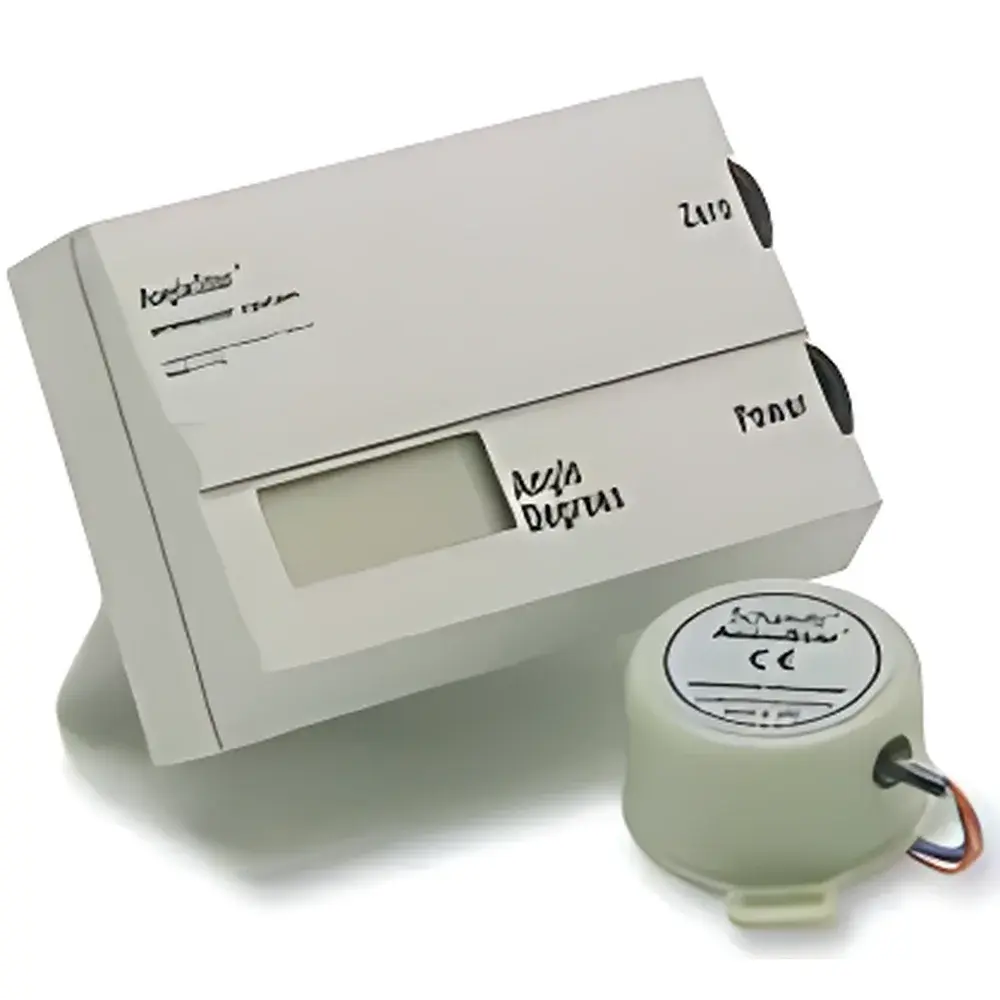
AngleStar® York Instrument Electronic Angle Measurement System
| Brand | York Instrument |
|---|---|
| Origin | USA |
| Manufacturer | York Instrument |
| Type | Imported |
| Model | AngleStar® Series |
| Power Supply | 9 V DC battery (or external DC source) |
| Cable Length | Standard 4 ft (1.2 m), up to 200 ft (61 m) |
| Operating Temperature | –18 °C to 55 °C |
| Linear Range Options | ±20°, ±45°, or 0–90° |
| Resolution | 0.01° (high-res ±20° model) or 0.1° (±45°/0–90° models) |
| Linearity | ±0.1° (0–10°), ±1% of reading (10–45°) |
| Zero Repeatability | ±0.1° |
| Sensitivity Axis Error | <1% below 45° |
| Time Constant | 0.3 s |
| Frequency Response | 0.5 Hz |
| Cable | 4-conductor, AWG 26, PVC jacket |
Overview
The AngleStar® Electronic Angle Measurement System by York Instrument is a precision-engineered inclinometer solution designed for reliable, real-time angular displacement monitoring in industrial, geotechnical, and mechanical applications. Based on MEMS-based capacitive sensing technology, the system operates on the principle of detecting minute changes in capacitance between internal electrodes as gravitational orientation shifts relative to the sensor’s sensitive axis. This enables high-stability analog-to-digital conversion of tilt angle into calibrated digital output displayed on an integrated LCD module. Unlike optical or servo-based systems, the AngleStar® employs solid-state transduction—eliminating moving parts, reducing drift, and ensuring long-term stability across thermal and mechanical stress cycles. Its modular architecture separates the sensing element from the display unit, supporting flexible deployment in constrained or hazardous environments where direct line-of-sight access is impractical.
Key Features
- Modular three-component design: independent MEMS inclinometer sensor, ruggedized LCD display unit, and field-terminable shielded cable
- Extended remote operation: sensor-to-display separation up to 200 ft (61 m) without signal degradation, enabled by low-noise differential signaling over 4-conductor AWG 26 cable
- Three calibrated measurement configurations: ±20° high-resolution mode (0.01° resolution, P/N 02160003-000), ±45° standard linear range (0.1° resolution, P/N 02160001-000), and unidirectional 0–90° vertical alignment mode (0.1° resolution, P/N 02160005-000)
- Thermal robustness: specified performance maintained across –18 °C to +55 °C ambient operating range, with internal temperature compensation algorithms minimizing thermal zero shift
- Low-power architecture: optimized for 9 V alkaline battery operation with typical service life exceeding 1,000 hours; optional external DC input supports continuous-duty integration into powered instrumentation racks
- Fast dynamic response: 0.3 s time constant and 0.5 Hz bandwidth suitable for slow-to-moderate mechanical settling applications, including structural settlement monitoring and platform leveling
Sample Compatibility & Compliance
The AngleStar® system is compatible with rigidly mounted metallic, composite, or concrete substrates requiring non-contact or embedded angular reference. Sensor mounting requires flat, non-flexing surfaces with minimal vibration transmission—recommended fastening via threaded inserts or adhesive bonding per IPC-CC-830B Class 2 guidelines. The device complies with IEC 61000-4-2 (ESD immunity), IEC 61000-4-3 (radiated RF immunity), and meets UL 61010-1 requirements for electrical safety in measurement equipment. While not certified for SIL or ATEX use, its intrinsic design—no internal energy storage beyond battery supply, no spark-prone components—supports deployment in non-classified industrial zones under ISA-TR12.24.01 risk assessment protocols. Calibration traceability follows NIST-traceable procedures per ISO/IEC 17025-accredited internal standards.
Software & Data Management
The AngleStar® operates as a self-contained, firmware-driven instrument with no host PC dependency. All calibration coefficients, linearization tables, and unit conversion parameters are stored in non-volatile memory. Display units feature user-accessible zero-set functionality with lockout option to prevent inadvertent offset adjustment. While the base configuration lacks USB or RS-232 interfaces, optional OEM interface modules (available under separate part numbers) provide ASCII serial output at 9600 baud for integration into SCADA, PLC, or custom data acquisition systems. Audit trails for zero calibration events are retained in volatile memory for the duration of power-on cycle—sufficient for GLP-aligned lab documentation when paired with manual logbook entries. Firmware updates require factory service; no field-upgradable bootloader is implemented to ensure regulatory consistency.
Applications
- Platform and foundation leveling in civil construction and heavy machinery setup, where sub-arcminute repeatability ensures compliance with ASTM E1155 floor flatness tolerances
- Antenna and radar dish alignment in telecommunications infrastructure, leveraging the 0–90° model’s monotonic response for elevation control verification
- Inclinometric monitoring of conveyor belt idler frames, excavator boom geometry, and haul truck body pitch in surface mining operations—deployed per MSHA-recommended static tilt thresholds
- Tooling fixture verification in CNC machining cells, where ±20° high-resolution mode validates workholding angularity against ISO 230-1 geometric accuracy standards
- Geotechnical instrumentation support, including shallow-borehole casing tilt arrays and retaining wall deflection tracking, when integrated with third-party dataloggers via analog output adapters
FAQ
What is the maximum recommended cable length for maintaining measurement integrity?
The system is validated for full specification compliance up to 200 ft (61 m) using factory-supplied 4-conductor AWG 26 PVC-jacketed cable. Longer runs require impedance matching and noise mitigation evaluation.
Can the AngleStar® be used in outdoor environments exposed to rain or dust?
The sensor housing meets IP65 rating for dust ingress protection and water jet resistance; however, the display unit is rated IP54 and requires sheltered mounting or optional NEMA 4X enclosure.
Is factory recalibration required after mechanical shock or thermal cycling?
Zero repeatability remains within ±0.1° following shocks up to 50 g (per MIL-STD-810G Method 516.6); recalibration is recommended only if zero drift exceeds this threshold or after repair.
Does the system support metric angular units (e.g., radians or gon)?
Display is fixed to degrees (°) only; no onboard unit conversion is implemented. External software parsing of serial output may apply user-defined scaling.
Are replacement batteries user-serviceable without voiding calibration?
Yes—the 9 V battery compartment is accessible without tools and does not affect internal calibration memory or sensor alignment.