
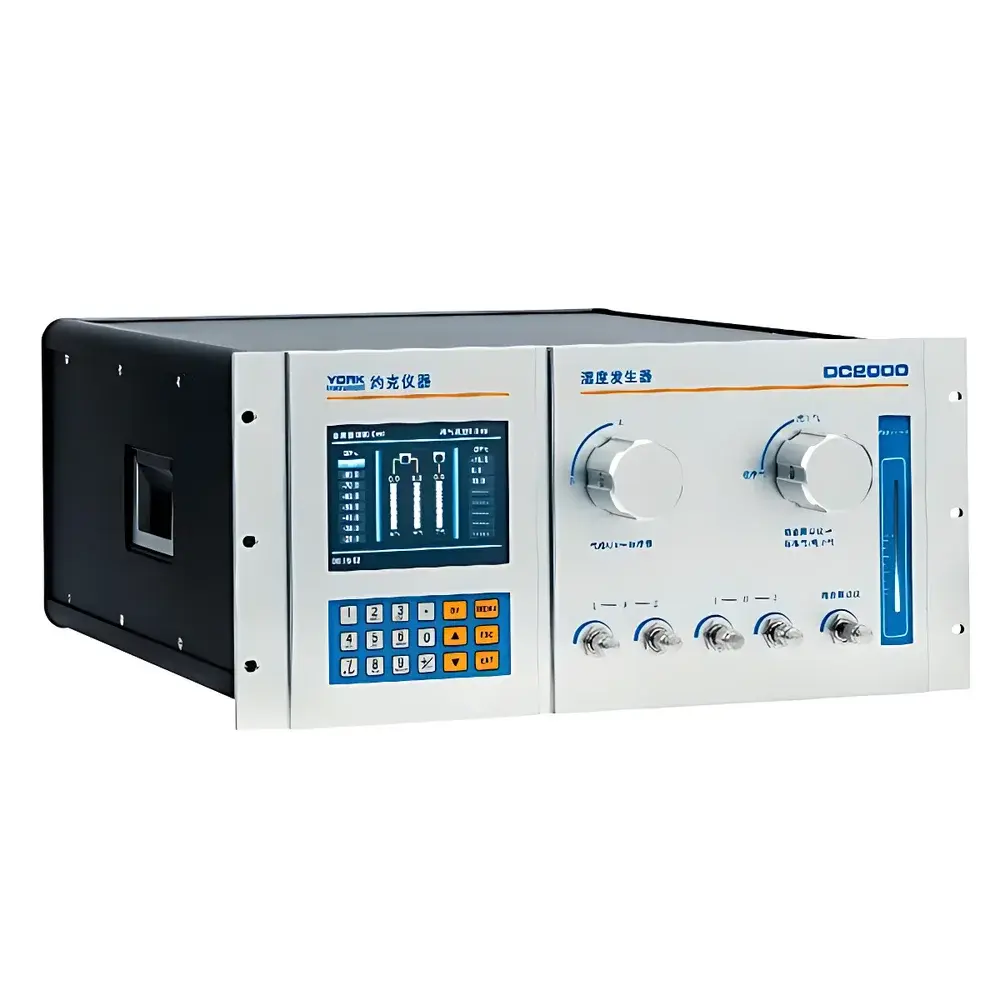
PhyMetrix DC2000 Low-Humidity Gas Generator
| Brand | PhyMetrix |
|---|---|
| Origin | USA |
| Model | DC2000 |
| Principle | Split-Flow Method |
| Dew Point Range | –80 °C to 0 °C DP |
| Accuracy | ±0.2 °C DP |
| Repeatability | ±0.2 °C DP |
| Stability | ±0.05 °C DP |
| Response Time | <2 min |
| Operating Temperature | 5–40 °C |
| Storage Temperature | –40–50 °C |
| Output Ports | 3 (1 reference + 2 working), 1/4″ 316 stainless steel VCR fittings |
| Adjustable Flow Rate | 0–5 L/min |
| Supply Pressure | 0.4–1.0 MPa |
| Dimensions (W×D×H) | 485×500×260 mm |
| Weight | 20 kg |
| Display | 5.6″ full-color LCD |
| Front Panel | 19″ or 21″ rack-mount compatible |
Overview
The PhyMetrix DC2000 Low-Humidity Gas Generator is an engineered calibration source designed for the precise, traceable generation of dry gas standards with controlled dew point values across a wide operational range (–80 °C to 0 °C DP). It employs a split-flow mixing methodology—where ultra-dry carrier gas (e.g., nitrogen or compressed air pre-dried to < –70 °C DP) is metered and combined with a precisely regulated micro-dose of moisture-saturated gas—to achieve thermodynamically stable, low-humidity output streams. This principle ensures high metrological integrity and eliminates reliance on chilled-mirror or permeation-based methods that suffer from hysteresis, slow equilibration, or temperature-dependent bias. The DC2000 is purpose-built for primary and secondary calibration laboratories, ISO/IEC 17025-accredited facilities, and industrial QA/QC environments requiring repeatable, auditable humidity references for sensor validation, instrument verification, and process control system commissioning.
Key Features
- Triple independent gas outputs: one dedicated reference port for direct connection to reference hygrometers (e.g., chilled-mirror dew point analyzers), plus two parallel working ports for simultaneous sensor testing or chamber conditioning.
- Multi-stage high-accuracy mass flow controllers (MFCs) with digital feedback loops ensure stoichiometric mixing fidelity and long-term drift stability—critical for maintaining ±0.2 °C DP accuracy under varying supply pressure and ambient conditions.
- Integrated pressure buffer vessel minimizes transient fluctuations in flow and dew point, enabling stable output even during upstream pressure variations or rapid setpoint changes.
- Full-digital front-panel interface with 5.6″ color TFT display provides real-time visualization of all operational parameters—including actual vs. setpoint dew point, individual MFC readings, supply pressure, and system status diagnostics.
- Rack-mountable 19″ or 21″ standard front panel facilitates seamless integration into automated calibration workstations, environmental test enclosures, or centralized gas distribution systems.
- Each output channel features a precision needle valve and inline flowmeter, allowing independent fine-tuning of volumetric flow (0–5 L/min) without cross-channel interference or recalibration.
Sample Compatibility & Compliance
The DC2000 accepts compressed air or inert gases (N₂, Ar, He) as input, provided the source dew point is ≤ –70 °C DP at the specified inlet pressure (0.4–1.0 MPa). It is compatible with all common humidity sensing technologies—including capacitance, aluminum oxide, quartz crystal microbalance (QCM), and chilled-mirror hygrometers—making it suitable for verifying sensors compliant with ISO 8503-2, ASTM E2207, and IEC 60751. The unit’s hardware architecture and firmware support GLP/GMP-aligned operation: audit trails are maintained for all parameter changes, setpoint modifications, and calibration events. Optional firmware upgrades enable 21 CFR Part 11-compliant electronic signatures and user-role-based access control—essential for pharmaceutical, aerospace, and medical device manufacturing environments subject to FDA or EU Annex 11 requirements.
Software & Data Management
While the DC2000 operates autonomously via its embedded controller, optional Ethernet or RS-232 connectivity enables remote monitoring and scripting via SCPI-compatible commands. Integration-ready drivers are available for LabVIEW, MATLAB, and Python (PyVISA), supporting automated calibration sequences and data logging synchronized with DUT (Device Under Test) acquisition. All generated dew point values, timestamps, flow rates, and system health metrics are timestamped and exportable in CSV format. Internal non-volatile memory retains ≥10,000 data points with time-stamped event logs—including power cycles, alarm triggers, and manual overrides—for full traceability in accredited laboratory audits.
Applications
- Primary calibration of chilled-mirror dew point analyzers, capacitive humidity transmitters, and polymer-film sensors against NIST-traceable references.
- Validation of environmental test chambers, dry boxes, and glovebox purge systems operating below –40 °C DP.
- Performance verification of moisture analyzers used in semiconductor fab cleanrooms and lithium-ion battery dry rooms.
- Supporting ISO 17025 clause 6.4.10 (Reference Materials) by providing documented, uncertainty-quantified humidity standards for internal method validation.
- Research applications in atmospheric science, cryogenic material storage, and vacuum drying process development where sub-zero dew point reproducibility is critical.
FAQ
What minimum inlet gas dryness is required for the DC2000 to achieve –80 °C DP output?
A supply gas dew point of ≤ –70 °C DP is mandatory; performance at the lower end of the range depends on consistent inlet dryness and pressure stability.
Can the DC2000 generate humidity levels above 0 °C DP?
No—the DC2000 is optimized exclusively for low-humidity generation (–80 to 0 °C DP); for higher RH or positive dew point ranges, PhyMetrix recommends the HC3000 series humidity generator.
Is the unit suitable for use in Class 100 cleanrooms?
Yes—the stainless steel wetted parts (316 SS VCR fittings), particle-free internal flow path, and absence of lubricants or outgassing polymers meet ISO 14644-1 Class 5 (Class 100) compatibility requirements.
Does the DC2000 require annual recalibration?
Per ISO/IEC 17025:2017 Clause 6.5.2, users must verify metrological performance at intervals defined by risk assessment; typical practice is semi-annual verification using a NIST-traceable chilled-mirror reference.
How is traceability established for the generated dew point values?
Traceability derives from factory calibration against NIST-traceable primary standards, with documented measurement uncertainty budgets (k=2) supplied in the Certificate of Calibration included with each unit.



