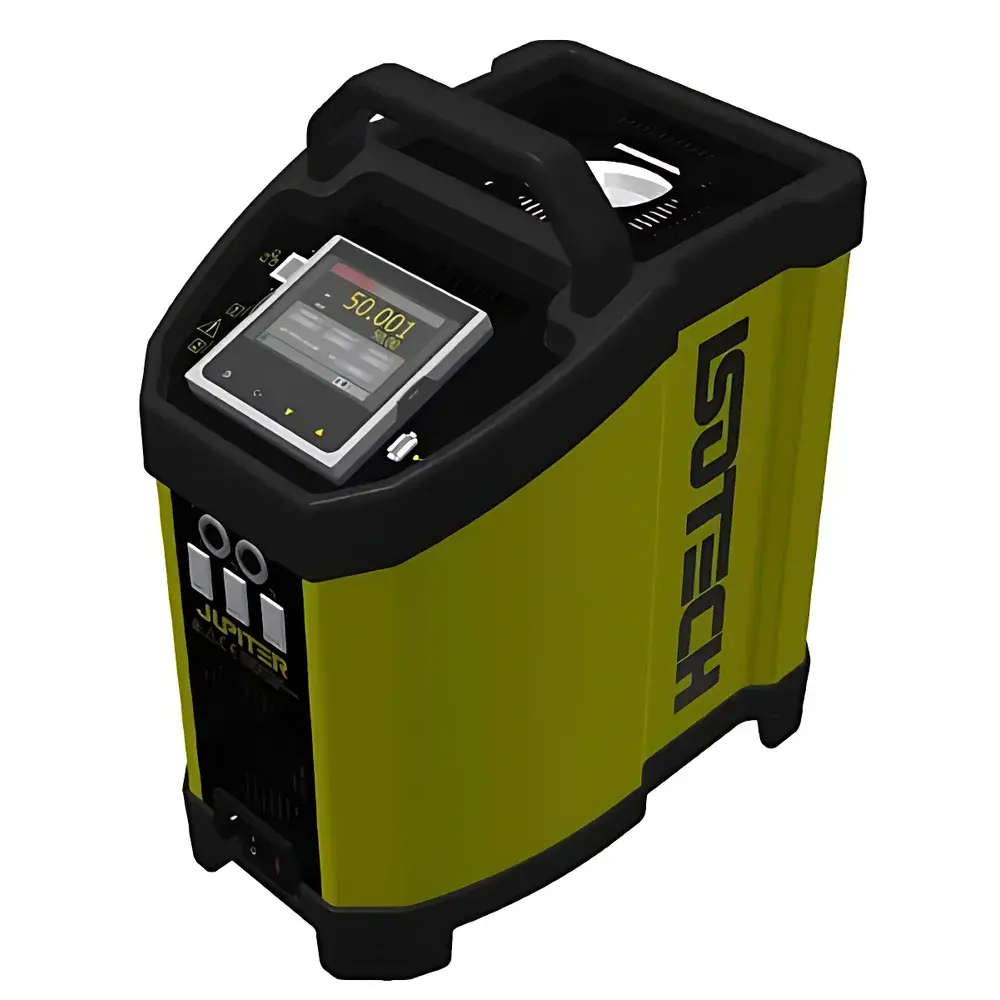
ISOTECH Jupiter 4852 Multi-Function Dry-Block Calibrator
| Brand | ISOTECH |
|---|---|
| Origin | USA |
| Model | Jupiter 4852 |
| Temperature Range | 35°C to 660°C |
| Stability | ±0.015°C @ 100°C, ±0.025°C @ 650°C |
| Temperature Resolution | 0.01°C (30–99.99°C), 0.1°C (other ranges) |
| Heating Time | <20 min (30°C to 650°C) |
| Cooling Time | <60 min (650°C to 150°C) |
| Calibration Well Dimensions | Ø35 mm × 148 mm depth |
| Well Insert Configuration | 6-hole standard block (2×Ø4.5 mm, 2×Ø6.4 mm, 1×Ø8.0 mm, 1×Ø9.5 mm |
| Display Units | °C, °F, K, %RH (via optional humidity module) |
| Input Channels | Dual sensor inputs + reference input |
| Thermocouple Support | E, J, K, N, R, S, T |
| RTD Support | Pt100, Pt1000 (2-/3-/4-wire) |
| Process Input | 4–20 mA (isolated) |
| CJC Accuracy | ±0.35°C |
| Power Supply | 220 VAC, 50/60 Hz, 1000 W |
| Dimensions (H×W×D) | 384 × 212 × 312 mm |
| Weight | 8.5 kg |
| Compliance | ASTM E2877, ISO/IEC 17025 (when used with accredited procedures), NIST-traceable calibration capability |
Overview
The ISOTECH Jupiter 4852 is a high-performance, multi-function dry-block calibrator engineered for precision temperature verification and calibration across laboratory, manufacturing, and field service environments. Utilizing a thermally optimized aluminum heating block with integrated PID-controlled solid-state heating elements and forced-air assisted cooling, the Jupiter 4852 delivers rapid thermal response and exceptional stability over its full operating range of 35°C to 660°C. Its design adheres to fundamental metrological principles—achieving traceability through internal reference sensors calibrated against NIST-traceable standards—and supports both primary calibration (e.g., thermocouple and RTD probe verification) and secondary process instrument validation (e.g., transmitters, controllers, and data loggers). The unit operates as a self-contained thermal source with no requirement for external fluid media, eliminating risks associated with oil degradation, evaporation, or contamination—making it ideal for cleanroom applications, pharmaceutical QC labs, and aerospace component testing where repeatability and environmental control are critical.
Key Features
- Triple-input measurement architecture: Simultaneous monitoring of two DUTs (Device Under Test) and one reference sensor enables real-time comparison and deviation analysis without manual switching.
- High-stability thermal block with ±0.015°C stability at 100°C and ±0.025°C at 650°C—validated per ASTM E2877 Annex A3 for dry-well performance assessment.
- Programmable temperature cycling: Up to 10 user-defined setpoints with dwell times, ramp rates, and auto-logging—fully configurable via front-panel interface or remote software.
- Integrated 4–20 mA process signal measurement with loop power supply and sink/source capability, supporting HART-compatible diagnostics when paired with optional communication modules.
- Modular well insert system: Standard 6-hole block accommodates common probe diameters (Ø4.5 mm, Ø6.4 mm, Ø8.0 mm, Ø9.5 mm); inserts are interchangeable and certified for axial uniformity (±0.05°C gradient over 60 mm depth).
- Network-enabled operation: Ethernet port supports B/S (Browser/Server) architecture—enabling live status monitoring, remote configuration, and secure data export from any web-enabled device (PC, tablet, smartphone) without client installation.
Sample Compatibility & Compliance
The Jupiter 4852 is compatible with a broad spectrum of temperature sensing elements including base-metal and noble-metal thermocouples (E, J, K, N, R, S, T), platinum resistance thermometers (Pt100, Pt1000 in 2-, 3-, and 4-wire configurations), and industrial process transmitters. Its well geometry (Ø35 mm × 148 mm depth) ensures adequate immersion depth per ISO 5170-1 and ASTM E740 requirements—minimum immersion of 15 × probe diameter or 75 mm, whichever is greater. For compliance-driven environments, the instrument supports audit-ready documentation: timestamped calibration logs include operator ID, ambient conditions, DUT identification, reference uncertainty, and pass/fail status per user-defined tolerance limits. When operated under documented SOPs, the system meets technical requirements for ISO/IEC 17025 accreditation and aligns with FDA 21 CFR Part 11 expectations for electronic records (with optional digital signature and audit trail enablement via firmware update).
Software & Data Management
The Jupiter 4852 ships with ISOTECH CalSoft™ Lite—a Windows-based calibration management application that supports automated report generation (PDF/CSV), uncertainty budgeting per GUM (Guide to the Expression of Uncertainty in Measurement), and integration with LIMS via ODBC-compliant database export. All calibration sessions are stored locally on the instrument’s internal flash memory (16 GB) with automatic backup to USB drives. Remote access via HTTPS-secured web interface allows authorized users to initiate calibrations, review historical trends, and export raw time-series data (temperature vs. time, deviation plots, statistical summaries) directly to Excel or MATLAB-compatible formats. Firmware updates are delivered over-the-air and include version-controlled release notes compliant with IEC 62304 software lifecycle requirements.
Applications
- Primary calibration of RTDs and thermocouples in metrology laboratories accredited to ISO/IEC 17025.
- Field verification of temperature sensors in HVAC commissioning, food processing lines, and sterile manufacturing suites (Grade A/B cleanrooms).
- Validation of temperature-controlled equipment including autoclaves, incubators, ovens, and stability chambers per ICH Q5C and USP .
- Production line QA/QC for thermocouple assemblies, transmitter loops, and safety-critical shutdown systems requiring SIL2-compliant test evidence.
- Educational use in engineering curricula covering thermal metrology, sensor physics, and closed-loop control theory.
FAQ
What is the minimum immersion depth required for accurate calibration using the Jupiter 4852?
Per ISO 5170-1, minimum immersion is defined as the greater of 15 × probe diameter or 75 mm. The standard well depth of 148 mm satisfies this for probes up to Ø9.5 mm.
Can the Jupiter 4852 perform simultaneous calibration of multiple probe types (e.g., K-type thermocouple and Pt100) in one cycle?
Yes—the triple-input architecture and independent channel configuration allow concurrent measurement and comparison of mixed sensor types, provided appropriate input modules are selected and configured.
Is the unit suitable for use in hazardous locations?
No—the Jupiter 4852 is rated for general-purpose indoor use (IP20) and does not carry ATEX, IECEx, or UL Class I Div 1 certification.
Does the instrument support external reference thermometer connection for enhanced uncertainty performance?
Yes—via the dedicated reference input channel, which accepts ITS-90 compliant PRTs with 0.001 Ω resolution and supports external 4-wire RTD connections with automatic lead compensation.
How is traceability maintained during routine operation?
Each unit ships with a NIST-traceable calibration certificate (including as-found/as-left data). Internal reference sensors are re-certified annually; users may perform intermediate checks using certified reference standards and document results within CalSoft™ Lite’s audit trail framework.