
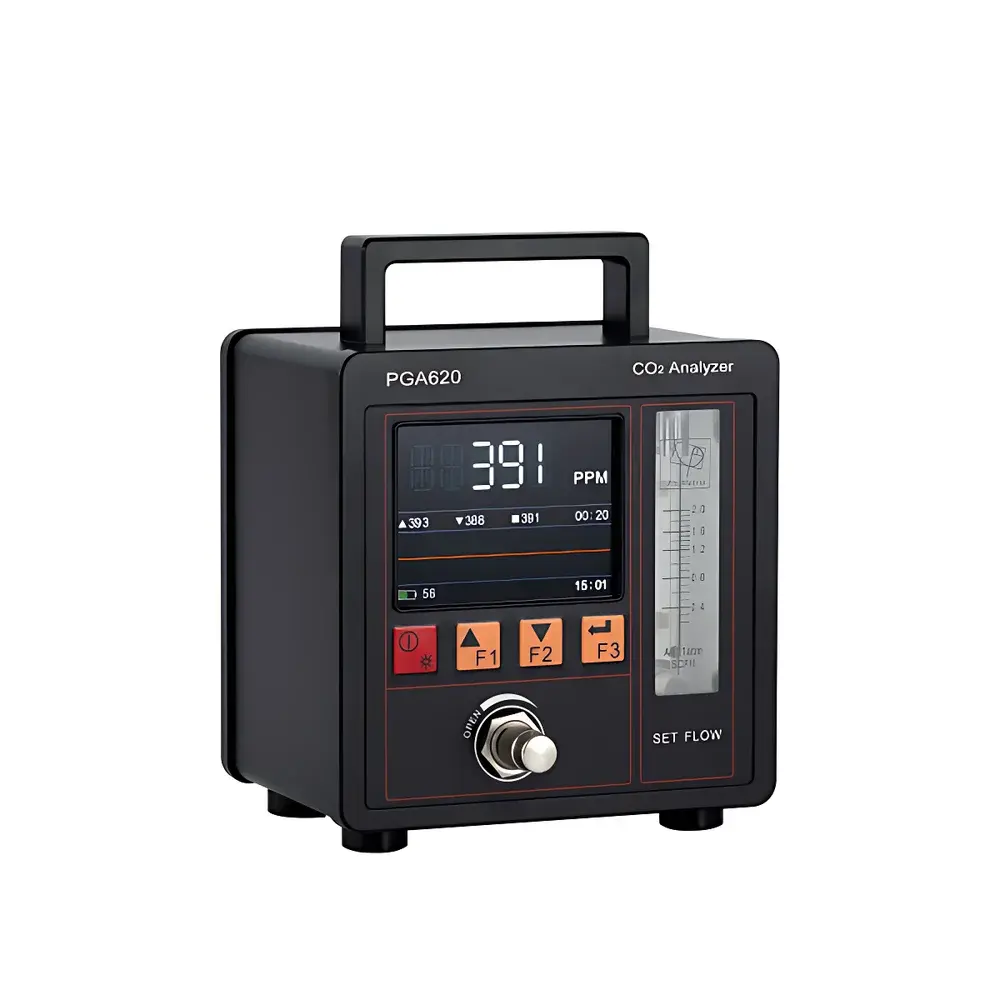
PhyMetrix PGA620 Portable NDIR Carbon Dioxide Analyzer
| Brand | PhyMetrix |
|---|---|
| Origin | USA |
| Model | PGA620 |
| Instrument Type | Portable |
| Detection Target | Single-component (CO₂) |
| Repeatability | ≤ ±1% FS |
| Resolution | 0.1 ppm or 0.01% |
| Response Time | T90 ≈ 0.15 s (@ 1 SCFH) |
| Linearity Error | ≤ ±2% FS (excluding calibration gas uncertainty) |
| Measurement Principle | Non-Dispersive Infrared (NDIR) |
| Range Options | 0–5000 ppm, 0–5%, 0–20%, 0–100% CO₂ |
| Zero Drift | ±2% FS |
| Operating Temperature | 0–45 °C |
| Power Supply | Rechargeable Li-ion battery |
| Interface | USB Type-C |
| Data Storage Capacity | Up to 10,000 records with timestamped logging |
| Housing Material | Anodized magnesium-aluminum alloy |
| Dimensions | 180 × 142 × 146 mm (H × W × D) |
| Weight | 2.1 kg |
| Inlet Fitting | 1/8" compression fitting |
| Compliance | GB/T 23938–2009 (High-Purity CO₂), GB 10621–2006 (Food-Grade Liquid CO₂) |
Overview
The PhyMetrix PGA620 Portable NDIR Carbon Dioxide Analyzer is an engineered solution for field-deployable, high-fidelity CO₂ concentration measurement across environmental monitoring, industrial hygiene, fermentation control, greenhouse management, and indoor air quality (IAQ) assessment applications. Built upon dual-beam non-dispersive infrared (NDIR) photometry, the PGA620 eliminates optical drift through real-time reference channel compensation—ensuring stable baseline performance over extended operational cycles without frequent zeroing. Its microcontroller-based signal processing architecture integrates temperature and pressure compensation algorithms, enabling accurate gas concentration calculation across variable ambient conditions. Unlike electrochemical or metal-oxide semiconductor sensors, the NDIR core provides inherent selectivity for CO₂, with negligible cross-sensitivity to common interferents such as CO, CH₄, H₂O vapor (within specified humidity limits), and VOCs—making it suitable for regulatory-grade spot checks and process validation in compliance-sensitive environments.
Key Features
- Ultra-fast response: T90 ≤ 0.15 seconds at 1 standard cubic foot per hour (SCFH) flow rate—optimized for dynamic sampling scenarios including stack monitoring and leak detection.
- Multi-range configurability: User-selectable full-scale ranges (0–5000 ppm, 0–5%, 0–20%, 0–100%) support both trace-level atmospheric monitoring and high-concentration industrial process streams.
- High-resolution display: 3.5-inch backlit LCD with graphical interface supports real-time trend curves, arithmetic delta calculations, rolling averages, and intuitive menu navigation.
- Rugged portable design: Magnesium-aluminum alloy chassis with colored anodized finish delivers mechanical durability, EMI shielding, and thermal stability—certified for operation from 0 to +45 °C.
- Onboard data integrity: Internal flash memory stores up to 10,000 timestamped readings with configurable logging intervals; USB Type-C port enables bulk export and firmware updates.
- Modular expandability: Optional accessories include integrated sample pump, heated Nafion™ dryer module, pressure/temperature transducers, portable thermal printer, and PC-based data management software with audit trail capability.
Sample Compatibility & Compliance
The PGA620 is validated for direct analysis of dry or moderately humid (non-condensing) gas streams. For applications involving particulate-laden, corrosive, or saturated samples, integration with a certified gas pre-treatment unit—including particle filtration, condensate trap, and optional permeation dryer—is recommended. The analyzer meets metrological requirements outlined in GB/T 23938–2009 (for high-purity carbon dioxide verification) and GB 10621–2006 (for food-grade liquid CO₂ purity assessment). While not intrinsically rated for hazardous locations, its low-power architecture and sealed housing comply with IEC 61000-4 electromagnetic compatibility standards. When used with traceable calibration gases and documented SOPs, data generated by the PGA620 supports GLP-aligned reporting and can be incorporated into ISO 17025-accredited laboratory workflows.
Software & Data Management
The bundled PC software provides secure configuration, calibration management, and post-acquisition analysis. It supports user-defined report templates, CSV/Excel export, and time-series visualization with statistical overlays (min/max/mean/stdev). Audit trail functionality records all parameter changes, calibration events, and user logins—enabling alignment with FDA 21 CFR Part 11 requirements when deployed in regulated manufacturing settings. Firmware updates are delivered via signed binary packages to ensure cryptographic integrity. All stored datasets retain embedded metadata including sensor serial number, calibration date, ambient temperature/pressure, and operator ID—facilitating traceability across multi-site deployments.
Applications
- Indoor Air Quality (IAQ) audits per ASHRAE Standard 62.1 and EN 13779
- Verification of CO₂ scrubber efficiency in closed-loop life support systems
- Real-time monitoring of fermentation headspace in biopharmaceutical and beverage production
- Leak detection and emissions quantification in refrigeration and fire suppression systems
- Calibration verification of fixed-mount CO₂ monitors in HVAC control networks
- Field validation of soil respiration fluxes in ecological research (with compatible soil probe interface)
FAQ
What calibration gases are required for routine operation?
Certified CO₂/N₂ mixtures traceable to NIST SRMs are recommended; typical concentrations include 1000 ppm and 50% CO₂ for two-point calibration across mid- and high-range spans.
Can the PGA620 measure CO₂ in high-humidity environments?
Yes—when paired with the optional Nafion™ membrane dryer or chilled mirror dew point controller, the instrument maintains accuracy up to 95% RH at 25 °C.
Is the internal battery replaceable in the field?
No—the rechargeable lithium-ion pack is sealed and service-replaceable only by authorized PhyMetrix technical centers to preserve IP65 ingress protection and calibration integrity.
Does the device support analog output or Modbus communication?
Not natively; however, the USB Type-C interface supports virtual COM port emulation for integration with SCADA systems via third-party protocol converters.
How often should zero and span calibration be performed?
Under normal use, zero calibration every 24 hours and span calibration every 7 days is advised; frequency increases under extreme temperature cycling or exposure to high-concentration CO₂ pulses.







