
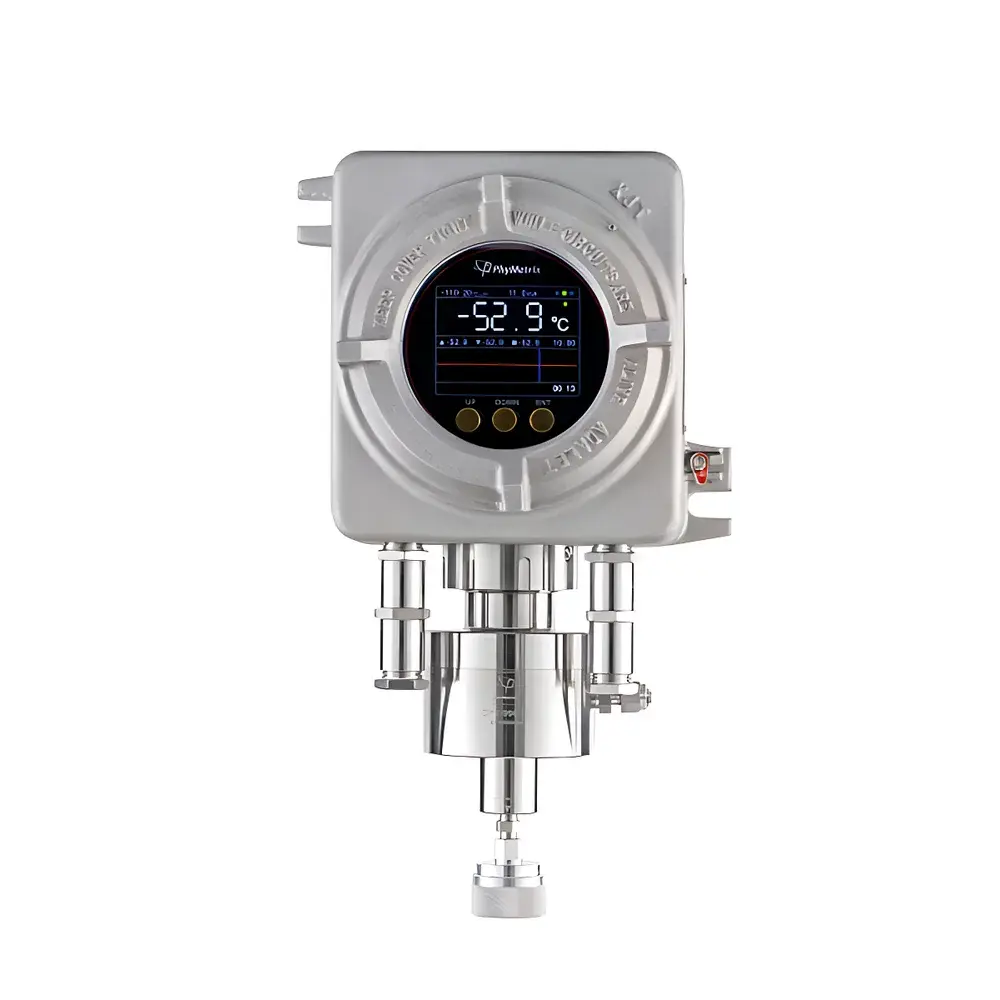
PhyMetrix DPT-990EX Intrinsically Safe Online Dew Point Analyzer
| Brand | PhyMetrix |
|---|---|
| Origin | USA |
| Model | DPT-990EX |
| Product Type | Online Dew Point Meter |
| Measurement Principle | Chilled-Mirror–Based Electrochemical Metal Oxide Sensor (Nanoporous Metal Oxide Film) |
| Operating Temperature Range | −110 °C to +20 °C (Dew Point) |
| Ambient Operating Temperature | −20 °C to +60 °C |
| Accuracy | ±1 °C |
| Repeatability | ±1 °C |
| Enclosure Rating | IP65 |
| Power Supply | 90–260 VAC (47–63 Hz) or 12–24 VDC (10 VA) |
| Output Signal | 4–20 mA HART-enabled analog output |
| Pressure Limit | ≤68 bar (gauge) |
| Sample Flow Rate | >1 NL/min |
| Certification | FM/CSA Class I, Div 1, Groups B, C, D |
Overview
The PhyMetrix DPT-990EX is an intrinsically safe, online dew point analyzer engineered for continuous, high-integrity moisture monitoring in hazardous industrial environments. It employs a proprietary nanoporous metal oxide thin-film sensor—developed and manufactured in the United States—that operates on a stabilized electrochemical principle calibrated against the thermodynamic dew point reference. Unlike conventional capacitive or aluminum oxide sensors, this sensor exhibits minimal hysteresis, negligible drift over extended operation, and immunity to condensate poisoning or hydrocarbon contamination. Its measurement range spans −110 °C to +20 °C dew point, making it suitable for ultra-dry gas applications such as instrument air drying, SF6 insulation gas monitoring in high-voltage switchgear, hydrogen purity verification, natural gas pipeline dehydration, and nitrogen blanketing systems in pharmaceutical and petrochemical process lines.
Key Features
- Intrinsically safe design certified to FM/CSA Class I, Division 1, Groups B, C, D and ATEX II 1G Ex ia IIC T4 Ga—fully compliant with IEC 60079-11 and ANSI/ISA-12.12.01 standards.
- Nanoporous metal oxide sensing element with in-situ thermal stabilization, delivering long-term baseline stability (<0.1 °C/year typical drift) and rapid response (T90 < 60 s across full range).
- Robust 316 stainless steel housing rated IP65, optimized for space-constrained installations (216 × 145 × 120 mm, 2.5 kg).
- Dual power input flexibility: universal AC (90–260 VAC, 47–63 Hz) or low-voltage DC (12–24 VDC, 10 VA), enabling integration into both control room and field-mounted architectures.
- HART 7–enabled 4–20 mA analog output with digital diagnostics, configurable alarm thresholds, and user-defined scaling—supports seamless integration with DCS, PLC, and SCADA systems.
- Traceable calibration certificate provided per ISO/IEC 17025 requirements, with NIST-traceable reference standards used during factory calibration at multiple points across the operational range.
Sample Compatibility & Compliance
The DPT-990EX is validated for use with non-corrosive, non-particulate process gases including compressed air, nitrogen, argon, helium, hydrogen, SF6, natural gas (up to 10% CO2), and dry synthetic gases. It requires a minimum sample flow rate of 1 NL/min and tolerates inlet pressures up to 68 bar (gauge). The sensor is insensitive to transient pressure spikes and stable under continuous exposure to saturated or near-saturated conditions when operated within its specified ambient temperature envelope (−20 °C to +60 °C). All certifications satisfy regional regulatory frameworks: FM/CSA for North America, ATEX for EU markets, and align with IECEx principles for global deployment. The device supports GLP-compliant data integrity through hardware-enforced audit trails when paired with compatible host systems.
Software & Data Management
While the DPT-990EX operates as a stand-alone analog transmitter, its HART interface enables configuration, diagnostics, and real-time parameter readout via handheld communicators (e.g., Emerson 475 or AMS Device Manager). Engineering units (°C or °F dew point), damping time, alarm setpoints, and linearization curves are fully programmable. Optional firmware updates—distributed via secure PhyMetrix technical support portal—maintain alignment with evolving industry practices. Raw sensor output and diagnostic flags (e.g., sensor health, temperature deviation, signal saturation) are accessible through standard HART commands. No embedded data logging is included; however, the device integrates natively with historian platforms supporting HART pass-through protocols for trend analysis and predictive maintenance workflows.
Applications
- Continuous moisture monitoring in instrument air dryers for semiconductor fabrication facilities, where dew point excursions below −70 °C must be detected with sub-degree resolution.
- SF6 gas quality assurance in GIS substations—ensuring compliance with IEEE C37.122.1 and IEC 62271-1 moisture limits for dielectric integrity.
- Hydrogen fuel cell feed gas validation per SAE J2719 and ISO 8573-8 Class 1 specifications (≤−80 °C dp).
- Dehydration system performance verification in natural gas transmission pipelines, meeting GPA 2166 and ISO 8573-3 Class 2 requirements.
- Pharmaceutical inert gas blanketing (N2/Ar) in lyophilization and reactor purge loops, supporting FDA 21 CFR Part 11–aligned environmental monitoring programs.
FAQ
What certification standards does the DPT-990EX meet for hazardous area installation?
It carries FM/CSA Class I, Division 1, Groups B, C, D approval and ATEX II 1G Ex ia IIC T4 Ga certification—covering Zone 0/20 gas and dust environments.
Is the sensor susceptible to contamination from oil mist or hydrocarbons?
No—the nanoporous metal oxide film is chemically inert to common compressor lubricants and hydrocarbon vapors; no filter cartridges or pre-conditioning stages are required under typical operating conditions.
Can the DPT-990EX be calibrated onsite?
Yes—field calibration is supported using certified chilled-mirror or NIST-traceable dew point generators; PhyMetrix provides documented procedures and traceable reference gas kits for routine verification.
Does the device support digital communication beyond HART?
HART is the primary digital interface; Modbus RTU or Foundation Fieldbus variants are not available. Integration with higher-level networks relies on HART-to-Modbus gateways or DCS-native HART multiplexers.
What is the expected service life of the sensor under continuous operation?
With proper installation (avoiding liquid carryover and particulate ingress), the sensor demonstrates ≥5 years of functional stability before recalibration is recommended—validated by accelerated life testing per IEC 61511 Annex F guidelines.
Related Products




