
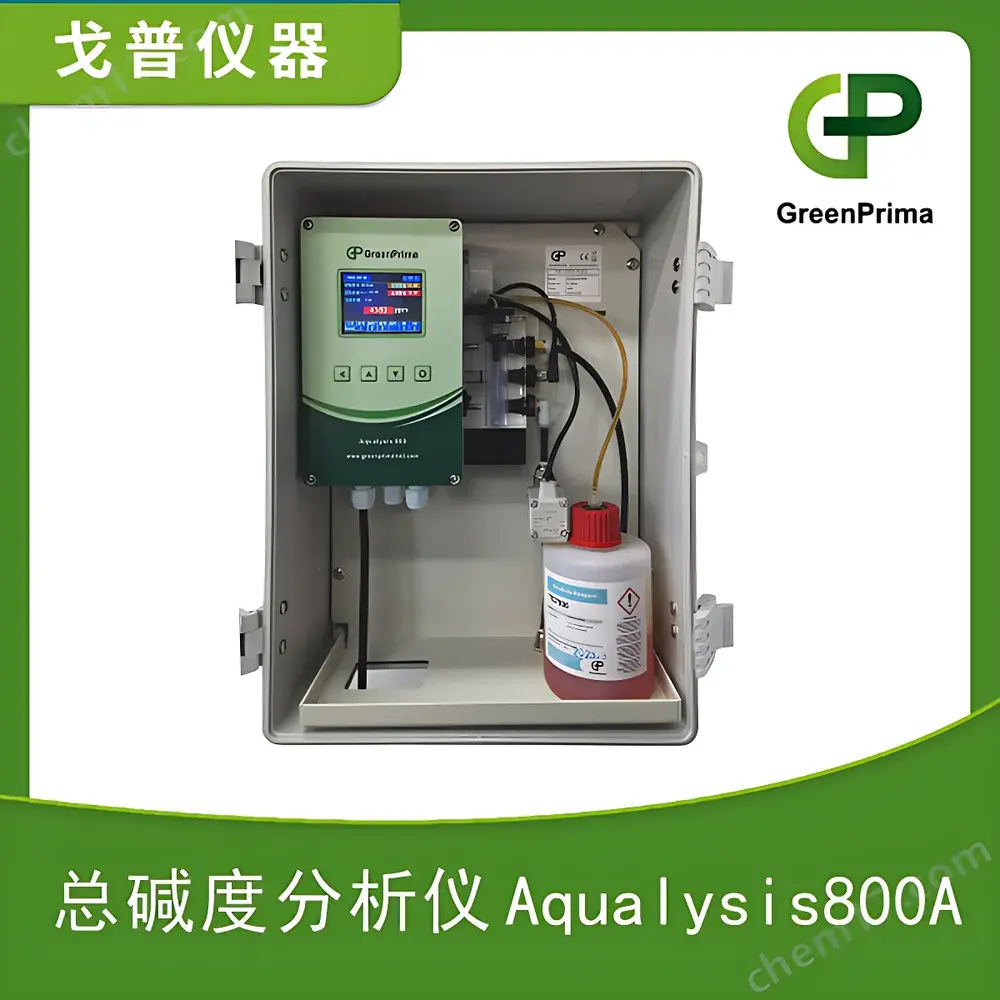
GreenPrima Aqualysis 800A Total Alkalinity Analyzer
| Brand | GreenPrima |
|---|---|
| Origin | United Kingdom |
| Manufacturer Type | Manufacturer |
| Origin Category | Imported |
| Model | Aqualysis 800A |
| Measurement Principle | Titrimetric Colorimetry |
| Measurement Time | 2–8 min (alkalinity-dependent) |
| Accuracy | ±2% of selected reagent upper limit |
| Repeatability | ±2% of selected reagent upper limit |
| Power Supply | 85–265 VAC, 47–63 Hz |
| Power Consumption | 25 VA (operational), 3.5 VA (standby) |
| Enclosure Rating | IP65 |
| Dimensions | 400 × 300 × 180 mm (H×W×D) |
| Weight | 4 kg |
| Display | Color LCD |
| Output Options | 4 programmable relay outputs (250 V, 4 A), 1 isolated 4–20 mA output (max. 750 Ω), 1 RS485 interface |
| Input Options | 2 programmable digital inputs (IN1: start analysis |
| IN2 | stop analysis) |
| Sampling Interval | 1–360 min (configurable) or triggered by external/flow signal |
| Rinse Duration | 15–1800 s (user-configurable) |
| Sample Water Requirements | pH 4–10 |
| Environmental Operating Temp. | 10–40 °C |
| Units Supported | °dH, °f, ppm CaCO₃, mmol/L |
Overview
The GreenPrima Aqualysis 800A Total Alkalinity Analyzer is an industrial-grade, online analytical instrument engineered for continuous or interval-based quantification of total alkalinity in aqueous process streams. It employs a validated titrimetric colorimetric measurement principle—combining precise acid dosing with photometric endpoint detection—to determine alkalinity as calcium carbonate (CaCO₃) equivalence across a defined concentration range. Unlike potentiometric or conductivity-based approximations, this method delivers chemically specific, stoichiometrically grounded results compliant with standard water quality protocols including ISO 9963-1, ASTM D1067, and APHA 2320 B. Designed for integration into closed-loop water treatment systems, the Aqualysis 800A supports real-time feedback control of lime-soda softening, acid dosing, and CO₂ stripping processes—ensuring consistent compliance with boiler feedwater specifications (e.g., ASME PTC 19.11, VGB S006) and pharmaceutical water standards (USP , EP 2.2.43).
Key Features
- Robust titrimetric colorimetric architecture with dual-wavelength photometric detection for high interference rejection and stable endpoint resolution
- Programmable measurement cycles (1–360 minutes) or event-triggered analysis via digital input or flow pulse signal
- Four independently configurable relay outputs supporting alarm, control, and maintenance sequencing (250 V AC / 4 A)
- Isolated 4–20 mA analog output with full-scale calibration traceability and user-defined scaling (ppm CaCO₃, mmol/L, °dH, or °f)
- RS485 Modbus RTU interface for seamless integration into SCADA, DCS, or PLC-based supervisory systems
- Onboard data logging with timestamped measurement records, diagnostic events, and fault history (retained for ≥30 days)
- Self-diagnostic routines including reagent level monitoring, valve actuation verification, and optical path integrity checks
- Compact IP65-rated enclosure (400 × 300 × 180 mm, 4 kg) suitable for wall-mount or panel installation in utility corridors and mechanical rooms
- Low reagent consumption (6 months under typical operation)
Sample Compatibility & Compliance
The Aqualysis 800A is validated for use with clarified, non-turbid water samples meeting specified matrix constraints: pH 4–10, dissolved iron <3 ppm, copper <0.2 ppm, aluminum <0.1 ppm, and manganese <0.2 ppm. It operates reliably within a sample temperature range of 5–40 °C and inlet pressure of 0.2–5 bar (optimal at 1–2 bar). The analyzer complies with electromagnetic compatibility requirements per EN 61326-1 and functional safety guidelines aligned with IEC 61508 SIL 2 for critical water quality monitoring applications. Its design supports audit-ready operation under GLP and GMP environments, with optional firmware enabling time-stamped audit trails, user access levels, and electronic signature support for FDA 21 CFR Part 11 readiness.
Software & Data Management
Local configuration and diagnostics are performed via intuitive navigation on the integrated color LCD interface. Remote supervision and parameter management are supported through GreenPrima’s web-enabled Aqualink™ configuration utility (accessible via Ethernet or RS485-to-Ethernet gateway), which provides live status dashboards, historical trend visualization, and exportable CSV reports. All measurement data—including raw absorbance values, titrant volume consumed, calculated alkalinity, and system health flags—are stored with microsecond timestamps and synchronized to NTP servers when network-connected. Firmware updates are delivered via signed binary packages with cryptographic verification to ensure integrity and traceability.
Applications
- Continuous monitoring of boiler feedwater and condensate return streams to prevent caustic embrittlement and scale formation
- Real-time control of ion exchange regeneration cycles in water softening plants
- Quality assurance of purified water (PW) and water for injection (WFI) in pharmaceutical manufacturing facilities
- Alkalinity profiling in cooling tower systems to optimize biocide dosing and minimize corrosion risk
- Regulatory compliance reporting for municipal wastewater effluent and surface water discharge permits (e.g., EPA NPDES)
- Process validation and routine verification in food & beverage production where mineral balance affects product stability
FAQ
What measurement principle does the Aqualysis 800A use, and how does it differ from conductivity-based alkalinity estimation?
It uses titrimetric colorimetry with standardized sulfuric acid titration and photometric endpoint detection—delivering chemically specific alkalinity (as CaCO₃) rather than conductivity-derived approximations subject to ionic interference.
Can the Aqualysis 800A be integrated into an existing DCS without third-party gateways?
Yes—it natively supports Modbus RTU over RS485, allowing direct register mapping to most modern DCS platforms without protocol conversion hardware.
Is calibration required before each analysis cycle?
No. The system performs automatic zero and span verification using dedicated reagent blanks and standard solutions during scheduled maintenance windows; field calibration is only needed after reagent replacement or sensor cleaning.
What is the minimum sample flow rate required for reliable operation?
A sustained flow of ≥150 mL/min is recommended to ensure representative sampling and adequate flushing between analyses; lower flows may necessitate auxiliary pumping or flow conditioning.
Does the analyzer support remote firmware updates and cybersecurity features?
Yes—firmware updates are cryptographically signed and applied over secure HTTP(S); role-based access control, session timeouts, and TLS 1.2 encryption are available in v3.2+ firmware.





