
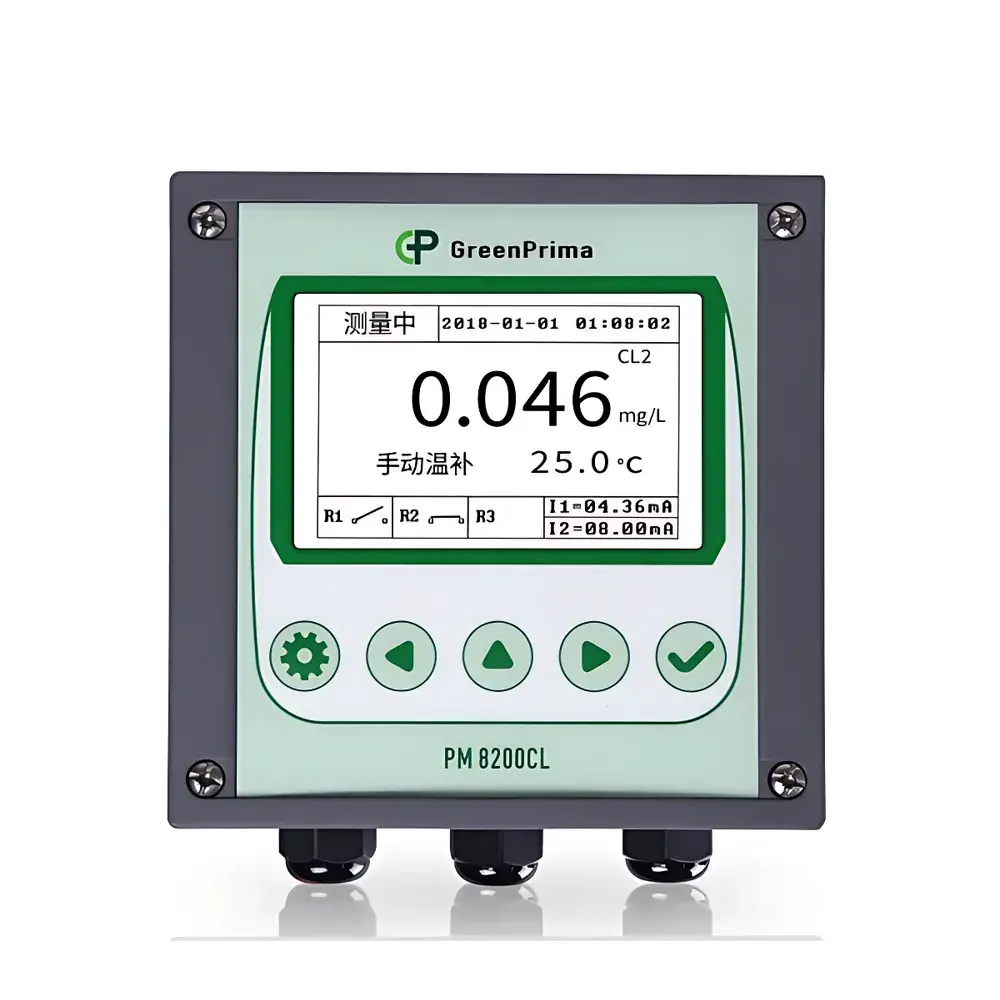
GreenPrima PM8200CL Advanced Residual Chlorine, Chlorine Dioxide & Ozone Online Analyzer
| Brand | GreenPrima |
|---|---|
| Origin | United Kingdom |
| Manufacturer | GreenPrima Ltd. |
| Type | Online Analyzer |
| Measurement Principle | Amperometric Electrochemical Sensor (Constant Potential Method) |
| Measured Parameters | Free Chlorine, Combined Chlorine, Chlorine Dioxide, Ozone |
| Range | 0–2.000 ppm / 0–20.00 ppm (dual-range auto-scaling) |
| Accuracy | ±0.001 ppm or ±0.01 ppm (full-scale dependent) |
| Repeatability | ±0.001 ppm or ±0.01 ppm |
| Resolution | 0.001 ppm / 0.01 ppm |
| LOD | 0.001 ppm / 0.01 ppm |
| Temperature Compensation | –10 to 130 °C (NTC10K or PT1000, manual/automatic) |
| Operating Temp. | 0–70 °C |
| Storage Temp. | –20 to 70 °C |
| Display | Backlit graphical LCD |
| Data Storage | 600,000 records |
| Power Supply | 90–260 VAC, 50/60 Hz or 24 VDC optional |
| Enclosure Rating | IP65 |
| Communications | RS485, MODBUS-RTU compliant |
| Analog Outputs | Dual isolated 4–20 mA (max. 500 Ω, ±0.1% FS) |
| Cleaning Output | Programmable interval (0.1–1000 h) and duration (1–1000 s) |
| Housing Dimensions | 144 × 144 × 106 mm |
| Panel Cutout | 138 × 138 mm |
| Weight | 0.86 kg |
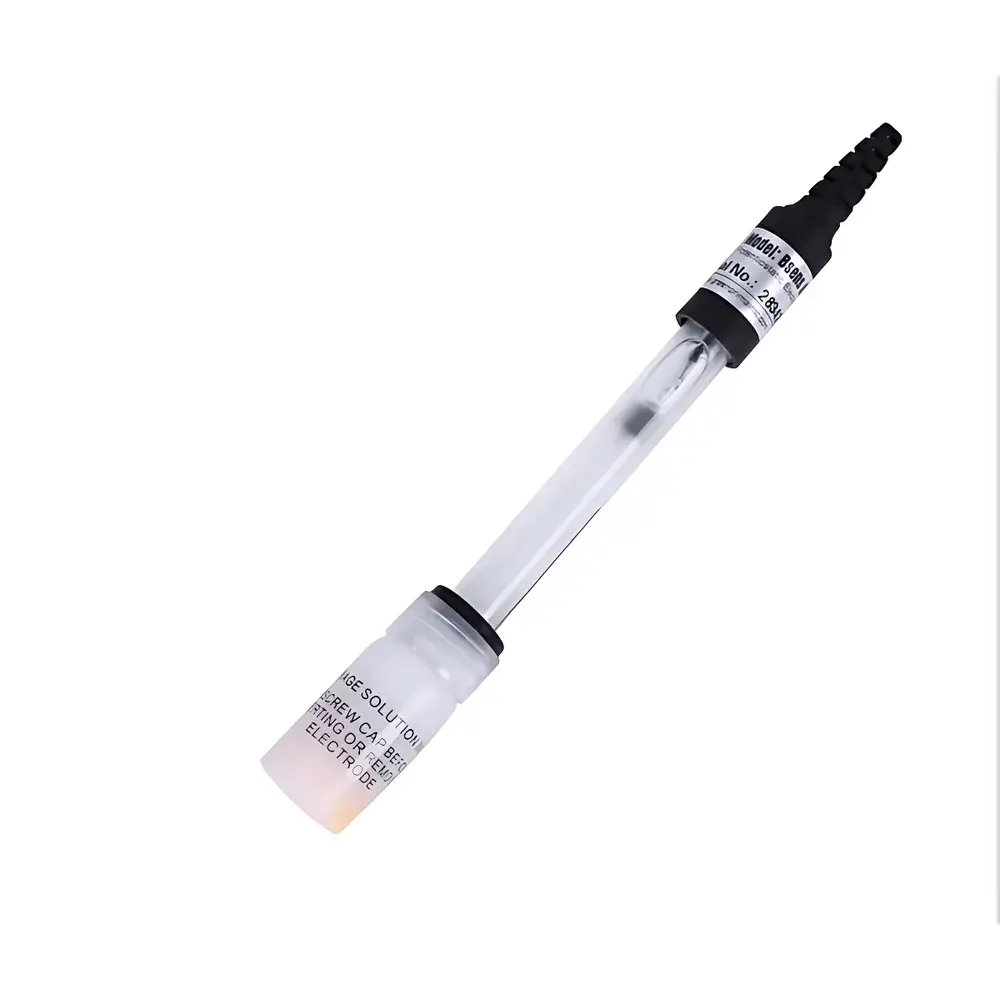
| Sensor Model | Bsens650 |
| Sensor Range | 0–2.000 / 0–20.00 ppm |
| Sensor Accuracy | ±2% FS |
| Sensor Electrode Material | Glass body with dual-platinum ring working electrode |
| Max. Pressure Rating | 5 bar |
| Connection | PG13.5 fixed thread |
| Cable Length | 3 m |
Overview
The GreenPrima PM8200CL is a high-precision, multi-analyte online analyzer engineered for continuous, real-time quantification of free chlorine, combined chlorine, chlorine dioxide (ClO₂), and ozone (O₃) in aqueous process streams. It operates on the amperometric electrochemical principle—specifically, the constant-potential (galvanic) method—where a stable polarization voltage is applied between a working electrode (dual-platinum ring) and a reference electrode. Under this controlled potential, target oxidants undergo selective reduction at the electrode surface, generating a diffusion-limited current linearly proportional to their concentration. This electrochemical architecture eliminates reliance on colorimetric reagents, membrane replacement, or electrolyte refills—significantly reducing operational overhead and long-term calibration drift. The system integrates three core components: the PM8200CL controller unit, the Bsens650 amperometric sensor, and the BAF615 flow-through cell—designed to maintain laminar, pressure-stabilized sample flow across the electrode surface for reproducible mass transport conditions.
Key Features
- True multi-analyte capability: Simultaneous or configurable measurement of free chlorine, total chlorine, ClO₂, and O₃ using a single sensor platform
- Constant-potential amperometry with dual-platinum ring electrode ensures high selectivity, low cross-sensitivity, and minimal fouling in turbid or organic-rich waters
- No consumables: Eliminates membrane cartridges, internal electrolyte solutions, and chemical reagents—reducing total cost of ownership and maintenance frequency
- Dual-range auto-scaling detection (0–2.000 ppm and 0–20.00 ppm) with 0.001 ppm resolution in low range and 0.01 ppm in high range
- Integrated temperature compensation using NTC10K or PT1000 probes, supporting accurate measurements across –10 to 130 °C sample temperatures
- Robust industrial enclosure rated IP65, compatible with wall-mount, pole-mount, and panel-mount installations
- Dual isolated 4–20 mA analog outputs with 0.1% full-scale accuracy and RS485 interface compliant with MODBUS-RTU protocol for seamless SCADA and DCS integration
- Programmable automatic cleaning output to trigger external solenoid valves or air-pulse systems—configurable from 0.1 to 1000 hours interval and 1 to 1000 seconds duration
Sample Compatibility & Compliance
The PM8200CL is validated for use in potable water distribution networks, municipal drinking water treatment plants, swimming pool recirculation systems, hospital wastewater disinfection units, pharmaceutical purified water loops (PW/WFI), and industrial cooling tower circuits. Its sensor design meets the electrochemical performance criteria referenced in ISO 7393-2 (water quality — determination of free chlorine and total chlorine — amperometric method) and aligns with EPA Method 334.0 for residual oxidant monitoring. While not certified for regulatory submission without site-specific validation, the instrument’s data integrity framework—including time-stamped storage of 600,000 measurement records, non-volatile memory, and audit-ready configuration logs—supports GLP and GMP environments. The 4–20 mA outputs and MODBUS-RTU interface facilitate traceability in FDA 21 CFR Part 11-compliant systems when paired with appropriate electronic record controls.
Software & Data Management
The PM8200CL controller features an embedded real-time operating system with a backlit graphical LCD interface supporting both English and Chinese menu navigation. All operational parameters—including measurement range, temperature compensation mode, analog output mapping, cleaning schedule, and alarm thresholds—are configured locally via intuitive soft keys. Measurement data are stored internally with millisecond-level timestamps; export is supported via MODBUS polling by supervisory systems. No proprietary software is required for basic operation, though GreenPrima provides optional PC-based configuration utilities for batch parameter upload/download and trend visualization. Data logging complies with IEC 62443-3-3 cybersecurity baseline requirements for field instrumentation, with password-protected access levels for operator, engineer, and administrator roles.
Applications
- Municipal water treatment: Real-time monitoring of chlorine residual at clearwell outlets, booster stations, and distribution system endpoints
- Swimming pool & spa management: Closed-loop control of ClO₂ or NaOCl dosing based on dynamic demand signals
- Pharmaceutical water systems: Continuous verification of sanitization efficacy during hot water rinse cycles or ozone hold phases
- Hospital sterilization: Monitoring of ozone concentrations in wastewater effluent prior to discharge compliance verification
- Food & beverage processing: Verification of sanitizer concentration in CIP rinse water and post-process equipment contact surfaces
- Industrial cooling water: Detection of breakpoint chlorination status and early warning of biofilm formation risk
- Membrane filtration plants: Guard monitoring upstream of RO/NF membranes to prevent oxidative damage
FAQ
Does the PM8200CL require daily calibration or zero-point adjustment?
No. The constant-potential amperometric design delivers inherent zero stability. Field calibration is recommended only after sensor replacement or if drift exceeds ±2% FS over 30 days—typically verified using NIST-traceable standard solutions.
Can the same Bsens650 sensor measure chlorine, chlorine dioxide, and ozone interchangeably?
Yes. The sensor operates across multiple optimized polarization potentials. The controller automatically selects the appropriate voltage based on selected analyte mode—no hardware change is needed.
What flow rate is required in the BAF615 flow cell for optimal performance?
A minimum flow of 150 mL/min is recommended to ensure laminar flow and eliminate boundary layer effects. The cell includes integrated flow restrictors and pressure relief to maintain consistent hydraulic conditions up to 5 bar.
Is the PM8200CL suitable for seawater or brackish water applications?
It is not recommended for direct seawater use due to chloride-induced interference and accelerated electrode passivation. For saline matrices, consult GreenPrima for optional silver/silver chloride reference electrode variants and extended validation protocols.
How does the instrument handle particulate fouling in raw water applications?
The BAF615 flow cell supports inline mechanical filtration (5–10 µm) upstream. Combined with programmable air or clean-water purge cycles, the system maintains electrode surface integrity in suspended-solids-laden streams typical of pre-filtration monitoring points.







