
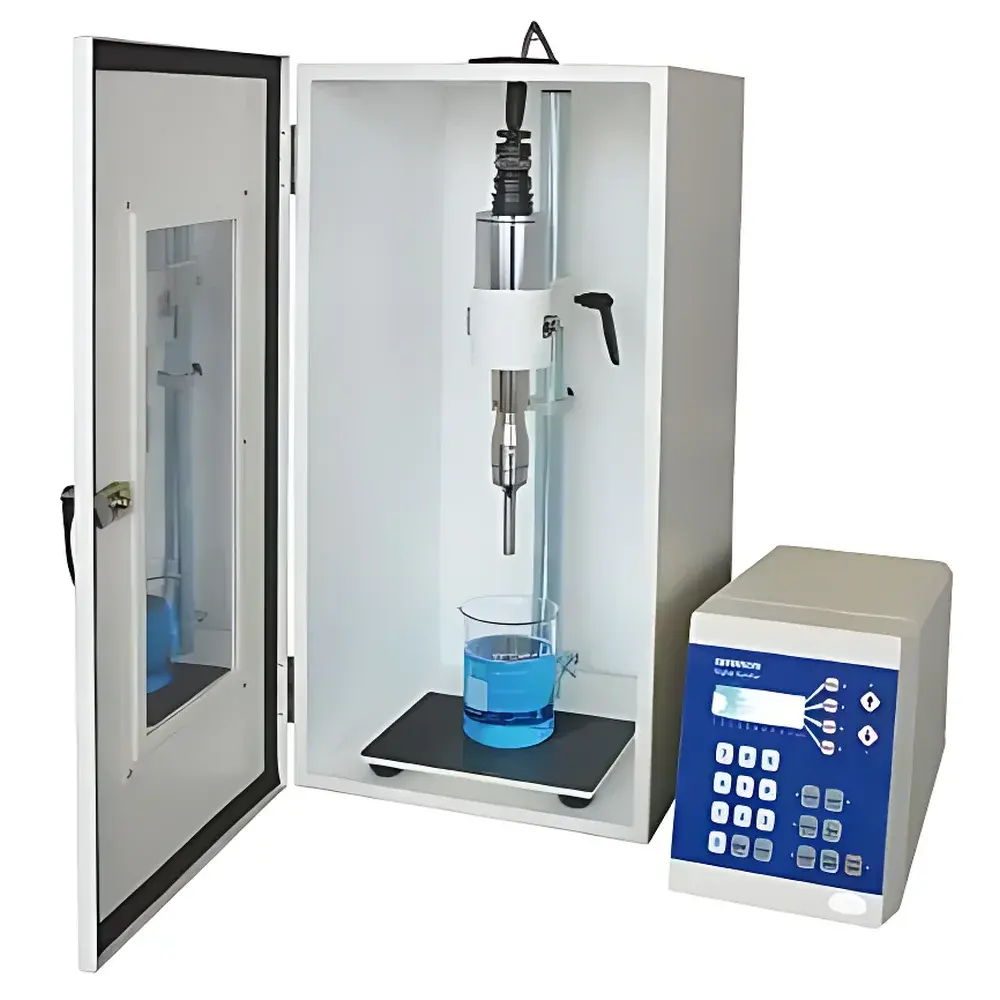
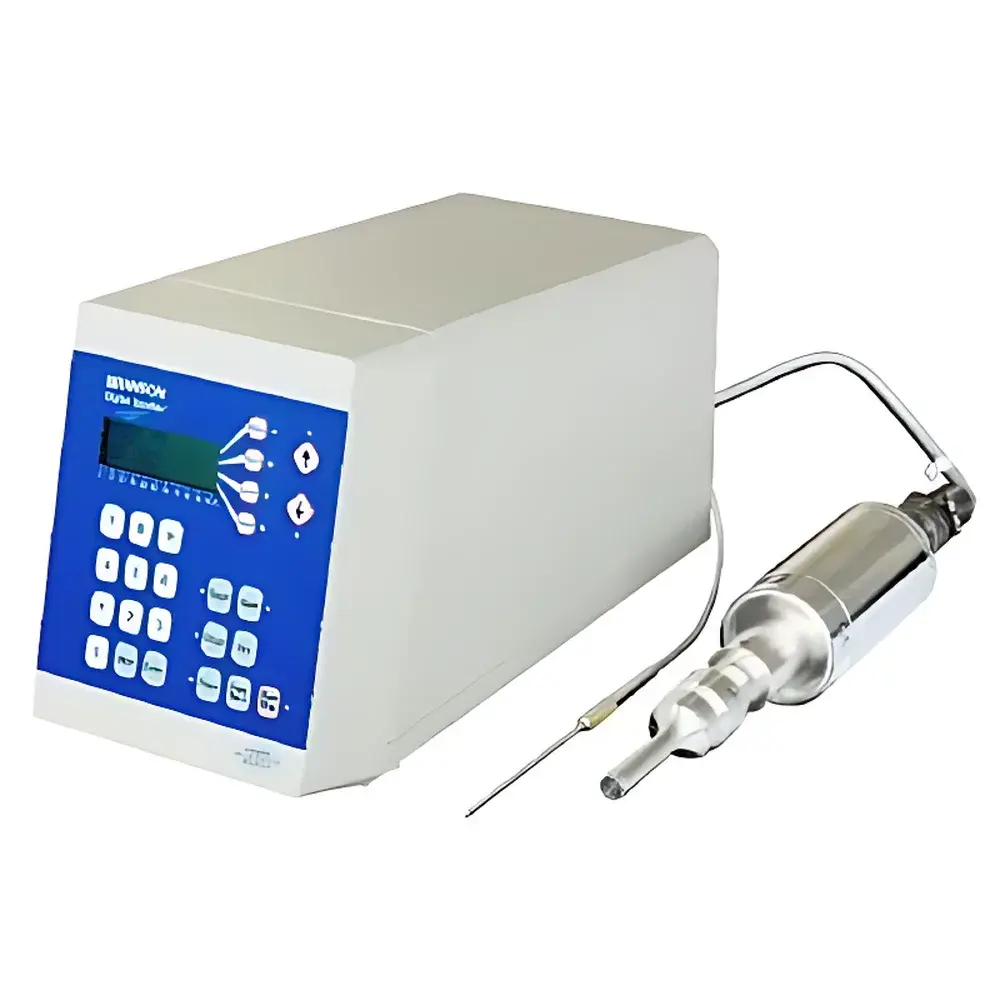
Branson Sonifier® S-250D Digital Ultrasonic Cell Disruptor
| Origin | USA |
|---|---|
| Manufacturer Type | Authorized Distributor |
| Origin Category | Imported |
| Model | S-250D |
| Instrument Type | Ultrasonic Cell Disruptor |
| Output Power | 200 W (continuously adjustable) |
| Operating Frequency | 20 kHz |
| Voltage Rating | 230 V AC, 50/60 Hz |
| Max Current | 4 A |
| Standard Probe | 1/2″ (13 mm) titanium alloy probe |
| Minimum Sample Volume | 0.25 mL (with optional 1/8″ probe) |
| Standard Processing Volume | 10–250 mL |
| Adjustable Amplitude Range | 10–100% |
| Pulse Duration | 0.1–9.9 s |
| Pulse Interval | 0.1–9.9 s |
| Timer Range | 1 s–9 h 59 min 59 s |
| Data Storage | 20 user protocols |
| Interface | RS-232 serial port |
| Weight | 10.1 kg |
Overview
The Branson Sonifier® S-250D Digital Ultrasonic Cell Disruptor is a precision-engineered laboratory instrument designed for controlled mechanical lysis of biological cells and subcellular structures via high-intensity ultrasonic cavitation. Operating at a fixed frequency of 20 kHz, the system converts electrical energy into longitudinal acoustic vibrations transmitted through a titanium alloy probe immersed in the sample medium. These vibrations generate transient microbubbles that collapse violently (inertial cavitation), producing localized shear forces, shockwaves, and extreme temperature gradients—mechanisms proven effective for disrupting bacterial cell walls, viral envelopes, fungal spores, plant tissues, and mammalian cells without significant thermal denaturation when operated under pulsed conditions. The S-250D is engineered for reproducible, scalable disruption across volumes ranging from 0.25 mL (with microprobe) to >500 mL (in continuous-flow configurations), making it suitable for both discovery-stage R&D and process development in regulated environments.
Key Features
- Digital amplitude control (10–100%) with real-time bar-graph power display for precise energy delivery
- Programmable pulse mode: adjustable on/off durations (0.1–9.9 s each), enabling thermal management during sensitive applications such as protein extraction or nucleic acid isolation
- Integrated timer with resolution down to 1 second and maximum duration of 9 hours, 59 minutes, 59 seconds
- RS-232 serial interface for remote parameter configuration, operational logging, and timestamped protocol export to external PCs
- Onboard memory storing up to 20 user-defined methods—including amplitude, pulse settings, duration, and temperature thresholds (when paired with optional temperature probe)
- Multi-language UI support (English, German, French, Spanish, Chinese) for international lab deployment
- Self-diagnostic startup sequence verifying transducer impedance, generator output stability, and probe coupling integrity
- User I/O port for external trigger input and analog monitoring of power/temperature signals
- Low-heat microtip probe option (1/8″) delivering up to 70% amplitude—significantly higher than conventional probes limited to ~40%—enabling efficient lysis of small-volume, high-value samples
Sample Compatibility & Compliance
The S-250D accommodates diverse sample matrices including aqueous suspensions, viscous lysates, emulsions, and particulate dispersions. Its modular probe architecture supports interchangeable titanium alloy tips (standard 13 mm, micro 3 mm, cup-horn, and flow-cell variants), allowing optimization for microbial pellets, tissue homogenates, nanoparticle dispersion, or solvent-based extractions. The system complies with IEC 61000-6-3 (EMC emissions) and IEC 61010-1 (safety requirements for laboratory equipment). When deployed in GxP-regulated workflows—including those aligned with USP , ASTM E2500, and FDA 21 CFR Part 11—the S-250D supports audit-ready data integrity through timestamped method execution logs and password-protected protocol editing. Optional acoustic enclosures reduce ambient noise to ≤70 dB(A) and mitigate aerosol generation per ISO 15190:2020 biosafety guidelines.
Software & Data Management
While the S-250D operates autonomously via its front-panel interface, its RS-232 port enables integration into centralized lab informatics systems. Third-party software (e.g., LabVIEW, Python pySerial, or custom LIMS modules) can read operational parameters—including actual delivered power, cumulative run time, and alarm status—in ASCII format. All stored protocols retain metadata: date/time stamp, operator ID (manually entered), amplitude setting, pulse profile, and total cycle count. No proprietary drivers are required; standard null-modem cables suffice. For GLP/GMP traceability, users may configure automatic log exports to networked drives at method completion, satisfying requirements for electronic record retention per Annex 11 and ALCOA+ principles.
Applications
- Cell lysis for recombinant protein purification (E. coli, yeast, insect, and mammalian expression systems)
- Chromatin shearing in ChIP-seq and ATAC-seq library preparation
- Nanoparticle deagglomeration and uniform dispersion in drug delivery formulations
- Extraction of intracellular metabolites, lipids, and RNA from Gram-positive bacteria and plant tissues
- Emulsification of oil-in-water systems for cosmetic and food-grade colloids
- Cleaning of microfluidic channels and MEMS devices using cavitation-assisted solvent circulation
- Accelerated solvent extraction (ASE) of environmental contaminants from soil/sediment matrices
FAQ
What safety certifications does the S-250D hold?
The instrument meets IEC 61010-1 for electrical safety and IEC 61000-6-3 for electromagnetic compatibility. It is not CE-marked for medical device use but is certified for general laboratory application in the EU and North America.
Can the S-250D be validated for use in GMP manufacturing environments?
Yes—when paired with documented IQ/OQ protocols, calibrated temperature probes, and electronic log archiving, the system supports qualification under ASTM E2500 and ISPE Baseline Guide Vol. 5.
Is probe sterilization possible?
Titanium alloy probes tolerate autoclaving (121°C, 20 min, saturated steam), though repeated cycles may affect tip geometry and acoustic efficiency; periodic amplitude verification is recommended.
Does Branson provide application support for method development?
Branson Technical Services offers free consultation on probe selection, amplitude optimization, and pulse parameter tuning for specific cell types or matrices, supported by published application notes and peer-reviewed case studies.
How often does the transducer require recalibration?
No routine recalibration is specified; however, annual performance verification—measuring amplitude linearity, power output consistency, and thermal cutoff response—is advised for labs operating under ISO/IEC 17025 or CAP accreditation.






