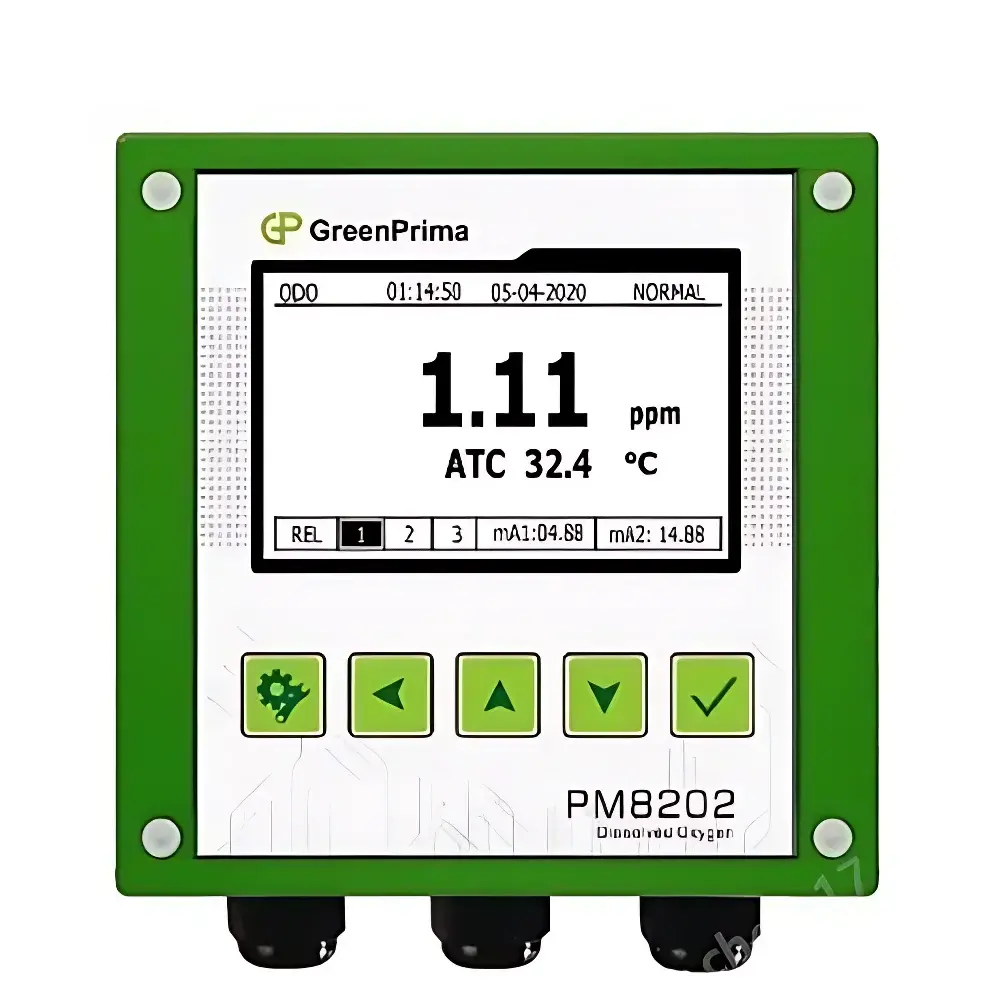
GreenPrima PM8202D Polarographic Dissolved Oxygen Analyzer
| Brand | GreenPrima |
|---|---|
| Origin | United Kingdom |
| Manufacturer Type | Original Equipment Manufacturer (OEM) |
| Product Category | Imported Industrial Online DO Analyzer |
| Model | PM8202D |
| Measurement Range | 0.00–20.00 ppm / 0.00–200.00 ppb |
| Resolution | 0.001 ppm / 0.01 ppb |
| Accuracy | ±0.02 ppm / ±0.02 ppb |
| Temperature Compensation | −10 to +130 °C (manual or automatic, NTC10K or PT1000 sensor input) |
| Operating Temperature | −10 to +70.0 °C |
| Storage Temperature | −20 to +70.0 °C |
| Enclosure Dimensions | 144 × 144 × 108 mm |
| Panel Cutout | 138 × 138 mm |
| Weight | 0.87 kg |
| Display | Backlit dot-matrix LCD (dual-language: English/Chinese) |
| Data Logging Capacity | 600,000 records |
| Power Supply | 90–260 VAC, 50/60 Hz or optional 24 VDC |
| Analog Outputs | Two isolated 4–20 mA outputs (max. loop resistance 500 Ω, accuracy ±0.1% FS, configurable for DO or temperature) |
| Digital Communication | RS485 Modbus RTU |
| Relay Outputs | Two independent Hi/Lo alarm relays (5 A / 250 VAC / 30 VDC, programmable hysteresis) |
| Cleaning Cycle Control | Adjustable interval (0.1–1000 h) and duration (1–1000 s) |
| Installation Options | Wall-mount, pipe-mount, panel-mount |
| Ingress Protection | IP65 |
| Electrode Compatibility | Bsens420, Bsens430, Bsens440 polarographic sensors (Clark-type, membrane-covered, aqueous electrolyte-based) |
Overview
The GreenPrima PM8202D Polarographic Dissolved Oxygen Analyzer is an industrial-grade online measurement system engineered for continuous, high-stability monitoring of dissolved oxygen (DO) concentration in liquid process streams. It operates on the classical Clark polarographic principle: molecular oxygen diffuses through a gas-permeable membrane into an aqueous electrolyte solution, where it is electrochemically reduced at a cathode (typically gold or platinum) under a fixed polarizing voltage (−0.6 to −0.8 V vs. Ag/AgCl). The resulting diffusion-limited current is linearly proportional to the partial pressure of dissolved O₂, enabling precise quantification in real time. Designed for integration into critical water quality control loops, the PM8202D delivers trace-level sensitivity down to 200 ppb with sub-ppb resolution, making it suitable for applications demanding strict regulatory compliance—including pharmaceutical water systems (PW, WFI), bioreactor fermentation, power plant condensate monitoring, and municipal wastewater treatment.
Key Features
- Robust IP65-rated enclosure with fully sealed, corrosion-resistant housing—engineered for long-term deployment in humid, chemically aggressive, or outdoor environments.
- Dual-range measurement capability: 0.00–20.00 ppm (mg/L) and 0.00–200.00 ppb, selectable via configuration menu; ideal for both bulk water and ultra-pure water applications.
- High-resolution display: backlit dot-matrix LCD showing real-time DO value, temperature, timestamp, relay status, and system diagnostics—supports English and Chinese language modes.
- Flexible electrode compatibility: supports multiple GreenPrima polarographic sensors (Bsens420, Bsens430, Bsens440), each optimized for specific flow regimes, fouling resistance, and membrane lifetime.
- Comprehensive temperature compensation using either NTC10K or PT1000 inputs—applied automatically across the full −10 to +130 °C range to correct for solubility and diffusion coefficient variations.
- Two isolated 4–20 mA analog outputs (configurable for DO, temperature, or error status) with ≤0.1% full-scale accuracy and maximum loop load of 500 Ω.
- RS485 Modbus RTU interface for seamless integration into DCS, SCADA, or PLC-based automation systems—enabling remote parameter configuration, data polling, and alarm event logging.
- Programmable cleaning control: users define cleaning interval (0.1–1000 hours) and duration (1–1000 seconds) to maintain sensor performance in high-fouling media such as activated sludge or seawater.
- Two independent relay outputs with user-defined high/low setpoints and adjustable hysteresis—certified for 5 A resistive load at 250 VAC or 30 VDC.
Sample Compatibility & Compliance
The PM8202D is validated for use in aqueous matrices including potable water, secondary effluent, seawater, boiler feedwater, fermentation broth, and purified water per USP Water for Injection (WFI) specifications. Its Clark-type electrochemical architecture complies with ISO 5814:2012 (Water quality — Determination of dissolved oxygen — Electrochemical probe method) and ASTM D888-22 (Standard Test Methods for Dissolved Oxygen in Water). When deployed with appropriate sensor calibration protocols and maintenance schedules, the analyzer supports GLP and GMP documentation requirements—including audit trails for calibration events, alarm logs, and configuration changes. Optional 24 VDC power input enables safe operation in hazardous area zones when paired with intrinsically safe barriers (not included).
Software & Data Management
The PM8202D incorporates embedded non-volatile memory capable of storing up to 600,000 timestamped measurement records—sufficient for >6 months of continuous 1-minute logging. All stored data are accessible via Modbus register mapping or local display export. The device supports password-protected configuration (three-tier access: operator, engineer, administrator) to prevent unauthorized modification of calibration constants, alarm thresholds, or communication parameters. While no proprietary PC software is bundled, the Modbus RTU implementation conforms to standard register maps published in the device’s technical manual—facilitating integration with third-party historian platforms (e.g., Ignition, Siemens Desigo, Emerson DeltaV) and custom Python/Node-RED data acquisition scripts. Firmware updates are performed via USB-to-serial adapter using ASCII command protocol.
Applications
- Municipal & Industrial Wastewater: Real-time DO control in aerobic digesters, oxidation ditches, and MBR systems to optimize energy consumption and nitrification efficiency.
- Pharmaceutical Manufacturing: Continuous monitoring of purified water (PW) and water-for-injection (WFI) distribution loops per FDA 21 CFR Part 11 and EU Annex 11 data integrity guidelines.
- Food & Beverage Production: Ensuring oxygen exclusion during cold wort aeration, carbonated beverage filling, and sterile filtration validation.
- Power Generation: Monitoring condensate and feedwater deaerator performance to mitigate oxygen-induced corrosion in steam cycles.
- Aquaculture & Hatchery Operations: Maintaining optimal DO levels (>5 mg/L) in recirculating aquaculture systems (RAS) with automated feedback to aerators or pure oxygen injectors.
- Biotechnology Fermentation: Closed-loop control of dissolved O₂ in stirred-tank bioreactors (STRs), supporting metabolic pathway optimization and scale-up reproducibility.
FAQ
What electrochemical principle does the PM8202D employ?
It uses the Clark-type polarographic method, relying on oxygen diffusion through a selective silicone or Teflon membrane into an internal electrolyte, followed by amperometric reduction at a noble metal cathode.
How often must the electrolyte be replaced?
Typical replacement intervals range from 3 to 6 months under continuous operation, depending on temperature, flow velocity, and sample matrix fouling potential—documented in the sensor-specific maintenance schedule.
Is automatic temperature compensation mandatory?
No—both manual and automatic compensation modes are supported; however, automatic mode using integrated NTC10K or PT1000 probes is strongly recommended for process stability across wide thermal gradients.
Can the PM8202D operate in pressurized pipelines?
Yes, when used with compatible pipe-mount electrodes (e.g., Bsens440 with threaded process connection), provided the system pressure remains within the sensor’s rated limit (typically ≤10 bar at 25 °C).
Does the analyzer support FDA 21 CFR Part 11 compliance?
The hardware provides foundational capabilities—including user authentication, electronic signatures (via password tiers), and immutable audit logs—but full Part 11 compliance requires validation of the entire operational context (network infrastructure, historian, SOPs) by the end user.