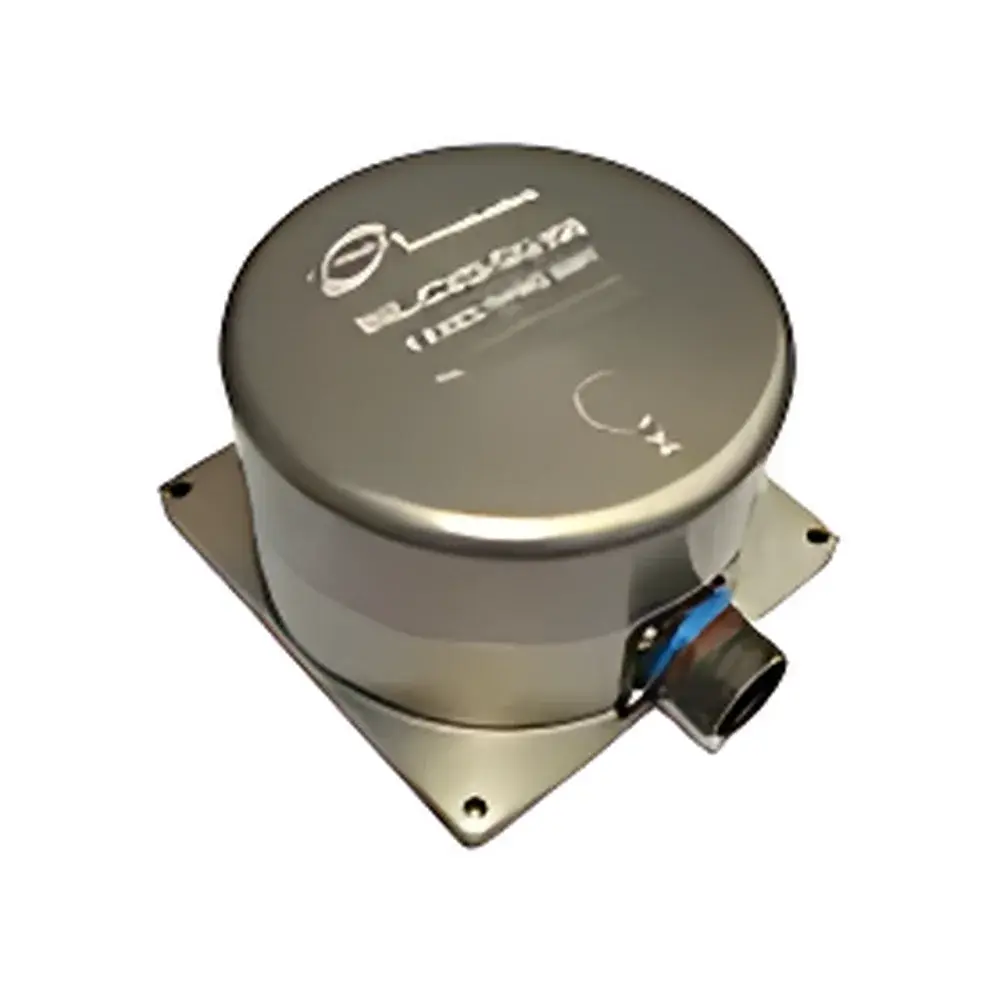
INNALABS INL-CVG-GU100 Single-Axis Digital Coriolis Vibratory Gyroscope
| Brand | INNALABS |
|---|---|
| Origin | Germany |
| Model | GU100 (Digital Output) |
| Axis Count | 1 (X or Y) |
| Output Interface | RS-232/422/485 |
| Output Data Rate | 2000–9000 Hz |
| Measurement Range | ±110 deg/s |
| Bandwidth | 300 Hz |
| Bias Stability (RT, 1σ) | <0.1 deg/hr |
| Bias Stability (Full Temp Range, 1σ) | <10 deg/hr |
| Bias Repeatability (Power-On, 1σ) | 0.5 deg/hr |
| Angle Random Walk (ARW) | <0.008 deg/√h |
| Noise Density (0.1–100 Hz, RMS) | <0.008 deg/s |
| Scale Factor Error (Full Temp, 1σ) | <2500 ppm |
| Scale Factor Linearity | <500 ppm |
| Startup Time | <1 s |
| Input Voltage | +12 to +36 VDC (MIL-STD-461/1275 compliant) |
| Power Consumption | <1.7 W @ 15 VDC |
| Operating Temperature | −40 °C to +85 °C |
| Storage Temperature | −55 °C to +90 °C |
| Vibration (Operational) | 12 g RMS, 1–2000 Hz, 10 min/axis |
| Vibration (Transport) | 3 g RMS, 1–2000 Hz, 1 h/axis |
| Shock | 500 g, 0.5 ms half-sine |
| MTBF (MIL-HDBK-217F) | 500,000 hr |
| EMI/EMC | MIL-STD-461E compliant |
| Lifetime | 17 years |
| Weight | 0.9 kg |
| Dimensions | 107 mm × 107 mm × 68 mm (L × W × H) |
| Built-in Self-Test (BIT) | Yes |
| Temperature Compensation | Yes (Bias & Scale Factor) |
Overview
The INNALABS INL-CVG-GU100 is a high-performance single-axis digital Coriolis vibratory gyroscope engineered for mission-critical inertial sensing applications where long-term stability, low noise, and wide dynamic bandwidth are non-negotiable. Unlike tuning-fork or MEMS-based angular rate sensors, the GU100 leverages a precision-machined resonant silicon structure operating in a controlled vacuum environment, enabling true Coriolis force detection via differential capacitance readout. Its core measurement principle relies on detecting minute phase-shifted displacements induced by angular rotation orthogonal to the primary vibration mode—yielding direct, linear, and temperature-compensated angular rate output with minimal hysteresis or quadrature error. Designed to meet stringent requirements of aerospace-grade inertial systems, the GU100 delivers bias stability below 0.1°/hr at room temperature (1σ), with full-temperature-range stability maintained under <10°/hr—making it suitable for extended autonomous operation without external aiding.
Key Features
- Single-axis angular rate sensing with digital output via RS-232/422/485 serial interface, supporting configurable data rates from 2 kHz to 9 kHz.
- High intrinsic robustness: qualified to survive 500 g, 0.5 ms half-sine mechanical shock and operate continuously under 12 g RMS random vibration (1–2000 Hz).
- Wide operational temperature range (−40 °C to +85 °C) with integrated, factory-calibrated temperature compensation for both bias and scale factor.
- Low-angle random walk (<0.008 °/√h) and ultra-low noise floor (<0.008 °/s RMS over 0.1–100 Hz band), enabling high-fidelity attitude estimation over extended integration periods.
- MIL-STD-461E-compliant electromagnetic compatibility and MIL-STD-1275 power input conditioning ensure reliable deployment in electrically noisy vehicle and platform environments.
- Built-in self-test (BIT) functionality supports automated diagnostics during power-up and runtime, fulfilling system-level health monitoring requirements per DO-160 and MIL-STD-810.
Sample Compatibility & Compliance
The GU100 is designed for integration into rigidly mounted inertial subsystems where mechanical isolation and thermal management are implemented per manufacturer guidelines. It complies with MIL-HDBK-217F for reliability prediction (MTBF = 500,000 hours), and its qualification testing aligns with MIL-STD-810H (vibration, shock, temperature, humidity) and MIL-STD-461E (conducted/radiated emissions and susceptibility). While not inherently certified for aviation airworthiness (e.g., DO-178C or DO-254), the device is widely deployed in Class III UAVs, UUVs, and land-based IMUs where system-level certification incorporates component-level test evidence. Its digital output protocol supports deterministic timing and CRC-protected frames—enabling traceable data acquisition in GLP/GMP-aligned test laboratories and production calibration facilities.
Software & Data Management
The GU100 communicates via ASCII or binary serial protocols with fixed frame structures, allowing seamless integration into custom host firmware or third-party inertial navigation software stacks (e.g., MATLAB Simulink, ROS 2, or LabVIEW Real-Time). Configuration parameters—including output rate, filter settings, and BIT trigger modes—are programmable via command set. All internal calibration coefficients (bias, scale factor, misalignment, temperature polynomials) are stored in non-volatile memory and accessible via diagnostic commands. While no proprietary PC application is bundled, INNALABS provides comprehensive register maps, timing diagrams, and example code repositories (C/C++, Python) for rapid prototyping. For audit-trail compliance in regulated environments, users may log raw sensor frames with synchronized timestamps to support FDA 21 CFR Part 11 or ISO 13485 data integrity requirements.
Applications
- Inertial Measurement Units (IMUs) and Attitude and Heading Reference Systems (AHRS) for autonomous ground vehicles (AGVs), unmanned aerial vehicles (UAVs), and remotely operated underwater vehicles (ROVs).
- Stabilization platforms for electro-optical payloads, satellite communication antennas, and maritime radar masts requiring sub-arcminute pointing accuracy.
- Hybrid INS/GPS navigation systems where gyro drift must remain bounded over GPS-denied intervals exceeding 10 minutes.
- Dynamic calibration rigs and motion simulation testbeds requiring traceable, low-noise angular rate references across industrial and defense R&D labs.
- Structural health monitoring systems integrating inertial sensing with strain and acceleration data for modal analysis of rotating machinery or civil infrastructure.
FAQ
What is the recommended mounting orientation for optimal performance?
The GU100 is axis-specific (X or Y configured at manufacture); mechanical alignment tolerance should be ≤±0.1° relative to the intended rotation axis. Use kinematic mounts or precision dowel pins to minimize thermal-induced stress.
Does the GU100 support synchronous sampling with external triggers?
Yes—hardware trigger input (TTL-compatible) enables edge-triggered data capture with jitter <1 µs, critical for multi-sensor time alignment in distributed IMUs.
Is factory recalibration required after mechanical shock exposure?
No—shock survivability up to 500 g is validated per MIL-STD-810H Method 516.6; post-shock bias shift remains within specification limits without intervention.
Can the GU100 operate continuously at +85 °C ambient?
Yes—thermal design ensures junction temperature remains within silicon limits; derating is not required across the full specified operating range.
How is scale factor linearity verified during calibration?
Using rate table testing per IEEE Std 952-1997, with ≥12 discrete angular rates spanning ±110 deg/s, fitted to a 3rd-order polynomial; residual error <500 ppm full-scale.