
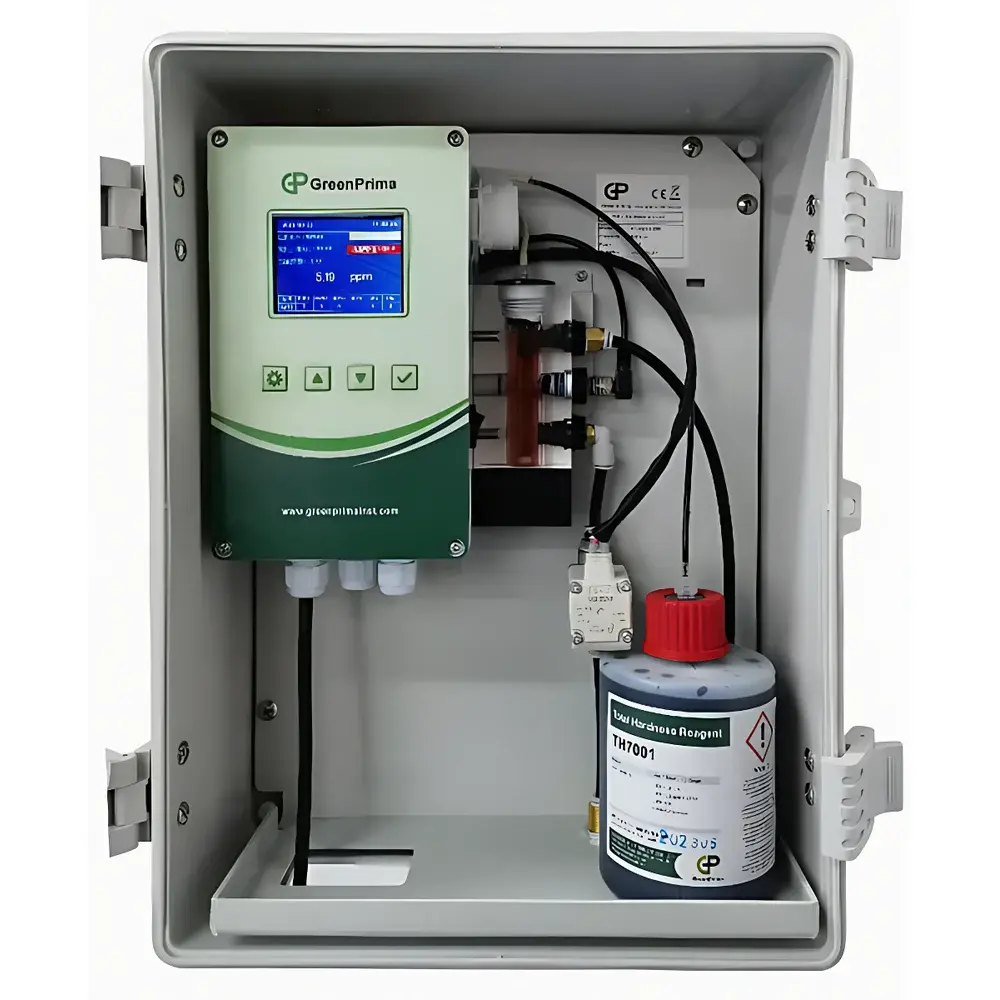
GreenPrima Aqualysis 800 Online Total Hardness Analyzer
| Brand | GreenPrima |
|---|---|
| Origin | Shanghai, China |
| Manufacturer Type | Manufacturer |
| Regional Classification | Domestic (China) |
| Model | Aqualysis 800 |
| Instrument Type | Online Water Quality Analyzer |
| Measured Parameter | Calcium & Magnesium Hardness (as CaCO₃) |
| Measurement Method | Photometric Titration (Colorimetric Endpoint Detection) |
| Range | 0.447–625.8 ppm CaCO₃ |
| Accuracy | ±2% of selected reagent upper limit |
| Repeatability | ±1% of selected reagent upper limit |
| Cycle Time | ~3 min (hardness-dependent) |
| Display | Color LCD with bilingual (EN/CN) interface |
| Dimensions | 400 × 300 × 180 mm (W×H×D) |
| Weight | 4 kg |
| Enclosure Rating | IP65 |
| Power Supply | 85–265 VAC, 47–63 Hz |
| Power Consumption | 25 VA (operational), 3.5 VA (standby) |
| Output Interfaces | 4 programmable relay outputs (250 VAC, 4 A), 1 × 4–20 mA (max. 750 Ω), 1 × RS485 (Modbus RTU) |
| Input Interfaces | 2 digital inputs (IN1: start analysis |
| IN2 | stop analysis) |
| Data Logging | Internal storage with timestamped records |
| Sample Requirements | pH 4–10 |
| Sample Temp. | 5–40 °C |
| Operating Ambient Temp. | 10–40 °C |
| Sample Pressure | 0.2–6 bar (recommended: 1–2 bar) |
| Mounting | Wall-mounted |
| Calibration | Auto-zero and endpoint validation via dual-wavelength photometry |
| Compliance | Designed for GLP-compliant operation |
Overview
The GreenPrima Aqualysis 800 Online Total Hardness Analyzer is an industrial-grade, fully automated photometric titration system engineered for continuous, real-time monitoring of total calcium and magnesium hardness in aqueous streams. It operates on the principle of endpoint-detection titration: a standardized EDTA-based reagent is dispensed incrementally into a precisely metered water sample under controlled pH conditions (buffered to pH ≈ 10), while a chromogenic indicator (e.g., Eriochrome Black T) undergoes a distinct color shift at stoichiometric equivalence. This color transition is quantified using dual-wavelength photometry—measuring absorbance at both the peak and reference wavelengths—to eliminate interference from turbidity or background coloration. The instrument calculates hardness concentration as CaCO₃-equivalent (ppm, °dH, °f, or mmol/L) based on reagent consumption volume and calibrated titrant strength. Its design prioritizes long-term stability in harsh process environments, including boiler feedwater systems, cooling tower circuits, pharmaceutical purified water loops, and RO permeate lines—where uncontrolled hardness can lead to scale formation, heat transfer inefficiency, membrane fouling, and regulatory nonconformance.
Key Features
- Compact wall-mount enclosure (400 × 300 × 180 mm, 4 kg) with IP65-rated front panel for indoor/outdoor deployment in utility corridors or mechanical rooms.
- Bilingual color LCD interface supporting intuitive navigation, real-time trend visualization, and contextual alarm status without external PC dependency.
- Programmable measurement intervals (0–360 minutes) and configurable rinse cycles (15–1800 s) to optimize reagent usage and minimize carryover in low- or high-hardness applications.
- Four independent relay outputs assignable to discrete control actions—e.g., softener regeneration trigger, alarm escalation, or bypass valve actuation—each rated at 250 VAC / 4 A.
- Dual digital inputs enabling synchronization with external PLCs or sampling pumps (IN1 initiates analysis; IN2 halts sequence), facilitating integration into centralized SCADA architectures.
- Embedded data logging with time-stamped hardness values, reagent batch IDs, calibration timestamps, and diagnostic flags—exportable via RS485 (Modbus RTU) for LIMS or MES ingestion.
- Low-maintenance architecture: no moving parts in optical path; self-cleaning fluidic manifold; reagent cartridges designed for >30 days of unattended operation at standard 1-hr cycle intervals.
Sample Compatibility & Compliance
The Aqualysis 800 accommodates a broad spectrum of process and environmental waters—including boiler feedwater (deionized/RO-treated), cooling tower blowdown, pharmaceutical WFI/PW, municipal surface water, and geothermal effluents—provided they meet specified matrix constraints: pH 4–10, iron < 3 ppm, copper < 0.2 ppm, aluminum < 0.1 ppm, and manganese < 0.2 ppm. These limits ensure minimal interference with EDTA–metal complexation kinetics and chromophore stability. The analyzer complies with core principles of ISO 6059 (water quality — determination of hardness — EDTA titrimetric method) and aligns with USP and EP 2.2.25 guidelines for purified water monitoring. When deployed with validated configuration management and electronic signature-enabled software (e.g., GreenPrima’s optional Aqualogix Suite), it supports audit trails, user access controls, and data integrity protocols required under FDA 21 CFR Part 11 and EU Annex 11 for GMP-regulated facilities.
Software & Data Management
Data acquisition and system supervision are handled via embedded firmware with non-volatile memory for ≥6 months of hourly hardness records. All measurements include metadata: sample ID (if assigned), reagent lot number, operator ID (optional), temperature-compensated reading, and confidence index derived from photometric signal-to-noise ratio. RS485 Modbus RTU enables bidirectional communication with DCS or historian systems; the 4–20 mA analog output is field-configurable for linear or square-root scaling across any segment of the instrument’s dynamic range. Optional cloud-connectivity modules support TLS-encrypted MQTT telemetry for remote diagnostics and predictive maintenance alerts—e.g., low-reagent warnings, optical window fouling detection, or pump stroke deviation trends—without compromising network segmentation requirements in critical infrastructure.
Applications
- Real-time hardness verification upstream of ion exchange softeners to prevent resin exhaustion and premature breakthrough.
- Continuous monitoring of steam-cycle condensate return lines to detect corrosion-induced metal leaching (e.g., copper or iron contamination).
- Automated quality gate for pharmaceutical purified water distribution loops, ensuring compliance with USP hardness limits (<0.1 ppm as CaCO₃) prior to point-of-use filtration.
- Performance validation of nanofiltration or reverse osmosis membranes by tracking hardness rejection ratios across multiple operating pressures and flow rates.
- Regulatory reporting for municipal wastewater discharge permits where hardness thresholds govern coagulant dosing efficiency in tertiary treatment stages.
FAQ
What hardness units does the Aqualysis 800 support?
The instrument displays results in ppm CaCO₃, °dH (German degrees), °f (French degrees), and mmol/L—user-selectable via the LCD menu.
Can the analyzer operate with custom reagent concentrations?
No. It is calibrated exclusively for GreenPrima-certified TH-series hardness reagents (TH7001 through TH7100), each pre-formulated to target defined ranges (e.g., TH7001: 0.447–5.34 ppm; TH7050: 22.3–625.8 ppm). Substitution invalidates traceability and regulatory compliance.
Is periodic recalibration required?
Yes. Initial calibration uses NIST-traceable hardness standards; subsequent verification is recommended every 30 days or after reagent cartridge replacement, following the built-in calibration wizard.
How does the system handle sample turbidity or color?
Dual-wavelength photometry (typically 525 nm and 700 nm) automatically corrects for non-specific absorbance, enabling reliable endpoint detection even in mildly colored or suspended-solid-laden samples within specification limits.
Does the Aqualysis 800 support remote firmware updates?
Firmware updates require local USB connection and authenticated administrative credentials; over-the-air updates are disabled by default to maintain cybersecurity posture in OT environments.
Related Products







