
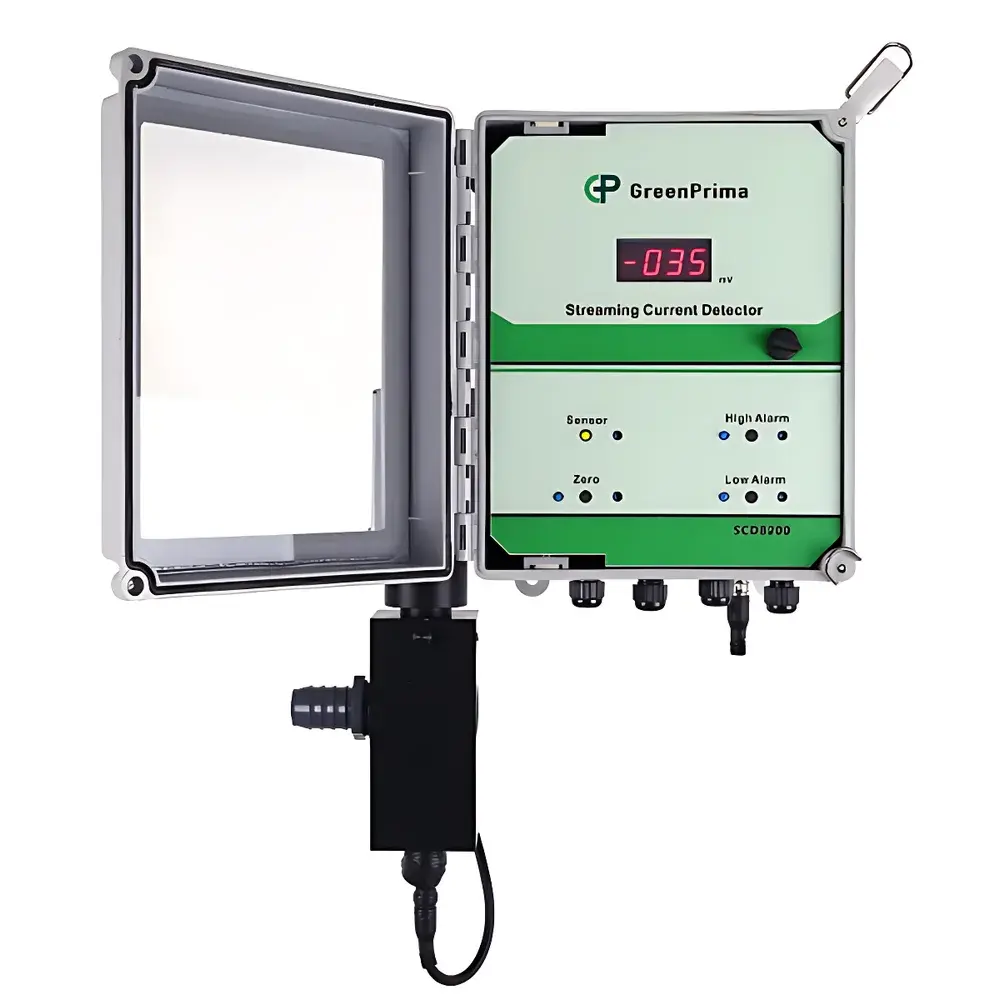
GreenPrima SCD8200 Streaming Current Detector
| Brand | GreenPrima |
|---|---|
| Origin | USA |
| Manufacturer Type | Manufacturer |
| Origin Category | Imported |
| Model | SCD8200 |
| Power Supply | 230 VAC |
| Measurement Range | −1000 to +1000 mV |
| Accuracy | ±0.1% of full scale |
| Display | LED |
| Flow Rate | 1 L/min |
| Inlet Connection | 1/2" barbed fitting |
| Outlet Connection | 3/4" barbed fitting |
| Response Time | 1 s |
| Output Signals | 4–20 mA, −10 to +10 V, 0–10 V |
| Communication | Modbus (optional) |
| Alarm Outputs | Hi/Lo relay |
| Enclosure Rating | NEMA 4X, IP65 |
| Sensor Housing Material | Chemically resistant polymer |
| Motor Type | High-torque DC motor with continuous duty cycle |
| Dimensions | 11" × 6" × 5" (W×H×D) |
| Weight | 9 kg |
Overview
The GreenPrima SCD8200 Streaming Current Detector is an industrial-grade online electrokinetic analyzer engineered for real-time optimization of coagulant dosing in potable water treatment plants. It operates on the principle of streaming current measurement—a well-established electrokinetic technique that quantifies the net charge density at the shear plane of colloidal particles suspended in aqueous solution. As process water flows through a precision-machined sensor chamber, a motor-driven piston induces controlled laminar shear, mobilizing counter-ions in the diffuse double layer surrounding suspended particulates. This ion displacement generates a measurable alternating current across embedded electrodes—termed the streaming current—which correlates directly with the degree of surface charge neutralization induced by coagulants such as aluminum sulfate, ferric chloride, or polyaluminum chloride (PACl). Unlike endpoint-based jar testing, the SCD8200 provides continuous, second-by-second feedback on coagulation status, enabling dynamic feed-forward control loops compatible with modern SCADA and DCS architectures.
Key Features
- High-stability streaming current sensing with ±0.1% full-scale accuracy over extended operational cycles
- Dual-mode analog output (4–20 mA and ±10 V) with configurable scaling for seamless integration into PLC and DCS systems
- NEMA 4X/IP65-rated non-metallic enclosure—designed for outdoor installation in humid, chemically aggressive environments
- Self-diagnostic capability with integrated sensor-status LED and automatic zero-point verification routine
- Adjustable signal gain and manual zero offset compensation to accommodate site-specific water matrix variations
- High-torque, brushless DC motor ensuring consistent piston stroke velocity and long-term mechanical reproducibility
- Barbed inlet (1/2″) and outlet (3/4″) fittings for rapid, leak-free connection to existing sample lines without threaded adapters
Sample Compatibility & Compliance
The SCD8200 is validated for continuous operation with raw, clarified, and filtered surface water streams typical of municipal drinking water facilities. It accommodates turbidities up to 100 NTU and total suspended solids (TSS) concentrations ≤ 50 mg/L without sensor fouling when operated within specified flow parameters (1 L/min nominal). The device complies with ANSI/ISA-12.12.01 for non-incendive electrical equipment and meets UL 508A requirements for industrial control panels. Its analog output architecture supports compliance with EPA Method 180.1 (coagulant optimization guidance) and aligns with ISO 5725-2 precision criteria for routine process monitoring instrumentation. Optional Modbus RTU communication enables audit-ready data logging in accordance with GLP and GMP documentation frameworks.
Software & Data Management
While the SCD8200 operates as a standalone analog transmitter, its optional Modbus RTU interface allows bidirectional communication with supervisory control systems. When integrated into a historian-enabled SCADA platform, streaming current values can be time-stamped, trended, and correlated with coagulant feed rates, turbidity, pH, and UV254 absorbance. The instrument supports configurable alarm thresholds with dry-contact relay outputs for high/low deviation alerts—critical for early detection of coagulant underdosing or overdosing events. All calibration and diagnostic logs are retained in non-volatile memory and accessible via external HART-compatible handheld communicators or field-configurable terminal interfaces.
Applications
- Real-time coagulant dosage optimization in conventional rapid mix–flocculation–sedimentation trains
- Feed-forward control of PACl or ferric salt injection in membrane pre-treatment systems serving reverse osmosis (RO) and nanofiltration (NF) units
- Performance validation of inline coagulant analyzers during regulatory compliance audits (e.g., Safe Drinking Water Act Section 141.21)
- Process stability monitoring during source water quality shifts—including seasonal algae blooms or dissolved organic carbon (DOC) fluctuations
- Sludge dewatering optimization in wastewater reclamation facilities where cationic polymer demand correlates with streaming current response
FAQ
How does streaming current differ from zeta potential measurement?
Streaming current reflects bulk charge neutralization in flowing water and is more robust for plant-wide control; zeta potential requires static, low-conductivity samples and is typically used in lab-scale colloid characterization.
Can the SCD8200 be installed on pressurized mainlines?
Yes—when paired with a properly sized pressure-reducing bypass loop, it accepts inlet pressures up to 100 psi; direct installation on unregulated mains is not recommended.
What maintenance intervals are required?
Sensor cleaning is advised every 3–6 months depending on raw water quality; piston seal replacement is specified at 18-month intervals per manufacturer service bulletin SB-SCD8200-03.
Is the device suitable for seawater or brackish water applications?
No—the high ionic strength suppresses measurable streaming current response; it is validated exclusively for freshwater matrices with conductivity < 2,000 µS/cm.
Does the SCD8200 support FDA 21 CFR Part 11 compliance?
As a hardware-only analog transmitter without electronic user authentication or audit trail generation, it does not independently meet Part 11—but its output signals may be captured and managed within a compliant enterprise system.
Related Products







