
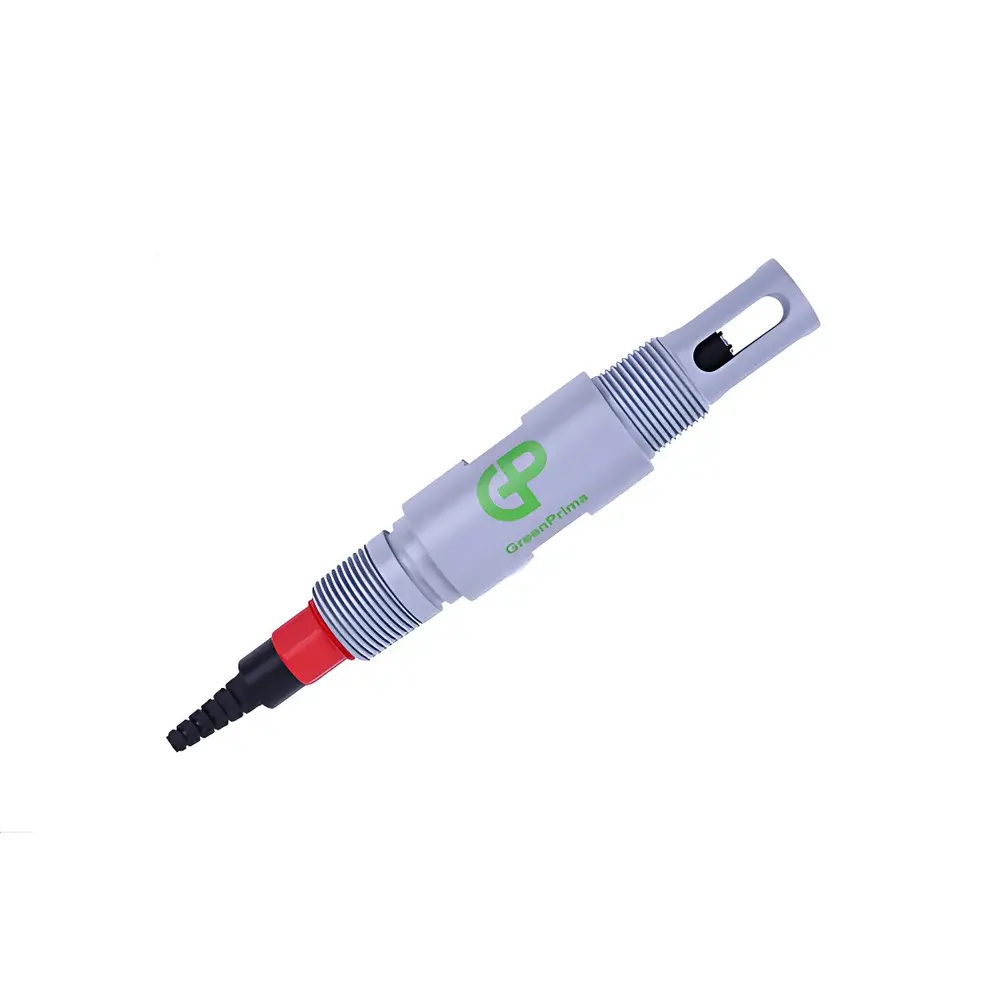
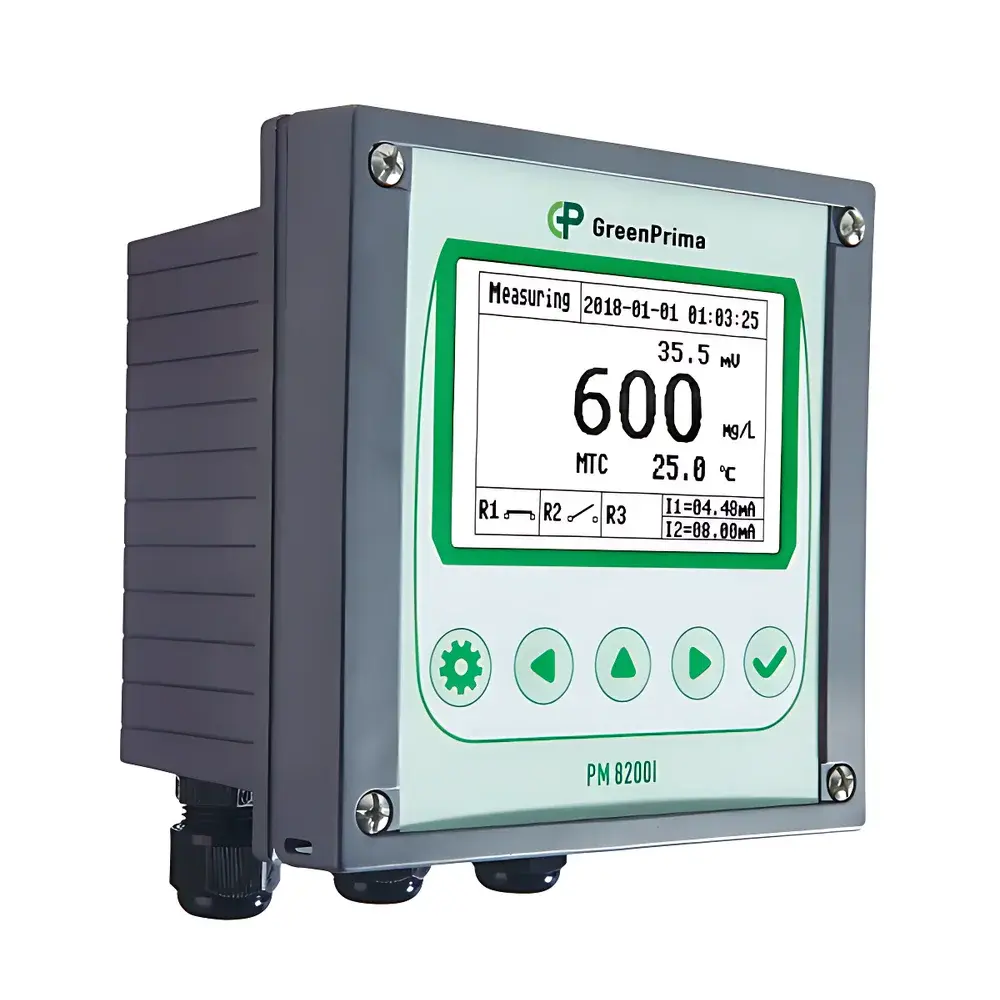
GreenPrima PM 8200I Online Chloride Ion Analyzer
| Brand | GreenPrima |
|---|---|
| Origin | United Kingdom |
| Manufacturer Type | Original Equipment Manufacturer (OEM) |
| Product Category | Imported Instrument |
| Model | PM 8200I |
| Detection Range | 0–30,000 mg/L Cl⁻ |
| Detection Limits | 0.01 / 0.1 / 1 ppm |
| Response Time | ≤30 s |
| Measurement Accuracy | ±0.01, ±0.1, or ±1 ppm (selectable resolution-dependent) |
| Operating Temperature | 0–70 °C |
| Temperature Compensation Range | −10 to 130 °C (NTC10K or PT1000 sensor compatible) |
| Enclosure Rating | IP65 |
| Power Supply | 90–260 VAC, 50/60 Hz or optional 24 VDC |
| Output | Dual isolated 4–20 mA |
| Relay Output | 1 multifunctional relay (for cleaning control, periodic alarm, fault alarm) |
| Data Storage | 600,000 timestamped records |
| Display | Backlit high-contrast dot-matrix LCD with adjustable contrast |
| Mounting Options | Wall-mount, pole-mount, panel-mount |
| Dimensions | 144 × 144 × 106 mm |
| Panel Cutout | 138 × 138 mm |
| Weight | 0.86 kg |
| Electrode Model | Bsens720 |
| Electrode Material | Polyphenylsulfone (PPS) |
| Max. Pressure Rating | 3.5 bar |
| Cable Length | 5 m |
| Compatible Media | Potable water, boiler feedwater, pharmaceutical water, industrial effluent |
Overview
The GreenPrima PM 8200I Online Chloride Ion Analyzer is an industrial-grade electrochemical monitoring system engineered for continuous, real-time quantification of chloride ion concentration in aqueous streams. It operates on the principle of potentiometric measurement using a solid-state, polymer-based ion-selective electrode (ISE)—the Bsens720—paired with a reference electrode in a dual-sensor configuration. The system employs Nernstian response calibration and automatic temperature compensation (ATC) to maintain measurement integrity across dynamic thermal conditions. Designed specifically for integration into municipal drinking water treatment plants, wastewater reclamation facilities, and process-critical industrial water loops—including power generation, pharmaceutical manufacturing, semiconductor fabrication, and electroplating—the PM 8200I delivers stable, trace-level detection without reagent consumption or optical interference. Its architecture conforms to long-term unattended operation requirements under ISO 9001-certified manufacturing and complies with EN 61326-1 (EMC) and EN 61000-6-2/6-3 standards.
Key Features
- High-stability chloride-selective electrode (Bsens720) constructed from chemically inert polyphenylsulfone (PPS), resistant to oxidation, scaling, and organic fouling in chlorinated and high-TDS environments
- Dual-range resolution switching: 0.01 ppm (low-range), 0.1 ppm (mid-range), and 1 ppm (high-range) modes—user-selectable to match application sensitivity requirements
- IP65-rated hermetically sealed enclosure with reinforced gasketing, enabling reliable deployment in humid, dusty, or splash-prone locations including pump stations and outdoor metering kiosks
- Backlit dot-matrix LCD with user-adjustable contrast and auto-dimming (3-minute timeout), supporting both English and Chinese language interfaces for multilingual operational environments
- Dual isolated 4–20 mA analog outputs with full-scale programmability (e.g., 0–1000 mg/L or 0–30,000 mg/L), each configurable independently for redundancy or multi-parameter trending
- RS485 serial interface compliant with MODBUS RTU protocol, facilitating seamless integration into SCADA, DCS, or PLC-based supervisory systems
- Configurable relay output supporting timed cleaning cycles (0.1–1000 h interval), duration-controlled solenoid activation (1–1000 s), and event-triggered alarms (e.g., sensor drift, signal loss, calibration overdue)
- Onboard non-volatile memory storing up to 600,000 timestamped data points (Cl⁻ concentration, temperature, system status, calibration logs), accessible via MODBUS or local display navigation
Sample Compatibility & Compliance
The PM 8200I is validated for use in potable water, secondary treated effluent, cooling tower makeup, boiler feedwater, and low-conductivity purified water systems (e.g., USP Purified Water, EP Water for Injection). It meets ASTM D511-20 (Standard Test Methods for Chloride Ion in Water) for field-deployable ISE-based quantification and supports GLP-compliant data integrity through time-stamped calibration records and audit-trail-capable firmware. While not FDA 21 CFR Part 11 certified out-of-the-box, its data export functionality (via MODBUS or optional USB dump) enables traceable archival in validated LIMS or electronic lab notebook (ELN) platforms. The Bsens720 electrode exhibits minimal interference from sulfate, nitrate, and bicarbonate ions at typical municipal water matrices (<5% cross-sensitivity per ISE selectivity coefficient data sheet).
Software & Data Management
No proprietary PC software is required for basic operation; all configuration, calibration, and diagnostics are performed locally via the front-panel interface. However, GreenPrima provides a free Windows-compatible configuration utility (PM-ConfigTool v3.x) supporting remote parameter setup, historical data extraction (.CSV), firmware updates, and calibration certificate generation. All stored measurements include UTC timestamps synchronized via internal RTC (battery-backed). For enterprise integration, the MODBUS RTU register map includes dedicated addresses for raw mV signal, compensated concentration, temperature, electrode impedance, and diagnostic flags—enabling predictive maintenance logic in upstream control systems. Data retention remains intact during power interruption due to EEPROM-backed storage.
Applications
- Municipal drinking water treatment: Continuous monitoring of residual chloride post-disinfection and pre-distribution to ensure compliance with WHO Guidelines for Drinking-water Quality (≤250 mg/L) and EPA Secondary Maximum Contaminant Levels
- Industrial wastewater discharge: Real-time tracking of chloride load from electroplating rinse baths, chlor-alkali process blowdown, or textile dyeing effluents prior to regulatory reporting
- Pharmaceutical water systems: Verification of chloride levels in purified water (PW) and water for injection (WFI) distribution loops per USP and EU GMP Annex 1 requirements
- Power plant chemistry control: Feedwater chloride surveillance to prevent stress corrosion cracking (SCC) in austenitic stainless steel condensers and steam generators
- Food & beverage processing: Monitoring of process water chloride content to avoid equipment pitting and ensure final product consistency
FAQ
What is the recommended calibration frequency for the Bsens720 electrode in continuous operation?
Calibration is advised every 7–14 days under stable conditions; however, automated drift checks can be scheduled daily via relay-triggered standard addition. Field validation against certified reference materials (CRM) is recommended quarterly.
Can the PM 8200I operate in seawater or brine applications?
No. While the electrode housing withstands 3.5 bar pressure, the Bsens720 is optimized for 0–30,000 mg/L (0–30 g/L); seawater (~19,000 mg/L Cl⁻) falls within range, but prolonged exposure above 25,000 mg/L may accelerate membrane saturation and require more frequent recalibration.
Is temperature compensation mandatory, and what sensors are supported?
Yes—temperature directly affects Nernst slope and junction potential. The unit accepts either NTC10K thermistors or PT1000 RTDs; manual offset entry is also available if external temperature data is supplied via MODBUS.
How is electrode fouling mitigated during long-term installation?
The integrated relay supports programmable mechanical or chemical cleaning cycles. Recommended protocols include low-pressure air purging (0.2–0.5 bar) or intermittent citric acid rinse (0.5% w/v, pH ~2.5), both triggered automatically based on impedance rise or time intervals.
Does the instrument support automatic zero and span calibration?
No—zero and span calibration must be performed manually using certified chloride standards (e.g., 10 mg/L and 1000 mg/L NaCl solutions). Auto-calibration is not implemented due to ISE drift characteristics and regulatory preference for documented human verification steps.







