
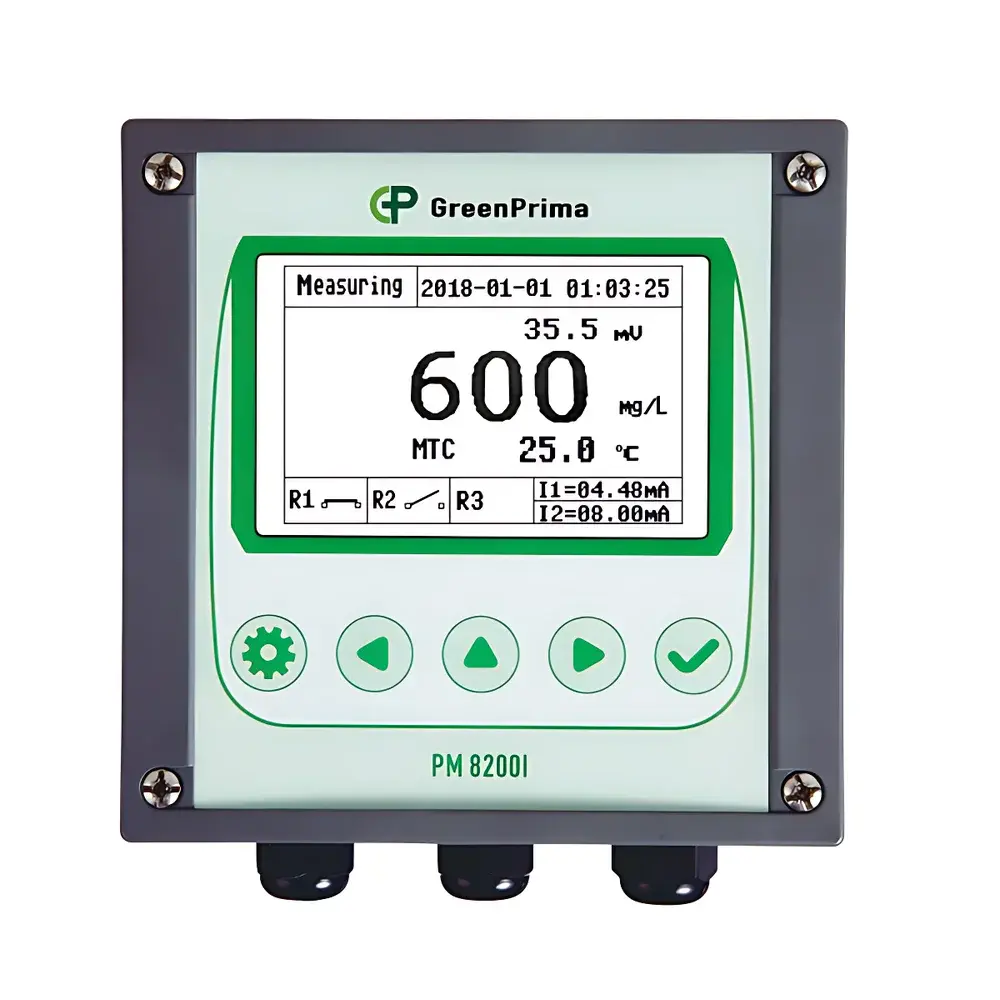
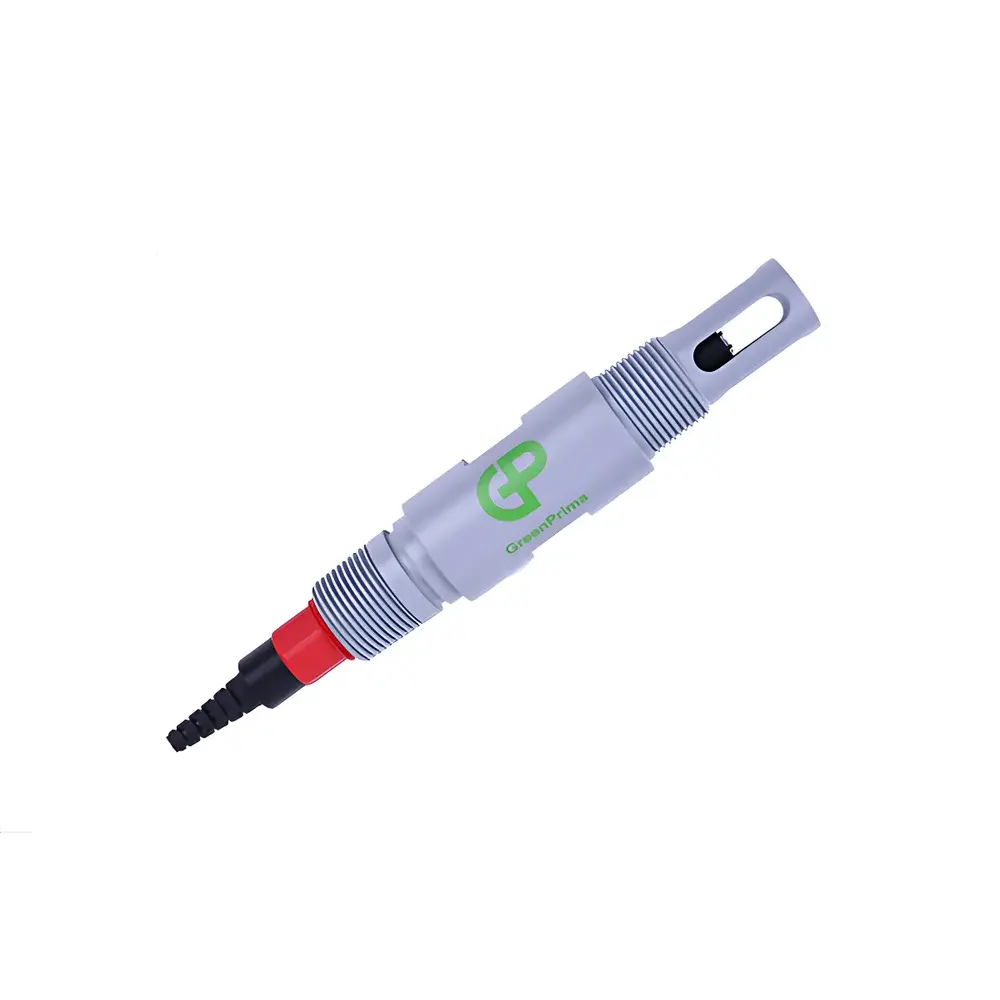
GreenPrima PM8200I Online Chloride Ion Analyzer
| Brand | GreenPrima |
|---|---|
| Origin | United Kingdom |
| Manufacturer Type | Original Equipment Manufacturer (OEM) |
| Product Category | Imported Instrument |
| Model | PM8200I Chloride |
| Instrument Type | Online Analyzer |
| Measurement Range | 0–30,000 mg/L Cl⁻ |
| Detection Limits | 0.01 / 0.1 / 1 ppm |
| Response Time | ≤30 s |
| Accuracy | ±0.01 / ±0.1 / ±1 ppm (depending on range) |
| Operating Temperature | 0–70 °C |
| Temperature Compensation | -10 to 130 °C (NTC10K or PT1000 sensor compatible) |
| Display | Backlit graphical LCD |
| Output | Dual isolated 4–20 mA (max. loop resistance 500 Ω, accuracy 0.1% FS) |
| Communication | RS485 with MODBUS RTU protocol |
| Relay Output | 1 multifunctional relay (for cleaning control, periodic alarm, fault alarm) |
| Data Logging | Up to 600,000 records with timestamped retrieval |
| Enclosure Rating | IP65 |
| Power Supply | 90–260 VAC, 50/60 Hz or optional 24 VDC |
| Mounting Options | Wall-mounted, pole-mounted, panel-mounted |
| Dimensions | 144 × 144 × 106 mm |
| Panel Cutout | 138 × 138 mm |
| Weight | 0.86 kg |
| Chloride Sensor | Bsens720 |
| Sensor Material | Polyphenylsulfone (PPS) |
| Electrode Max. Pressure | 3.5 bar |
| Cable Length | 5 m |
| Sensor Operating Temp. | -5 to 70 °C |
Overview
The GreenPrima PM8200I Online Chloride Ion Analyzer is a dedicated electrochemical process analyzer engineered for continuous, real-time quantification of chloride ion concentration in aqueous streams. It employs potentiometric measurement using a solid-state, polymer-based chloride-selective electrode (Bsens720), operating on the principle of ion activity-dependent potential difference across a selective membrane. This method conforms to ISO 9297 (water quality — determination of chloride — potentiometric method) and supports regulatory compliance in applications governed by EPA Method 325, ASTM D512, and USP <645>. Designed for unattended operation in industrial water treatment, boiler feedwater monitoring, pharmaceutical purified water systems, and municipal wastewater effluent control, the PM8200I delivers stable baseline performance under variable flow, temperature, and conductivity conditions. Its architecture integrates temperature-compensated signal conditioning, digital filtering, and adaptive calibration logic to minimize drift and ensure long-term reproducibility without manual intervention.
Key Features
- Potentiometric chloride sensing with Bsens720 electrode—chemically resistant PPS housing, 3.5 bar pressure rating, and 5 m shielded cable for flexible installation in pressurized or submerged configurations
- Dual independent 4–20 mA analog outputs, each configurable for chloride concentration, temperature, or status signals; fully isolated with 0.1% full-scale accuracy
- RS485 serial interface compliant with MODBUS RTU protocol for seamless integration into SCADA, DCS, and PLC-based automation infrastructures
- IP65-rated rugged enclosure with sealed front panel, enabling deployment in humid, dusty, or splash-prone environments including outdoor lift stations and chemical dosing rooms
- Graphical backlit LCD display supporting simultaneous visualization of chloride value (mg/L or ppm), temperature (°C), system status, relay states, and real-time trend indicators
- Configurable multifunction relay with programmable timing—supports automated electrode cleaning cycles (0.1–1000 h interval), maintenance alerts, and fault-triggered shutdown sequences
- Embedded non-volatile memory storing up to 600,000 timestamped data points with UTC synchronization; accessible via MODBUS register mapping or local menu navigation
- Full-featured calibration management: single-point or two-point standardization, slope validation, and drift compensation algorithms activated during zero/span verification
Sample Compatibility & Compliance
The PM8200I is validated for use with low-to-moderate ionic strength samples typical of drinking water, reverse osmosis permeate, boiler blowdown, cooling tower make-up, and treated wastewater effluents. It exhibits minimal interference from common anions—including sulfate, nitrate, and bicarbonate—within concentrations encountered in regulated utility and industrial settings. The Bsens720 electrode demonstrates stable response in pH ranges from 2.0 to 12.0 and tolerates suspended solids up to 50 mg/L without clogging. Regulatory alignment includes support for 21 CFR Part 11-compliant audit trails when paired with GreenPrima’s optional data acquisition software, and compatibility with GLP/GMP documentation workflows through traceable calibration logs and event-driven data export. All firmware and hardware design adhere to IEC 61326-1 (EMC for measurement equipment) and IEC 61000-4 series immunity standards.
Software & Data Management
Data integrity is maintained through dual-layer logging: onboard flash memory retains all measurements, alarms, and configuration changes with millisecond timestamps, while MODBUS-enabled remote polling allows centralized historian ingestion at user-defined intervals (1 s to 1 h). Configuration parameters—including measurement range selection, temperature compensation mode (manual/automatic), relay activation thresholds, and cleaning duty cycles—are managed via intuitive on-device menu navigation or remotely via ASCII command set. Firmware updates are performed over RS485 using signed binary packages to prevent unauthorized modification. Optional GreenPrima Analytics Suite (v3.x) provides web-based dashboard visualization, statistical process control (SPC) charting, deviation alerting, and PDF report generation aligned with ISO/IEC 17025 reporting requirements.
Applications
- Municipal and industrial wastewater treatment plants: continuous monitoring of chloride discharge limits per local environmental permits (e.g., EU Urban Wastewater Directive Annex I)
- Power generation facilities: boiler feedwater purity assurance to prevent stress corrosion cracking in steam turbines and heat exchangers
- Pharmaceutical manufacturing: USP <645> compliance for purified water and water-for-injection (WFI) systems where chloride must remain below 0.1 ppm
- Electroplating and PCB fabrication lines: bath chemistry control to avoid pitting corrosion and ensure uniform metal deposition
- Food & beverage processing: verification of rinse water quality post-CIP cycles and regulatory adherence to FDA Food Code §3-201.12
- Desalination pre-treatment: early detection of seawater intrusion or membrane failure in RO feed streams
FAQ
What calibration standards are recommended for the PM8200I?
Standard solutions traceable to NIST SRM 3199 (potassium chloride) at 10, 100, and 1000 ppm Cl⁻ are advised for initial setup and periodic verification.
Can the Bsens720 electrode be used in high-turbidity or oily wastewater?
Yes—its PPS body and integrated reference junction design resist fouling; however, mechanical filtration (e.g., 50 µm cartridge) upstream is recommended for samples exceeding 100 NTU or containing free oil.
Is temperature compensation mandatory?
Yes—chloride activity is thermally dependent; the instrument requires either integrated NTC10K or external PT1000 input for accurate compensation across the full 0–70 °C operating range.
How often does the electrode require maintenance?
Under typical municipal water conditions, cleaning every 7–14 days suffices; in aggressive industrial effluents, daily automated cleaning may be configured via the relay output.
Does the PM8200I support hazardous area installation?
No—the unit is rated for general-purpose use only (IP65); explosion-proof enclosures or intrinsically safe barrier kits must be provided externally if deployed in Zone 2 or Class I Div 2 locations.







