
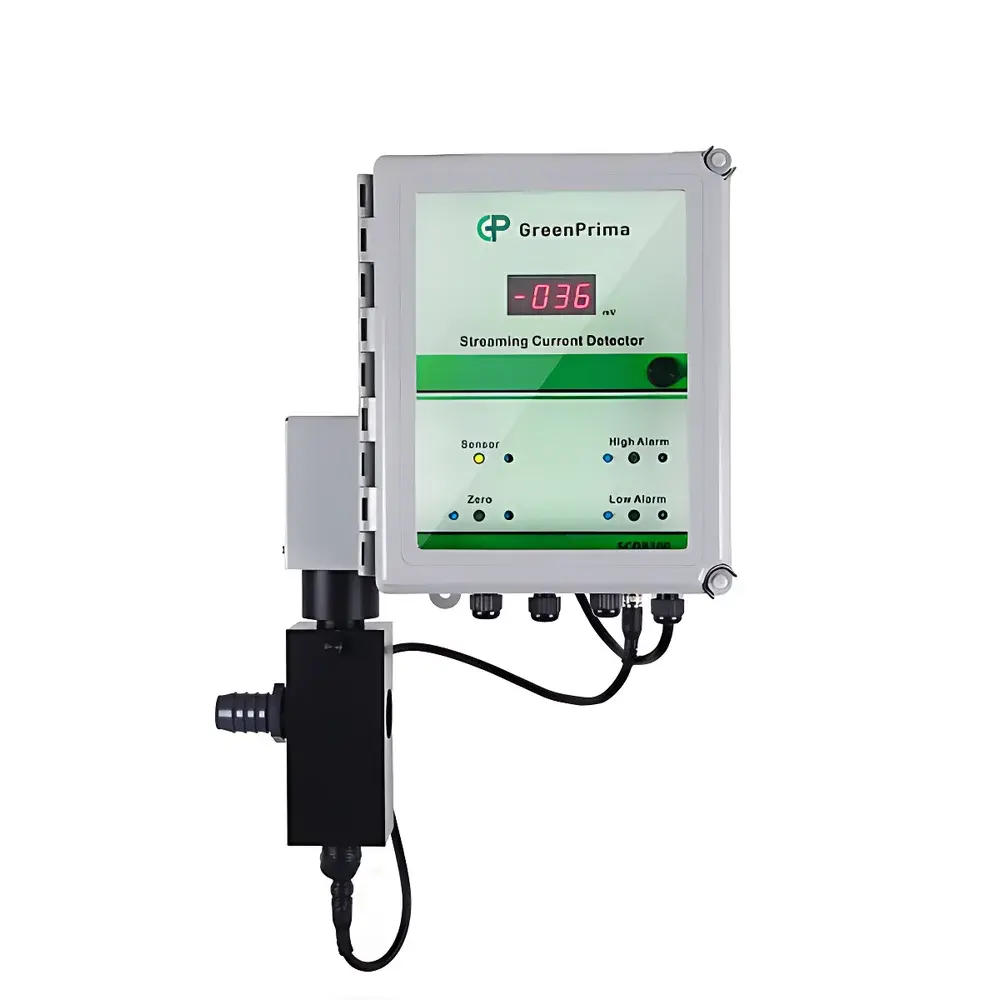
GreenPrima SCD8200 Streaming Current Detector
| Brand | GreenPrima |
|---|---|
| Origin | USA |
| Manufacturer | GreenPrima Ltd. (UK) |
| Model | SCD8200 |
| Power Supply | 100–240 VAC, 50/60 Hz |
| Measurement Range | −1000 to +1000 mV |
| Accuracy | ±0.1% of full scale |
| Response Time | ≤1 s |
| Flow Rate | 1 US gal/min (3.78 L/min) |
| Inlet/Outlet | 1/2″ and 3/4″ barbed quick-connect fittings |
| Electrode Material | Delrin® housing / 316 stainless steel / PTFE seals |
| Output Signals | 4–20 mA, ±10 V, 0–10 V |
| Communication | Optional MODBUS RTU (RS-485) |
| Alarm Outputs | Dual SPDT relays (high/low) |
| Enclosure Rating | NEMA 4X / IP65 |
| Dimensions | 11.0″ × 6.0″ × 5.5″ (279 × 152 × 140 mm) |
| Weight | 9 kg |
| Auto-zero Calibration | Yes |
| Self-Diagnostic LED Indicator | Yes |
Overview
The GreenPrima SCD8200 Streaming Current Detector is an industrial-grade online analytical instrument engineered for real-time monitoring and control of coagulant dosing in water and wastewater treatment processes. It operates on the principle of streaming current measurement—a well-established electrokinetic technique that quantifies the net surface charge of colloidal particles and dissolved ionic species in aqueous suspension. As a piston-driven flow cell passes sample water across two precisely spaced electrodes, controlled shear forces liberate counter-ions from the electrical double layer surrounding suspended colloids. The resulting alternating current—generated by the directional migration of these free ions under oscillatory flow—is measured as streaming current (in millivolts). This value correlates directly with the residual charge imbalance post-coagulation, providing a robust, process-relevant proxy for coagulant demand and floc formation efficiency.
Key Features
- True continuous online operation with sub-second response time (≤1 s), enabling dynamic feedback control of coagulant feed pumps.
- Self-contained, maintenance-optimized sensor design featuring chemically inert wetted materials: Delrin® body, 316 stainless steel electrodes, and PTFE sealing components—ensuring long-term stability in aggressive municipal and industrial effluents.
- Integrated auto-zero calibration routine eliminates manual drift correction and supports unattended operation over extended intervals.
- NEMA 4X/IP65-rated non-metallic enclosure with latch-closure housing—rated for permanent outdoor installation in humid, dusty, or splash-prone environments.
- Dual analog outputs (4–20 mA and ±10 V) plus optional MODBUS RTU (RS-485) support seamless integration into existing SCADA, DCS, or PLC-based process automation systems.
- Configurable high/low alarm relays provide fail-safe interlocks for coagulant pump shutdown or operator notification during charge reversal or dosage deviation.
- Onboard self-diagnostic LED indicator enables rapid field verification of sensor integrity, flow status, and signal validity without external instrumentation.
Sample Compatibility & Compliance
The SCD8200 is validated for use across a broad spectrum of influent and effluent matrices—including surface water, clarified secondary effluent, membrane pre-filtration streams, and sludge dewatering filtrates—with turbidity up to 200 NTU and total suspended solids (TSS) ≤150 mg/L. Its measurement methodology aligns with established electrokinetic assessment practices referenced in ASTM D5897-19 (Standard Test Method for Streaming Current Detection of Colloidal Charge) and supports compliance with ISO 5667-3 (water sampling—preservation and handling) for representative online sampling protocols. While not a standalone regulatory compliance device, the instrument delivers data traceable to GLP/GMP-aligned operational procedures when deployed within validated control strategies per EPA Guidance for Coagulant Optimization (EPA 815-R-04-007) and EU Drinking Water Directive (2020/2184) Annex I parameter monitoring frameworks.
Software & Data Management
The SCD8200 functions as a stand-alone transducer and does not require proprietary software for basic operation. However, its analog and MODBUS outputs are fully compatible with industry-standard historian platforms (e.g., Ignition, Siemens Desigo CC, Honeywell Experion PKS) for time-series logging, trend analysis, and alarm event correlation. When integrated into automated dosing loops, the streaming current signal serves as the primary process variable (PV) in PID-controlled coagulant injection—enabling closed-loop optimization that meets FDA 21 CFR Part 11 requirements when paired with audit-trail-enabled DCS systems. Raw mV output is linearly scalable and digitally timestamped at source, supporting ISO/IEC 17025-compliant uncertainty budgeting for laboratory-validated process control applications.
Applications
- Real-time optimization of polyaluminum chloride (PACl), ferric chloride, or cationic polymer dosing in potable water treatment plants.
- Monitoring coagulant demand shifts during seasonal raw water quality fluctuations (e.g., DOC spikes, algal blooms, or NOM variability).
- Control of chemical addition in low-pressure membrane (MF/UF) pretreatment to minimize irreversible fouling and extend membrane service life.
- Feedback regulation of flocculant dosing in sludge dewatering centrifuges and belt filter presses—reducing polymer consumption and improving cake dryness.
- Validation of jar test results in pilot-scale studies and full-scale commissioning of new coagulation basins.
- Supporting digital twin modeling of coagulation kinetics through high-frequency streaming current time-series datasets.
FAQ
How does streaming current differ from zeta potential measurement?
Streaming current reflects bulk colloidal charge density under dynamic flow conditions and is more robust for online process control; zeta potential requires static electrophoretic mobility measurements typically performed offline in lab settings.
Can the SCD8200 be used in seawater or high-salinity brines?
No—it is designed for freshwater and low-to-moderate conductivity applications (<5,000 µS/cm); high ionic strength suppresses measurable streaming current due to double-layer compression.
Is regular cleaning of the flow cell required?
The piston-driven design provides inherent self-cleaning action; routine inspection every 3–6 months is recommended depending on feed water fouling potential.
Does the instrument require reference standards for calibration?
No—zero-point calibration is fully automatic; span verification may be performed using certified charge-balanced standard solutions (e.g., 1 mM KCl + 0.1 mM Al2(SO4)3) per ASTM D5897 Annex A3.
What maintenance intervals are recommended for long-term reliability?
Annual replacement of O-rings and inspection of piston seal integrity is advised; no consumables or reagents are required during normal operation.
Related Products







