
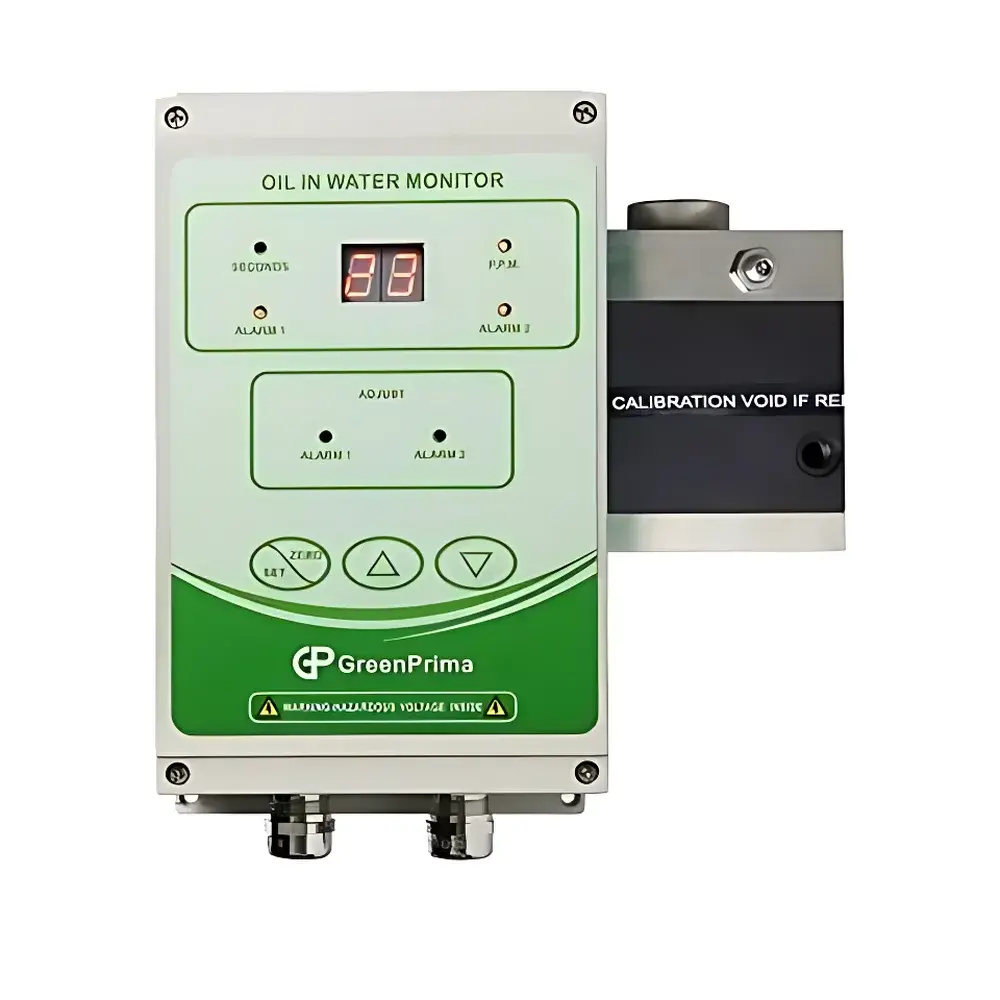
GreenPrima PRO CON7000 Online Oil-in-Water Analyzer
| Brand | GreenPrima |
|---|---|
| Origin | United Kingdom |
| Manufacturer Type | Manufacturer |
| Origin Category | Imported |
| Model | PRO CON7000 |
| Instrument Type | Online |
| Measurement Principle | Fluorescence-based Optical Detection (Non-Extractive, Solvent-Free) |
| Measurement Range | 0–99 ppm |
| Accuracy | ±2 ppm |
| Alarm Setpoint Range | 1–98 ppm (adjustable) |
| Alarm Delay 1 | 0–60 s (adjustable) |
| Alarm Delay 2 | 10–240 s (adjustable) |
| Display | 240 × 128 pixel touchscreen |
| Analog Outputs | 0/4–20 mA (min. load 820 Ω), 0–5 V / 1–5 V DC (min. load 50 kΩ) |
| Sample Flow Rate | 0.1–2 L/min |
| Sample Temperature | 1–40 °C |
| Sample Pressure | 0.1–10 bar |
| Ambient Temperature | 1–60 °C |
| Humidity | ≤90% RH at 55 °C |
| Enclosure Rating | IP55 |
| Electrical Safety | EN 61010-1, IEC 664 Category II |
| Weight | 2.25 kg |
| Dimensions (H×W×D) | 215 × 242 × 73 mm |
| Power Supply | 230 V / 115 V AC or 24 V AC |
| Max. Power Consumption | 10 VA |
Overview
The GreenPrima PRO CON7000 Online Oil-in-Water Analyzer is an industrial-grade, fluorescence-based optical sensor system engineered for continuous, real-time monitoring of hydrocarbon contamination in aqueous streams. Unlike solvent-extraction or gravimetric methods, the PRO CON7000 employs a non-contact, extractive-free excitation-emission principle: polycyclic aromatic hydrocarbons (PAHs) present in mineral oils, lubricants, and diesel absorb UV light and emit characteristic fluorescence signals proportional to concentration. This method delivers rapid response (<30 s T90), eliminates reagent consumption, and avoids cross-sensitivity to suspended solids—making it ideal for cooling water circuits, condensate return lines, and effluent discharge points where operational continuity and regulatory compliance are critical.
Key Features
- Automated self-diagnostic routine with built-in drift compensation—ensures long-term stability without manual recalibration.
- Adjustable measurement intervals (1–30 minutes) and externally triggered analysis via dry-contact input.
- Configurable dual-stage alarm logic with independently adjustable thresholds (1–98 ppm), delay timers (Alarm 1: 0–60 s; Alarm 2: 10–240 s), and relay outputs rated at 8 A @ 240 V AC.
- Intuitive 240 × 128 pixel resistive touchscreen interface with multilingual menu support (English, German, French, Spanish).
- Programmable analog outputs: isolated 4–20 mA (min. load 820 Ω) and voltage outputs (0–5 V / 1–5 V DC, min. load 50 kΩ) compliant with standard DCS/PLC signal acquisition.
- Robust mechanical design with IP55-rated enclosure; optional IP65 external junction box for field-mounted relay and I/O connections.
- Low-maintenance optical path with quartz flow cell and integrated temperature-compensated photodetector array.
Sample Compatibility & Compliance
The PRO CON7000 is validated for use with clear to mildly turbid aqueous matrices including engine cooling water, boiler condensate (with inline cooling accessory), freshwater circulation systems, and pre-treated industrial wastewater. It exhibits minimal interference from common ions (Ca²⁺, Mg²⁺, Cl⁻), dissolved organic carbon (DOC < 10 mg/L), and particulates up to 50 ppm total suspended solids (TSS)—a performance benchmark verified per ASTM D7622-22 Annex A1 for oil-in-water sensor validation. The instrument meets EN 61010-1 safety requirements for industrial measurement equipment and supports audit-ready operation under GLP and ISO/IEC 17025 frameworks. While not intrinsically safe, it is suitable for Zone 2/Class I, Division 2 environments when installed per IEC 60079-14 guidelines.
Software & Data Management
Data logging is supported via optional USB flash drive (FAT32 formatted), capturing timestamped concentration values, alarm events, diagnostic flags, and system status every 10 seconds. Logged files export as CSV for traceability and integration into LIMS or SCADA platforms. Firmware updates are performed locally via USB or remotely through Modbus RTU (RS-485 port, optional). All configuration changes—including calibration offsets, alarm setpoints, and output scaling—are recorded with user ID and timestamp in an internal event log, satisfying FDA 21 CFR Part 11 requirements for electronic records when deployed with appropriate access controls and audit trail review procedures.
Applications
- Real-time leak detection in lube oil coolers and jacket water systems within power generation and marine propulsion plants.
- Condensate purity assurance in steam cycle systems—enabling early intervention before turbine oil carryover compromises efficiency or causes blade fouling.
- Compliance monitoring of treated wastewater prior to environmental discharge (e.g., EPA 40 CFR Part 425, EU WFD Annex V).
- Groundwater remediation verification at hydrocarbon-contaminated sites using passive or pumped sampling manifolds.
- Process water quality control in food & beverage, pharmaceutical, and semiconductor manufacturing where hydrocarbon ingress poses product integrity risks.
FAQ
Does the PRO CON7000 require periodic calibration with standard oil solutions?
No. The analyzer uses factory-characterized optical response curves and on-board temperature/zero drift correction algorithms. Field verification against certified reference standards (e.g., ISO 9377-2 mineral oil emulsions) is recommended annually or after sensor replacement.
Can the unit operate continuously at 40 °C sample temperature?
Yes. The flow cell and detector electronics are thermally stabilized to maintain accuracy across the full 1–40 °C sample range. An external chiller is required only for samples >40 °C or for condensate applications where saturation vapor pressure must be reduced.
Is Modbus TCP supported for Ethernet integration?
Modbus TCP is not natively supported; however, RS-485 Modbus RTU communication is available via optional expansion module. Integration with Ethernet-based control systems requires a protocol gateway (e.g., Moxa EDS-G205A) configured for Modbus RTU-to-TCP bridging.
What maintenance intervals are specified for the optical window and flow path?
Under typical cooling water conditions (≤5 ppm TSS, ≤2 ppm Fe), the quartz flow cell requires cleaning every 6–12 months using 10% citric acid solution. No consumables or lamps are used—the LED excitation source has a rated lifetime of >50,000 hours.
How is sensor fouling addressed during long-term deployment?
The flow cell incorporates a 1.2 mm internal orifice and turbulent flow design to minimize deposit accumulation. Optional air-pulse or ultrasonic cleaning modules can be integrated upstream for high-fouling applications such as oily bilge water or refinery blowdown streams.
Related Products







