
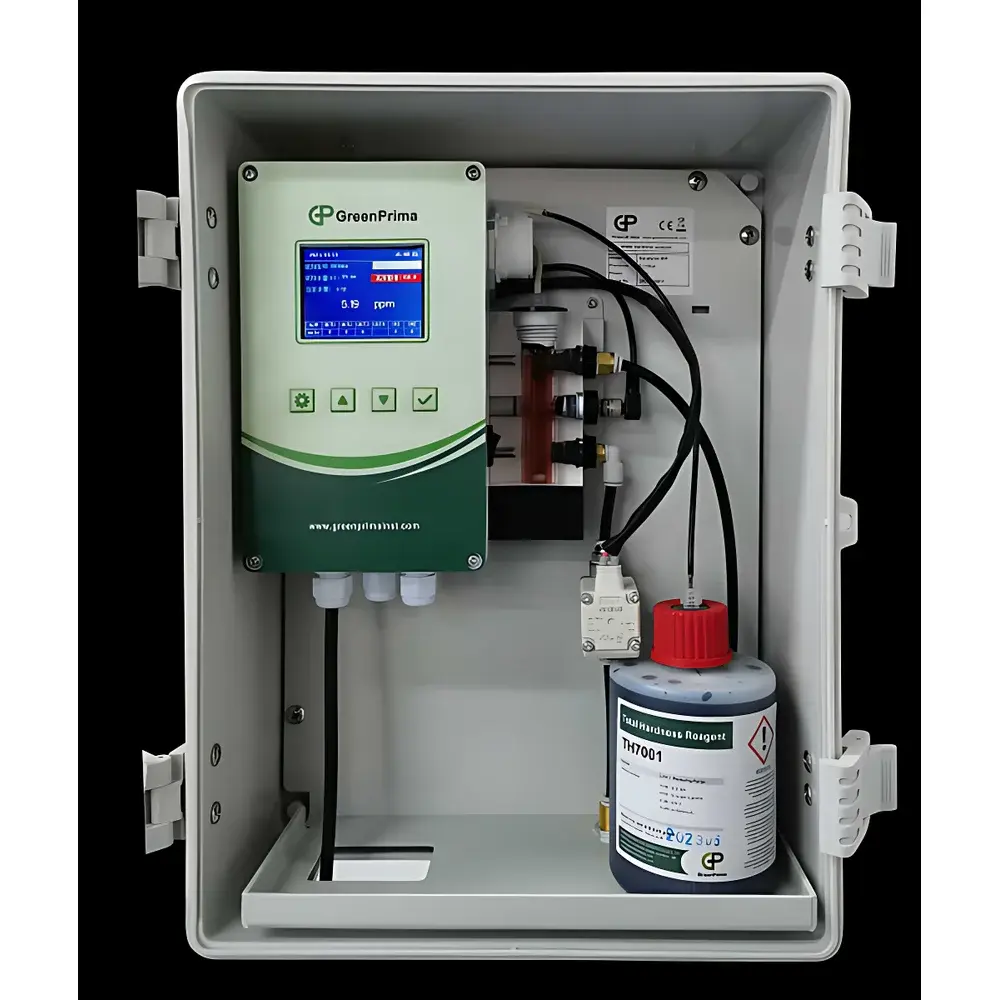
GreenPrima Aqualysis 800 Online Water Hardness Analyzer
| Brand | GreenPrima |
|---|---|
| Origin | Shanghai, China |
| Manufacturer Type | Manufacturer |
| Regional Classification | Domestic (China) |
| Model | Aqualysis 800 |
| Instrument Type | Online Water Quality Analyzer |
| Measured Parameter | Calcium and Magnesium Hardness (as CaCO₃) |
| Measurement Method | Photometric Titration (Colorimetric Endpoint Detection) |
| Measurement Range | 0.447–625.8 ppm as CaCO₃ |
| Accuracy | ±2% of selected reagent upper limit |
| Repeatability | ±1% of selected reagent upper limit |
| Cycle Time | ~3 minutes (hardness-dependent) |
| Display | Color LCD (Bilingual: English & Chinese) |
| Dimensions | 400 × 300 × 180 mm (W×H×D) |
| Weight | 4 kg |
| Enclosure Rating | IP65 |
| Power Supply | 85–265 VAC, 47–63 Hz |
| Power Consumption | 25 VA (operational), 3.5 VA (standby) |
| Output Interfaces | 4 programmable relay outputs (250 VAC / 4 A max), 1 isolated 4–20 mA analog output (750 Ω max), 1 RS485 (Modbus RTU) |
| Digital Inputs | 2 programmable (IN1: start analysis |
| IN2 | stop analysis) |
| Data Storage | Internal logging with timestamped records |
| Sample Requirements | pH 4–10 |
| Sample Temperature | 5–40 °C |
| Ambient Operating Temperature | 10–40 °C |
| Sample Pressure | 0.2–6 bar (recommended: 1–2 bar) |
| Mounting | Wall-mounted |
| Calibration & Maintenance | Factory-calibrated |
Overview
The GreenPrima Aqualysis 800 Online Water Hardness Analyzer is an industrial-grade, photometric titration-based instrument engineered for continuous, real-time monitoring of total hardness—expressed as calcium carbonate (CaCO₃)—in process and utility water streams. Unlike conventional conductivity- or ion-selective electrode-based estimations, the Aqualysis 800 employs a standardized colorimetric endpoint detection method compliant with ISO 6059 and ASTM D1126 protocols for hardness determination. The system automates the classical EDTA titration principle: a precisely metered sample reacts with a buffered chromogenic reagent (e.g., Eriochrome Black T), followed by incremental dosing of standardized EDTA solution until stoichiometric complexation of Ca²⁺ and Mg²⁺ ions is complete. The resulting absorbance shift at 550 nm is quantified via dual-beam photometry, delivering traceable, chemically grounded hardness values without cross-sensitivity to monovalent ions or alkalinity fluctuations. Designed for integration into closed-loop water treatment systems, it provides deterministic data for softener regeneration scheduling, boiler feedwater compliance verification, and pharmaceutical water system validation under USP and EU Annex 1 requirements.
Key Features
- Photometric titration platform with optical endpoint detection—ensures chemical specificity for Ca²⁺/Mg²⁺ over non-carbonate hardness interferences
- Bilingual (English/Chinese) color LCD interface with intuitive navigation, real-time trend visualization, and alarm status mapping
- Compact wall-mount form factor (400 × 300 × 180 mm, 4 kg) rated IP65 for deployment in humid mechanical rooms, boiler houses, and clean utility corridors
- Configurable measurement intervals (0–360 min) and programmable rinse cycles (15–1800 s) to adapt to variable flow dynamics and fouling risk profiles
- Four independent relay outputs assignable to hardness thresholds, maintenance alerts, or softener bypass commands; two digital inputs for external trigger synchronization (e.g., pump activation or valve position feedback)
- Isolated 4–20 mA output with HART-compatible configuration and Modbus RTU over RS485 for SCADA/DNC integration and centralized data aggregation
- Low-reagent architecture: average consumption of ≤1.2 mL per analysis using TH-series reagents (TH7001 to TH7100), supporting ≥30 days of continuous operation without service intervention
Sample Compatibility & Compliance
The Aqualysis 800 operates within defined physicochemical boundaries to maintain analytical integrity. Acceptable sample matrices include deionized, reverse osmosis, softened, and low-TDS surface waters—but exclude high-iron (>3 ppm), high-copper (>0.2 ppm), or highly turbid streams without pre-filtration. Its operational pH window (4.0–10.0) accommodates most treated industrial waters, while temperature tolerance (5–40 °C sample; 10–40 °C ambient) aligns with ASME PTC 19.11 and VDI 2046 standards for thermal system instrumentation. All firmware and data handling routines support audit-trail generation per FDA 21 CFR Part 11 when paired with compliant enterprise software. The analyzer meets IEC 61326-1 (EMC) and IEC 61010-1 (safety) directives, and its reagent cartridges are supplied with CoA documentation traceable to NIST SRMs.
Software & Data Management
Data acquisition is governed by embedded firmware supporting time-stamped internal storage of ≥10,000 measurement records, including raw absorbance values, titrant volume consumed, calculated hardness, and system diagnostics (e.g., pump stroke count, reagent level, optical path integrity). Export is supported via USB mass storage or Modbus polling. Optional GreenPrima DataLink™ software enables remote configuration, calibration history review, statistical process control (SPC) charting (X̄/R charts), and automated report generation aligned with ISO/IEC 17025 laboratory documentation frameworks. Audit trails record user actions, parameter changes, and calibration events with immutable timestamps—essential for GLP/GMP-regulated environments such as pharmaceutical purified water systems.
Applications
- Boiler feedwater hardness surveillance to prevent scale formation per ASME B31.1 and EN 12952-12 guidelines
- Softener effluent verification in HVAC cooling towers and district heating networks
- Final polish monitoring for WFI (Water for Injection) and Purified Water systems per USP , EP 2.2.42, and JP 17
- Closed-loop recirculation control in semiconductor ultrapure water (UPW) sub-loops where residual hardness must remain <10 ppb
- Performance validation of nanofiltration and ion exchange units during commissioning and routine PQ testing
FAQ
What measurement principle does the Aqualysis 800 use, and how does it differ from conductivity-based hardness estimation?
It applies photometric titration per ISO 6059, directly quantifying Ca²⁺/Mg²⁺ via stoichiometric EDTA chelation. Conductivity methods infer hardness indirectly and lack ion specificity—rendering them unreliable in mixed-salt or low-hardness applications.
Can the Aqualysis 800 be integrated into a DCS or PLC-controlled water treatment skid?
Yes—via isolated 4–20 mA output, Modbus RTU over RS485, and dry-contact relay signals compatible with Siemens S7, Rockwell ControlLogix, and Schneider EcoStruxure platforms.
Is reagent calibration required between batches, and how is traceability maintained?
Each TH-series reagent kit includes a certificate of analysis referencing NIST-traceable CaCO₃ standards. No field recalibration is needed; the system validates reagent potency automatically during each blank cycle.
Does the analyzer support multi-channel expansion for parallel sampling points?
Yes—when coupled with the GreenPrima MCS-4 or MCS-8 Multi-Channel Selector, it supports up to eight independent sample lines with auto-sequenced analysis and channel-specific alarm thresholds.
What maintenance tasks are required during normal operation?
Monthly visual inspection of tubing and cuvette cleanliness; quarterly verification of pump tube elasticity; annual optical alignment check—no routine sensor replacement or electrolyte refills required.
Related Products







