
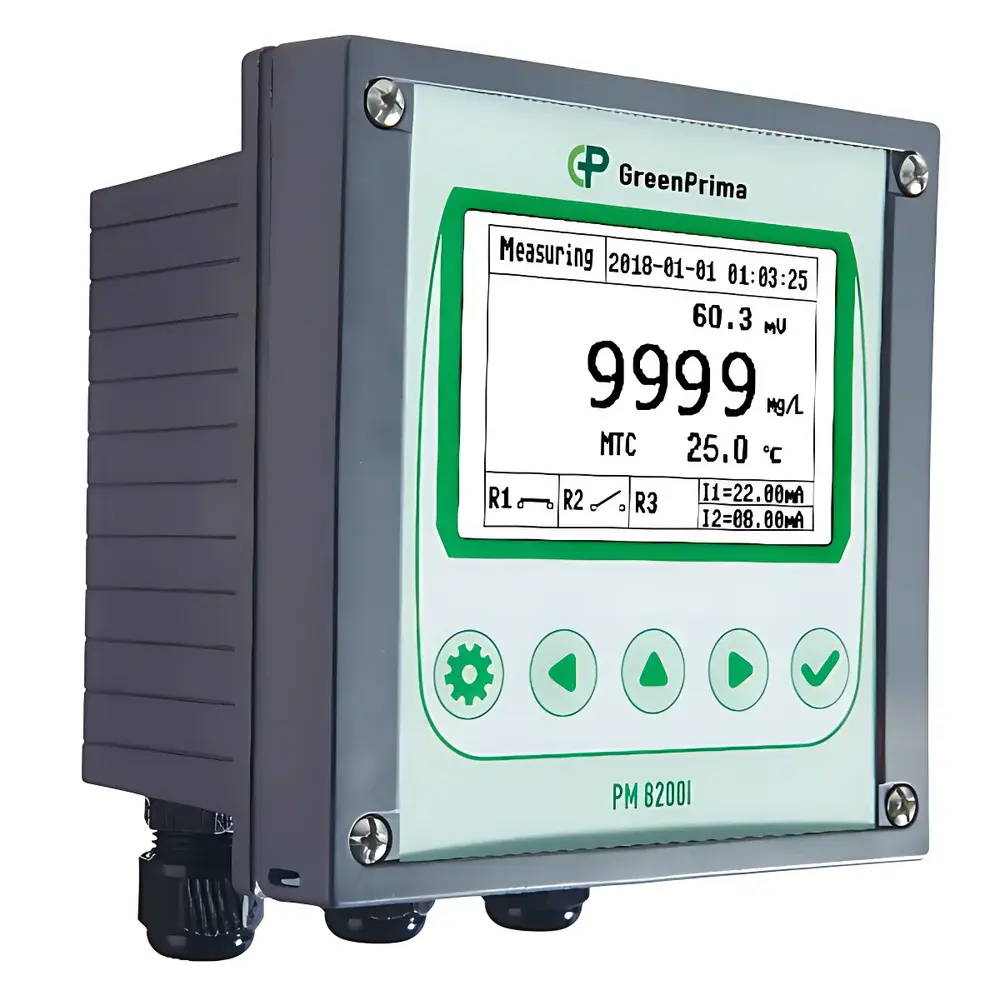
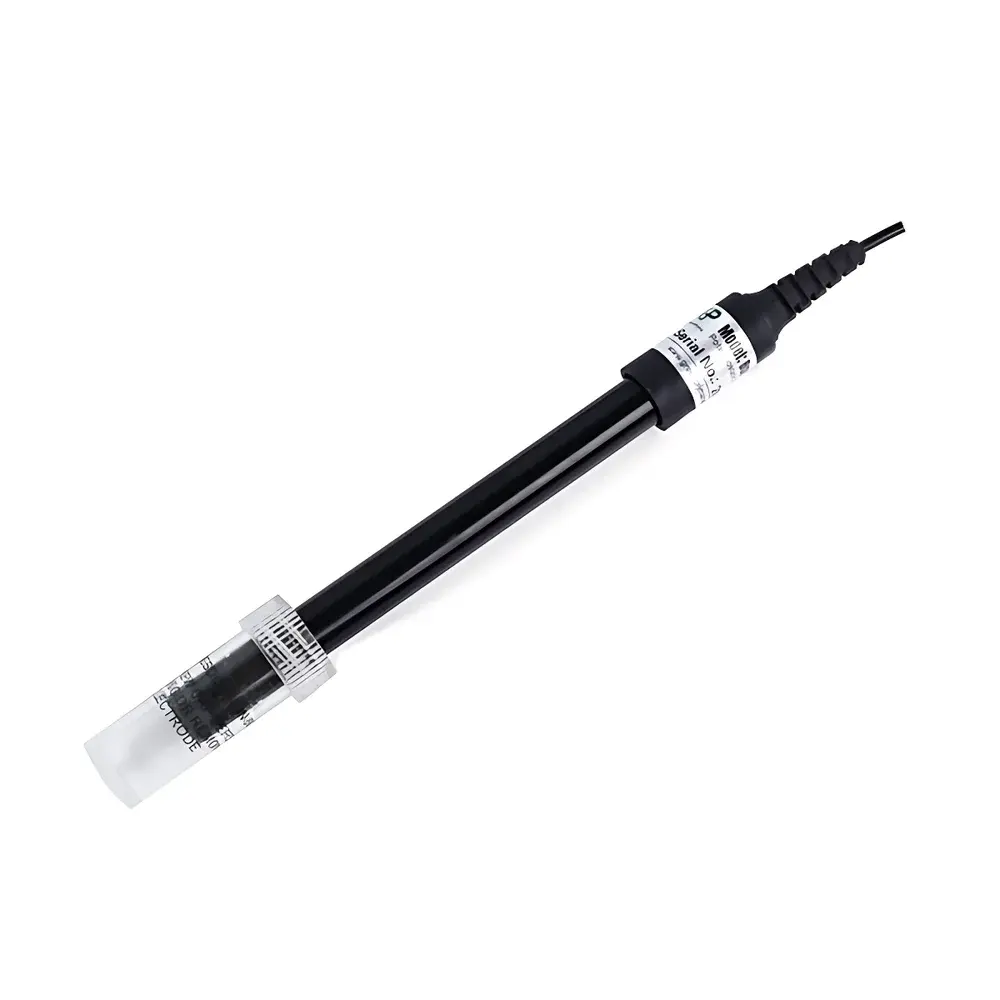
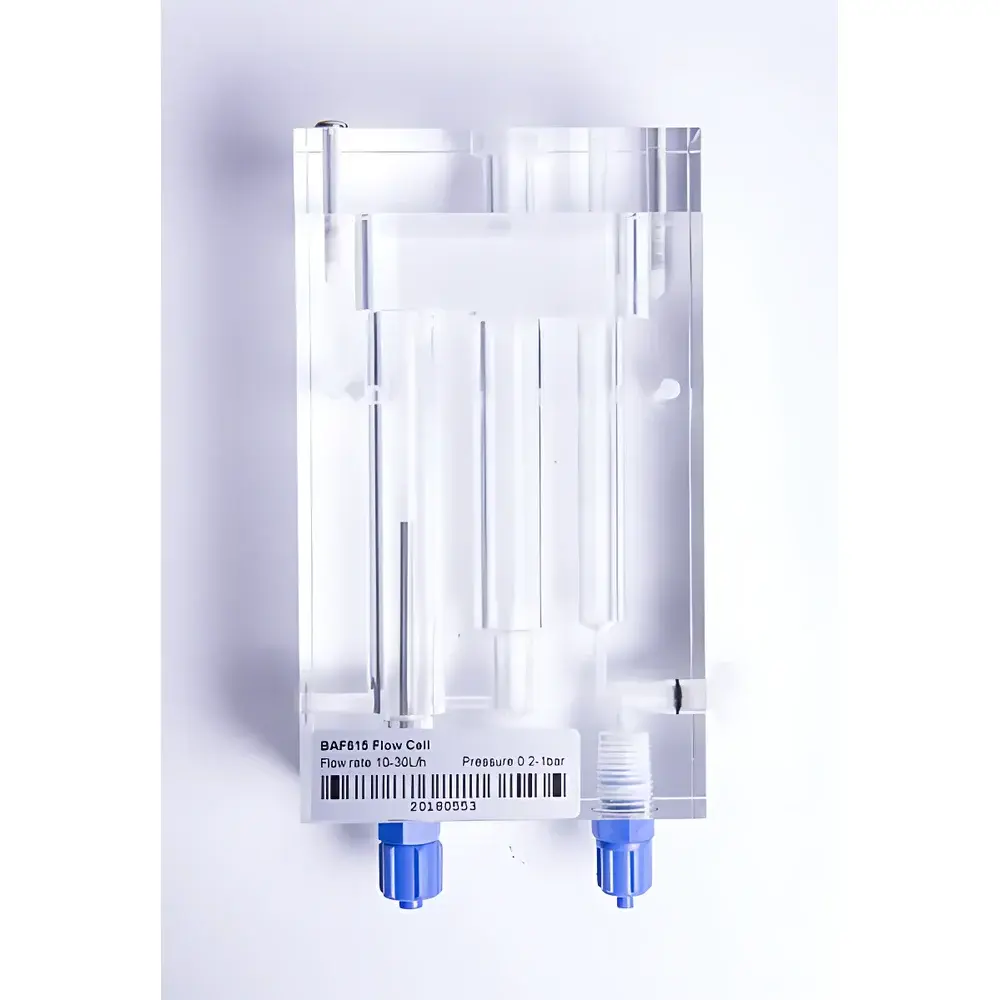
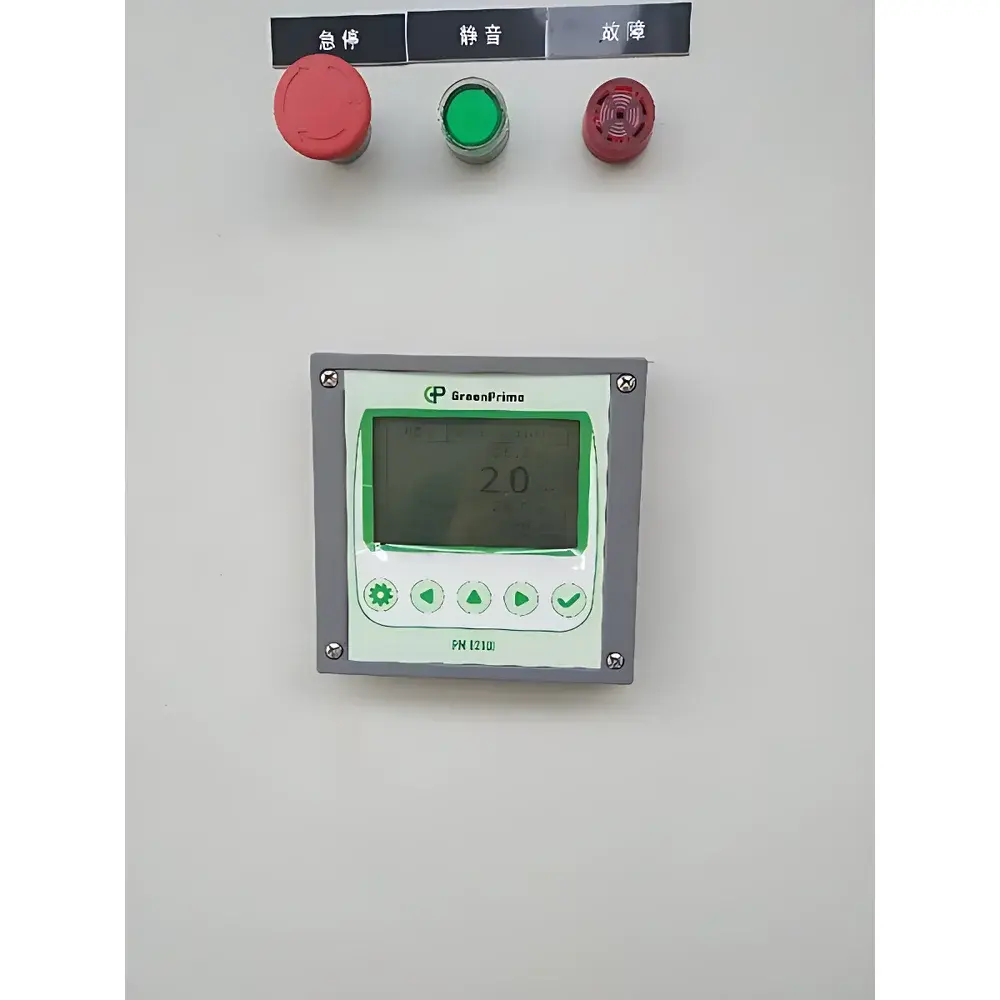
GreenPrima PM8200I Online Water Hardness Analyzer for Pharmaceutical-Grade Water
| Brand | GreenPrima |
|---|---|
| Origin | UK |
| Manufacturer | GreenPrima Ltd. |
| Model | PM8200I |
| Measurement Range | 0.00–20,000 ppm CaCO₃ |
| Resolution | 0.01 / 0.1 / 1 ppm |
| Accuracy | ±0.01 / ±0.1 / ±1 ppm (depending on range) |
| Temperature Compensation | –10 to 130 °C (NTC10K or PT1000 sensor, manual/automatic) |
| Operating Temperature | 0 to 70.0 °C |
| Storage Temperature | –20 to 70.0 °C |
| Display | Backlit graphical LCD |
| Data Storage | 600,000 records |
| Power Supply | 90–260 VAC, 50/60 Hz or 24 VDC (optional) |
| Enclosure Rating | IP65 |
| Communication | RS485, MODBUS RTU protocol |
| Analog Outputs | Two isolated 4–20 mA outputs (max. loop resistance 500 Ω, accuracy 0.1% FS) |
| Relay Output | One multifunction relay (for cleaning control, periodic alarm, fault alarm) |
| Cleaning Control | Adjustable interval (0.1–1000 h) and duration (1–1000 s) |
| Electrode Model | Bsens740 |
| Electrode Range | 0–40,000 mg/L as CaCO₃ |
| Electrode Resolution | 0.01 mg/L |
| Electrode Accuracy | ±3% FS |
| Electrode Material | PPS (polyphenylsulfone) |
| Electrode Max. Pressure | 3.5 bar |
| Electrode Connection | PG13.5 threaded fitting |
| Cable Length | 5 m |
| Mounting Options | Wall-mount, pole-mount, panel-mount |
| Dimensions | 144 × 144 × 106 mm |
| Panel Cutout | 138 × 138 mm |
| Weight | 0.86 kg |
Overview
The GreenPrima PM8200I Online Water Hardness Analyzer is a purpose-engineered instrument designed for continuous, real-time monitoring of calcium and magnesium ion concentration—expressed as calcium carbonate (CaCO₃) equivalence—in high-purity water systems. It operates on the principle of selective complexometric titration via integrated ion-selective electrode (ISE) technology, optimized for low-conductivity, low-ionic-strength matrices typical of pharmaceutical purified water (PW), water for injection (WFI), boiler feedwater, and ultrapure process water. Unlike colorimetric or photometric methods, the PM8200I employs a robust solid-state Bsens740 hardness sensor with PPS housing and NTC10K/PT1000 temperature compensation, enabling stable measurement across dynamic thermal gradients and variable flow conditions. Its architecture complies with core design expectations for GMP-regulated environments, including fail-safe signal integrity, traceable calibration logging, and immunity to electromagnetic interference in industrial plant settings.
Key Features
- IP65-rated sealed enclosure with corrosion-resistant PPS sensor housing, rated for continuous operation in humid, chemically aggressive, or mechanically demanding locations—including cleanroom utility corridors and boiler house control rooms.
- Dual isolated 4–20 mA analog outputs with 0.1% full-scale accuracy, configurable per user-defined scaling (e.g., 0–500 ppm → 4–20 mA), supporting integration into DCS, SCADA, or PLC-based supervisory systems without signal degradation.
- RS485 interface compliant with MODBUS RTU protocol (slave ID configurable), enabling bidirectional data exchange—including live readings, calibration status, sensor diagnostics, and event logs—for centralized asset management platforms.
- Configurable multifunction relay with programmable activation modes: scheduled maintenance trigger (e.g., auto-clean every 24 h), deviation alarm (e.g., >2 ppm threshold), or system fault notification (e.g., sensor timeout, power anomaly).
- Onboard non-volatile memory storing up to 600,000 timestamped records (hardness value, temperature, date/time, relay state), accessible via serial query or local display navigation—supporting retrospective trend analysis and audit readiness.
- Graphical backlit LCD with adjustable contrast and dual-language (English/Chinese) menu navigation—designed for intuitive operation by technicians without prior training, while maintaining full parameter configurability including auto-zero, slope calibration, and temperature coefficient selection.
Sample Compatibility & Compliance
The PM8200I is validated for use with low-TDS water streams where conductivity remains below 5 µS/cm—a critical requirement for pharmacopeial compliance (USP , EP 2.2.42, JP 2.05). It accommodates inlet pressures up to 3.5 bar and operates reliably across temperatures from –5 °C (sensor) to 70 °C (electronics), making it suitable for both ambient PW loops and heated WFI distribution systems. The Bsens740 electrode exhibits minimal drift in chloride-rich or silica-saturated matrices, ensuring long-term stability without frequent recalibration. While not intrinsically certified for hazardous areas, its design aligns with IEC 61000-6-2/6-4 EMC standards and supports GLP/GMP documentation workflows through exportable CSV logs and time-stamped calibration entries—facilitating FDA 21 CFR Part 11 readiness when paired with validated software interfaces.
Software & Data Management
Data retrieval occurs via MODBUS register mapping (holding registers 40001–40100), enabling seamless ingestion into third-party historian systems such as Siemens Desigo CC, Honeywell Experion PKS, or custom Python-based dashboards. The instrument does not include proprietary PC software; instead, it adheres strictly to open industrial protocols to avoid vendor lock-in. All stored records retain ISO 8601-formatted timestamps and are retained during power cycling. Configuration changes—including analog output scaling, relay logic, and cleaning schedules—are logged with operator ID (if external authentication is implemented) and timestamp, satisfying basic audit trail requirements under Annex 11 and ALCOA+ principles.
Applications
- Pharmaceutical water systems: Continuous hardness verification at PW/WFI generation skids, storage tank outlets, and point-of-use valves—ensuring compliance with USP Chapter and EU GMP Annex 1.
- High-pressure boiler feedwater circuits: Early detection of scale-forming cation ingress in steam generation loops for power plants and industrial cogeneration facilities.
- Electronics-grade ultrapure water (UPW): Monitoring post-polishing resin beds where residual Ca²⁺/Mg²⁺ must remain <1 ppb (via dilution-calibrated operation).
- Food & beverage process water: Validation of softening unit performance prior to CIP rinse cycles or ingredient mixing tanks.
- Marine engineering: Real-time hardness tracking in auxiliary boiler feed systems aboard commercial vessels, where seawater contamination poses acute scaling risk.
FAQ
What hardness units does the PM8200I report in?
The analyzer reports results exclusively in parts per million (ppm) as CaCO₃ equivalent—consistent with ASTM D1126 and ISO 6059 standards.
Is the Bsens740 electrode compatible with reverse osmosis permeate?
Yes—the electrode’s low-detection-limit configuration and temperature-compensated ISE response are validated for RO permeate with conductivity <1 µS/cm and pH 5.0–7.5.
Can the device be calibrated using standard solutions traceable to NIST?
Yes—calibration is performed using certified reference materials (e.g., Fluka 1000 ppm CaCO₃ standard), with slope and offset values stored in non-volatile memory alongside date/time stamps.
Does the PM8200I support automatic temperature compensation during rapid thermal transients?
Yes—dual-sensor input (NTC10K or PT1000) enables real-time compensation across –10 °C to 130 °C, with user-selectable compensation algorithms (linear, polynomial, or none).
How is sensor fouling mitigated during extended unattended operation?
The programmable relay triggers pneumatic or chemical cleaning cycles at user-defined intervals and durations, with status feedback logged for maintenance scheduling and root-cause analysis.







