
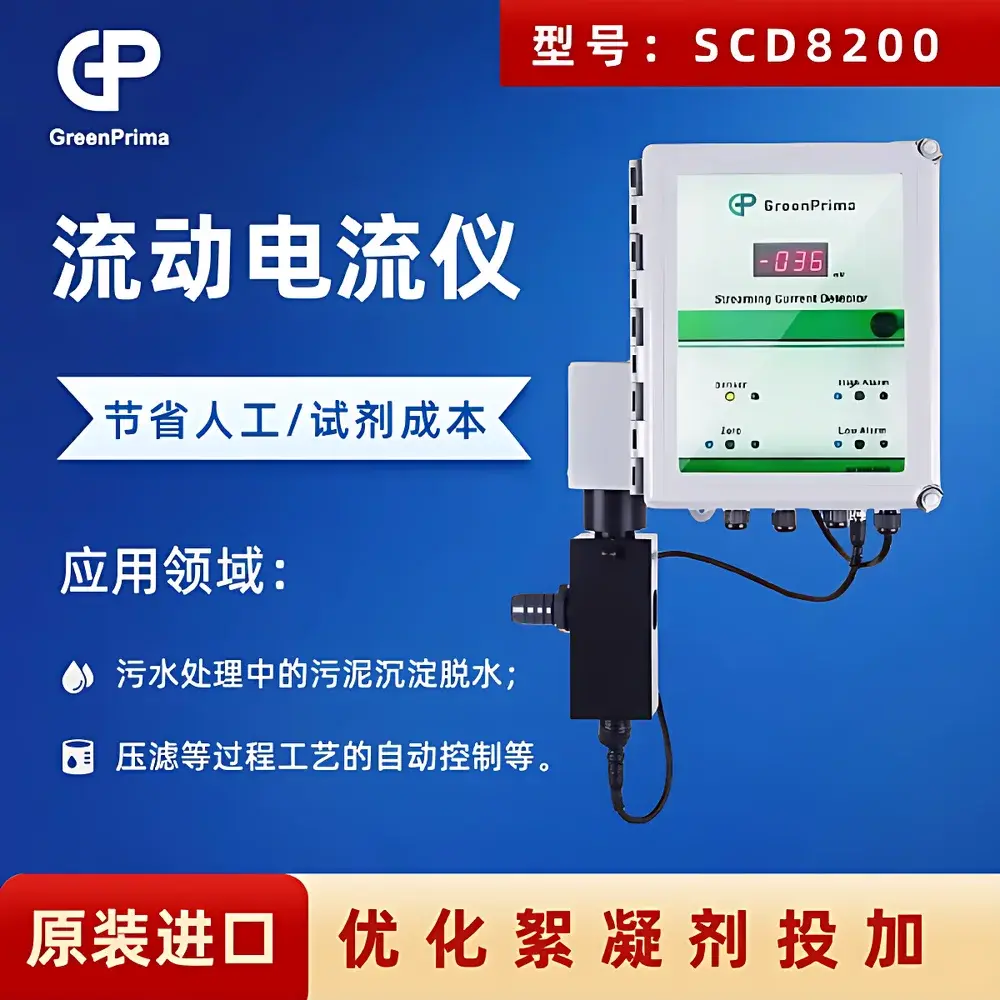
GreenPrima SCD8200 Streaming Current Detector
| Brand | GreenPrima |
|---|---|
| Origin | Germany |
| Manufacturer Type | Manufacturer |
| Origin Category | Imported |
| Model | SCD8200 |
| Power Supply | 100–240 VAC |
| Measurement Range | −1000 to +1000 mV |
| Accuracy | ±0.1% of full scale |
| Display | LED |
| Flow Rate | 1 L/min |
| Inlet Connection | 1/2" NPT |
| Outlet Connection | 3/4" NPT |
| Response Time | 1 s |
| Auto-zero Calibration | Yes |
| Sensor Material | Delrin / 316 Stainless Steel / PTFE |
| Output Signals | 4–20 mA, −10 to +10 V, 0–10 V |
| Communication Protocol | MODBUS RTU (optional) |
| Alarm Outputs | High/Low relay contacts |
| Enclosure Rating | IP65 |
| Dimensions | 279 mm × 152 mm (11.0" × 6.0") |
| Weight | 9 kg |
Overview
The GreenPrima SCD8200 Streaming Current Detector is an industrial-grade, online electrokinetic analyzer engineered for real-time monitoring and control of coagulation efficiency in water and wastewater treatment processes. It operates on the principle of streaming current measurement—a well-established electrophoretic technique that quantifies the net surface charge density of colloidal particles suspended in aqueous media. As process water flows continuously through a precision-machined detection chamber, a motor-driven piston induces controlled laminar shear, mobilizing counter-ions in the electrical double layer surrounding colloids. This ion displacement generates an alternating current across two embedded electrodes—termed the streaming current—which is directly proportional to the residual zeta potential of the system. Unlike offline jar tests or turbidity-based proxies, the SCD8200 provides a physicochemically grounded, millisecond-resolved signal correlated with coagulant demand and particle destabilization kinetics.
Key Features
- Real-time streaming current measurement with 1-second response time for dynamic process adaptation
- Integrated auto-zero calibration routine eliminating manual drift correction and reducing maintenance overhead
- Robust sensor architecture combining Delrin housing, 316 stainless steel wetted components, and PTFE-sealed electrodes for chemical resistance in aggressive oxidant or acidic environments
- Dual analog outputs (4–20 mA and ±10 V) plus optional MODBUS RTU serial interface for seamless integration into DCS, PLC, or SCADA systems
- IP65-rated enclosure suitable for wall-mount or pipe-rack installation in humid, chemically exposed utility corridors
- Configurable high/low relay alarms for automated feedforward or feedback control of coagulant dosing pumps
- LED display with intuitive status indicators for operational mode, calibration state, and fault diagnostics
Sample Compatibility & Compliance
The SCD8200 is validated for continuous operation with potable water, surface water, tertiary effluent, and sludge dewatering filtrate across pH 4.5–9.5 and turbidity up to 500 NTU. Its flow path design accommodates particulates ≤100 µm without clogging, and its electrode geometry minimizes polarization effects under variable conductivity conditions (200–2000 µS/cm). The instrument complies with IEC 61000-6-2 (EMC immunity) and IEC 61000-6-4 (EMC emissions), and supports audit-ready data logging when paired with compliant SCADA platforms. While not intrinsically certified for hazardous areas, it meets EN 61010-1 safety requirements for laboratory and industrial use. For regulated utilities, the device supports GLP-aligned operational qualification (OQ) protocols and can be configured with timestamped event logs traceable to ISO/IEC 17025 documentation standards.
Software & Data Management
The SCD8200 operates as a standalone field transmitter but is fully interoperable with third-party supervisory systems via MODBUS RTU over RS-485. When integrated into a modern water management platform, streaming current trends are synchronized with coagulant dosage rates, raw water turbidity, pH, and temperature to generate multivariate control models. Optional firmware updates enable configurable averaging windows (1–60 s), slope-based alarm hysteresis, and diagnostic flagging for low-flow or air-in-line events. All analog outputs include 16-bit DAC resolution, and digital communication supports CRC error checking and slave address assignment. No proprietary software is required; configuration is performed via front-panel keypad or MODBUS register writes using standard industrial tools (e.g., ModScan, Ignition SCADA).
Applications
- Optimization of polyaluminum chloride (PACl), ferric chloride, or cationic polymer dosing in drinking water plants
- Feedback control of coagulant injection in membrane pre-treatment for reverse osmosis and nanofiltration systems
- Monitoring charge neutralization efficacy during sludge conditioning prior to centrifuge or belt-press dewatering
- Process validation and troubleshooting of coagulation-flocculation performance in industrial wastewater streams (e.g., textile, pulp & paper, food processing)
- Supporting compliance reporting under EPA Clean Water Act guidelines and EU Drinking Water Directive (2020/2184) by documenting real-time coagulation stability
FAQ
What physical parameter does the SCD8200 actually measure?
It measures the streaming current (in millivolts), a direct electrophoretic indicator of net colloidal surface charge remaining after coagulant addition—distinct from zeta potential but linearly correlated under controlled shear and conductivity conditions.
Can the SCD8200 replace jar testing entirely?
No—it does not substitute for initial coagulant selection or dose optimization studies, but it replaces routine jar testing for ongoing process control once a stable coagulation window has been established.
Is calibration required before each use?
No. The auto-zero function compensates for baseline drift; however, periodic verification against a known reference sample (e.g., standardized kaolin suspension) is recommended per site-specific QA/QC procedures.
Does the instrument require sample filtration or pretreatment?
No filtration is needed for typical municipal or industrial influents; however, gross solids >100 µm should be removed upstream to prevent sensor abrasion or flow restriction.
How is the streaming current signal used in closed-loop control?
The 4–20 mA output is typically wired to a PID controller or PLC analog input, where setpoints are defined around the “charge neutral point” (CNP)—the minimum absolute streaming current value indicating optimal coagulant dosage.





