
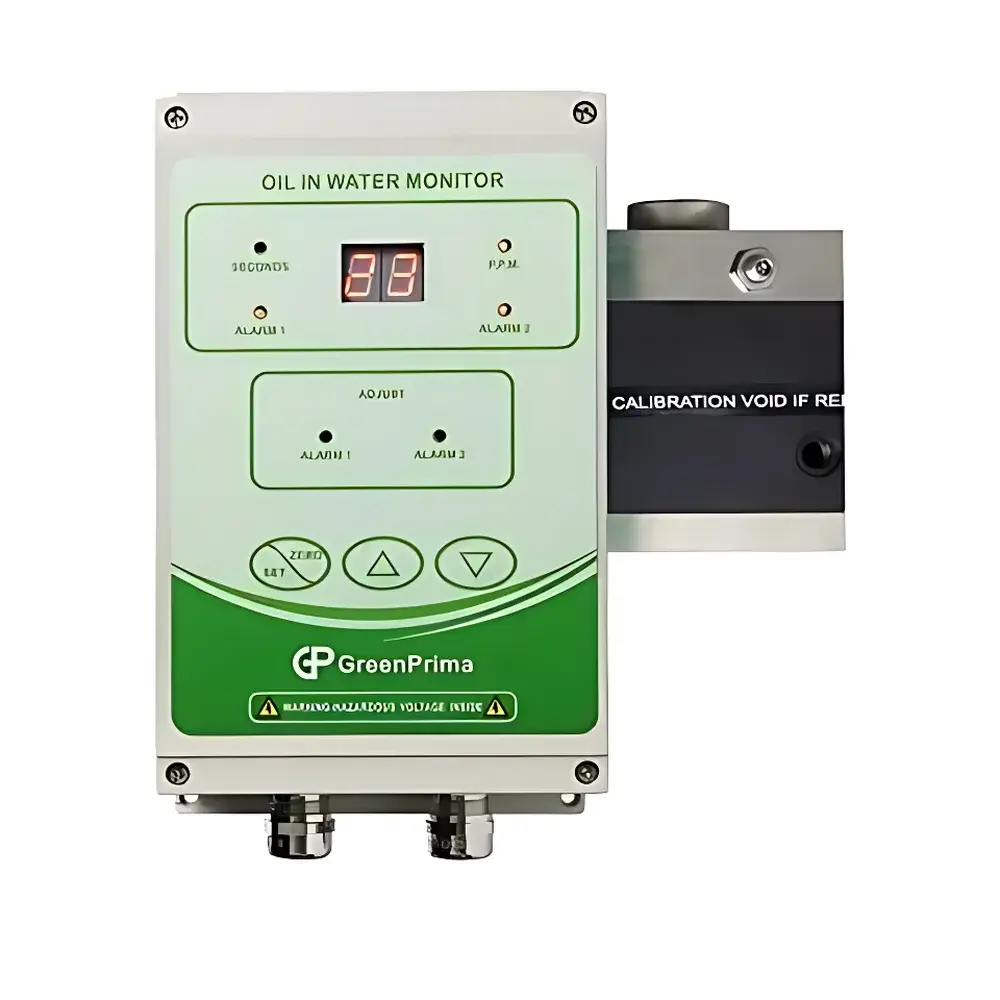
GreenPrima PROCON7000 Online Oil-in-Water Analyzer
| Brand | GreenPrima |
|---|---|
| Origin | United Kingdom |
| Manufacturer Type | Original Equipment Manufacturer (OEM) |
| Product Origin | Imported |
| Model | PROCON7000 |
| Instrument Type | Online Analyzer |
| Measurement Principle | Fluorescence-based Optical Detection (Non-Extractive, Solvent-Free) |
| Measurement Range | 0–99 ppm |
| Accuracy | ±2 ppm |
| Alarm Setpoint Range | 1–98 ppm (adjustable) |
| Alarm Delay | Alarm 1: 0–60 s |
| Alarm 2 | 10–240 s (both adjustable) |
| Display | 240 × 128 pixel TFT touchscreen |
| Output Signals | 0/4–20 mA (min. load 820 Ω), 0–5 V / 1–5 V DC (min. load 50 kΩ) |
| Sample Flow Rate | 0.1–2 L/min |
| Sample Temperature | 1–40 °C |
| Sample Pressure | 0.1–10 bar |
| Ambient Operating Temperature | 1–60 °C |
| Relative Humidity | ≤90% RH at 55 °C |
| Enclosure Rating | IP55 |
| Electrical Safety | EN 61010-1 / IEC 61000-6-2 & -6-3, Overvoltage Category II |
| Power Supply | 230 V / 115 V AC or 24 V AC, Max. 10 VA |
| Weight | 2.25 kg |
| Dimensions (H×W×D) | 215 × 242 × 73 mm |
Overview
The GreenPrima PROCON7000 Online Oil-in-Water Analyzer is a dedicated, non-extractive optical instrument engineered for continuous, real-time monitoring of hydrocarbon contamination in aqueous process streams. It employs a solvent-free fluorescence detection principle—optimized for aromatic and aliphatic hydrocarbons commonly found in lubricating oils, diesel, fuel oil, and hydraulic fluids. Unlike gravimetric or infrared methods requiring solvent extraction or complex calibration, the PROCON7000 uses fixed-wavelength UV excitation and selective emission filtering to quantify total oil content with high specificity and minimal interferences from suspended solids or turbidity. Designed for industrial cooling water circuits—including engine jacket water, boiler condensate (with optional inline cooler), and freshwater makeup systems—the analyzer delivers robust performance in demanding environments such as power generation facilities, refinery utility plants, and marine engine rooms. Its measurement range of 0–99 ppm and stated accuracy of ±2 ppm meet the technical requirements for early leak detection in heat exchangers and compliance-driven discharge monitoring per ISO 10303-11 and EPA Method 1664B equivalents.
Key Features
- Automated self-diagnostic routine with drift compensation algorithm ensures long-term stability without manual recalibration.
- Configurable measurement intervals (1–60 minutes) support both high-frequency surveillance and energy-efficient operation.
- Intuitive 240 × 128 pixel resistive touchscreen interface enables local setup, alarm threshold adjustment, and real-time trend review without external software.
- Dual independent alarm outputs (Alarm 1 and Alarm 2) with programmable delay (0–60 s and 10–240 s respectively) allow staged response protocols—e.g., alert → isolation → shutdown.
- Standard 4–20 mA analog output (isolated, min. load 820 Ω) and optional USB data logging interface (via RS-485 or USB-C adapter) support integration into DCS, SCADA, or asset management platforms.
- IP55-rated enclosure and industrial-grade relay contacts (8 A @ 240 V AC) permit direct connection to PLCs, solenoid valves, or audible/visual warning devices.
- No consumables, reagents, or sample preparation required—reducing lifecycle cost and operator dependency.
Sample Compatibility & Compliance
The PROCON7000 is validated for use with low-turbidity, low-suspended-solid water matrices typical of closed-loop cooling systems and treated industrial effluents. It accommodates sample temperatures from 1–40 °C and pressures up to 10 bar, with flow rates maintained between 0.1–2 L/min via integrated flow control or external metering pump. While not intended for raw sewage or highly emulsified wastewater without pre-filtration, it performs reliably on clarified or coagulated industrial discharges meeting ISO 5667-3 sampling guidelines. The analyzer complies with EN 61010-1 for electrical safety and meets EMC immunity standards per IEC 61000-6-2 and emission limits per IEC 61000-6-3. Its design supports GLP-aligned operational records when paired with timestamped analog output or optional USB logging—facilitating audit readiness under ISO/IEC 17025 and EU WFD (Water Framework Directive) reporting frameworks.
Software & Data Management
Local configuration and diagnostics are managed entirely through the onboard touchscreen UI; no proprietary PC software is required for basic commissioning or routine operation. All parameter settings—including alarm thresholds, delay timers, output scaling, and analysis start/stop triggers—are stored in non-volatile memory with battery-backed retention. For centralized monitoring, the 4–20 mA output can be mapped to plant historian systems using standard HART or Modbus RTU gateways (optional). USB data export (when enabled) provides CSV-formatted logs containing timestamp, measured value (ppm), status flags (e.g., “Flow Low”, “Signal Saturation”), and diagnostic counters—supporting traceability per FDA 21 CFR Part 11 when deployed in regulated utilities with appropriate access controls and audit trail configuration.
Applications
- Lubricating oil cooler leak detection in gas turbine and diesel engine cooling circuits.
- Continuous monitoring of boiler feedwater and condensate return lines to prevent tube fouling and corrosion.
- Pre-discharge verification of treated industrial wastewater prior to release into municipal sewers or surface water bodies.
- Groundwater monitoring at hydrocarbon-contaminated sites during remediation operations.
- Makeup water quality assurance in once-through cooling systems at thermal power stations.
FAQ
Does the PROCON7000 require periodic calibration with certified oil standards?
No. The instrument features factory-calibrated optical path geometry and embedded drift compensation. Field verification using a traceable reference standard (e.g., mineral oil in deionized water) is recommended annually—or after sensor cleaning—but full recalibration is not user-serviceable.
Can it detect emulsified oil effectively?
Yes, within its specified range and matrix constraints. The fluorescence method responds to dissolved and fine-emulsified hydrocarbons but may underestimate macro-emulsions or free-phase oil without inline homogenization.
Is installation possible in hazardous areas?
The base unit is rated IP55 and Class II, Division 2 suitable. For Zone 1/21 installations, an intrinsically safe barrier kit (sold separately) must be used with the 24 V AC variant.
What maintenance is required?
Quarterly inspection of the quartz flow cell window for fouling; cleaning with isopropyl alcohol and lint-free wipe. No moving parts or consumable optics are present.
How does it handle air bubbles or particulate interference?
Integrated flow sensing and signal validation algorithms suppress transient spikes caused by entrained air or brief turbidity events. Persistent deviation triggers a “Flow Low” or “Signal Invalid” status flag.







