
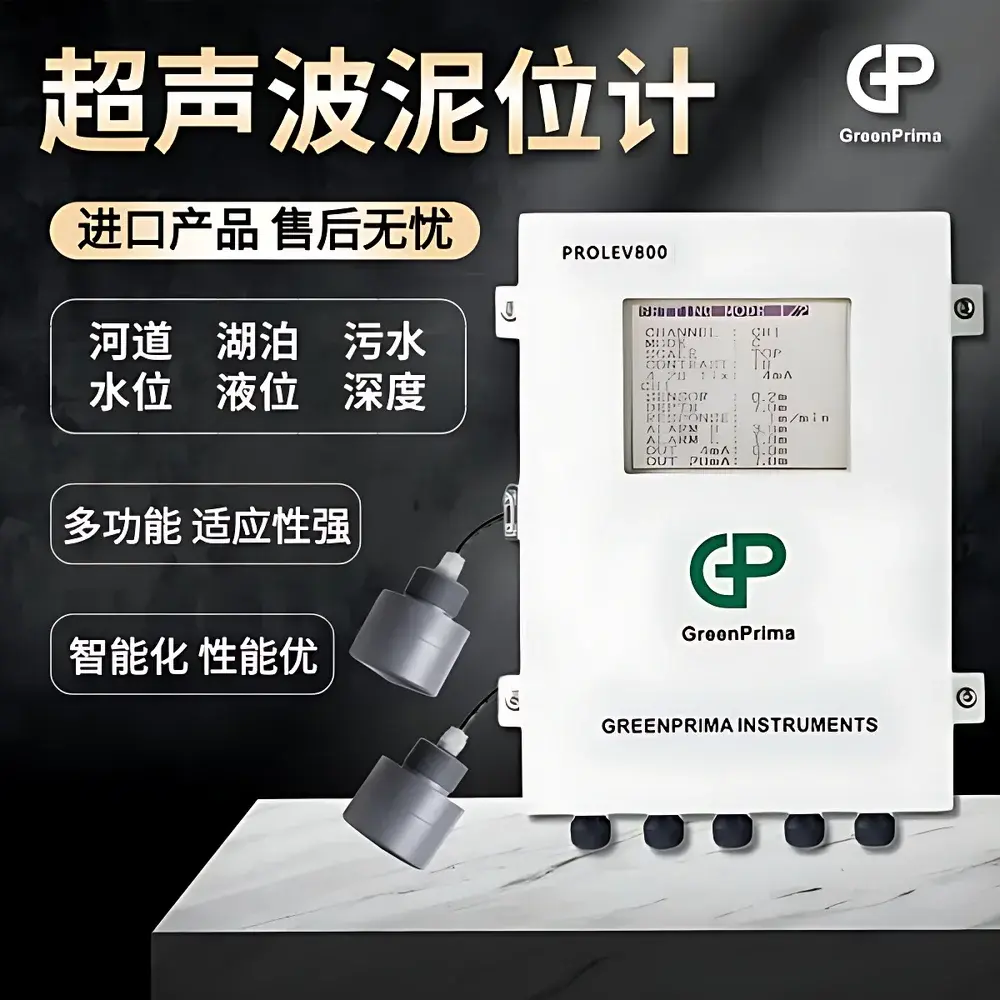
GreenPrima PROLEV800 Ultrasonic Sludge Interface Monitor
| Brand | GreenPrima |
|---|---|
| Origin | United Kingdom |
| Manufacturer Type | Original Equipment Manufacturer (OEM) |
| Product Category | Imported Instrument |
| Model | PROLEV800 |
| Price Range | USD 2,700 – 6,800 (FOB UK) |
| Measurement Range | 0.4–10 m |
| Sensor Capacity | Up to 2 independent transducers |
| Accuracy | ±1 cm |
| Response Time | 1 s |
| Operating Ambient Temperature | −20 to +60 °C |
| Display | Large-backlit LCD with graphical interface (numeric readout, trend plot, echo waveform) |
| Enclosure Rating | IP68 |
| Weight | 3.6 kg (transmitter), 3 kg per probe |
| Output | 4–20 mA analog (HART-compatible), dual high/low level alarms |
| Communication | RS-232C (cable length ≤10 m) |
| Power Supply | 85–264 VAC, 10 VA |
| Cable Length | 20 m standard |
Overview
The GreenPrima PROLEV800 Ultrasonic Sludge Interface Monitor is an industrial-grade, non-contact level measurement system engineered for continuous, real-time profiling of sludge blanket depth and settling dynamics in wastewater treatment infrastructure. It operates on the principle of time-of-flight ultrasonic pulse-echo measurement: a high-frequency transducer emits short-duration acoustic pulses downward into the liquid column; the elapsed time between emission and reception of echoes reflected from both the liquid surface and the suspended solids interface is precisely measured. By analyzing amplitude attenuation and transit time differentials across multiple echo returns, the instrument resolves the position of the sludge–supernatant boundary with ±1 cm repeatability—even under variable turbidity, temperature gradients, or surface foam conditions. Designed specifically for primary clarifiers, secondary sedimentation tanks, gravity thickeners, and ash settling ponds, the PROLEV800 delivers critical process intelligence without mechanical contact, eliminating fouling-related drift or maintenance downtime associated with submerged probes or optical systems.
Key Features
- Large-format backlit LCD display supporting simultaneous numeric depth readout, real-time echo waveform visualization, and dynamic trend plotting (5-minute to 48-hour history)
- Dual-sensor capability: single transmitter unit interfaces with two independent ultrasonic transducers—enabling differential monitoring across tank width or layered profiling in deep basins
- Embedded microprocessor with adaptive signal averaging and noise rejection algorithms ensures stable interface tracking during hydraulic surges or sludge blanket instability
- No moving parts or immersed electronics: transducer housing rated IP68, transmitter enclosure conforming to IEC 60529; suitable for outdoor mounting or wet control room environments
- Configurable brightness control and intuitive menu navigation simplify field commissioning and routine parameter adjustment (e.g., damping, alarm thresholds, averaging window)
- Integrated 4–20 mA output with HART protocol support enables seamless integration into DCS/SCADA systems; dual relay outputs provide fail-safe high/low level alarms
Sample Compatibility & Compliance
The PROLEV800 is validated for use in municipal and industrial wastewater streams containing suspended solids concentrations up to 30 g/L, including activated sludge, anaerobic digester supernatant, and coal-washing effluent. Its ultrasonic methodology remains unaffected by conductivity, pH (4–12), or moderate chemical dosing (e.g., ferric chloride, polymer coagulants). The device complies with EN 61326-1 (EMC for industrial environments), EN 61000-6-2/6-4, and meets CE marking requirements. While not intrinsically safe, it is suitable for Zone 2 classified areas when installed per IEC 60079-14 guidelines. Data logging and configuration changes are traceable via timestamped internal event records—supporting GLP-aligned operational documentation in regulated utilities.
Software & Data Management
Local data acquisition and visualization occur entirely on-device via the embedded LCD interface; no external PC is required for basic operation. RS-232C serial communication (up to 10 m cable run) allows connection to portable terminals or legacy PLCs for configuration backup, firmware updates, or raw echo data capture. All settings—including sensor calibration offsets, alarm hysteresis, and trend duration—are stored in non-volatile memory. While the PROLEV800 does not include cloud connectivity or proprietary software suites, its analog and digital outputs comply fully with ISA-50.00.01 (4–20 mA) and Modbus RTU over RS-232 (via optional firmware upgrade), facilitating interoperability with industry-standard asset management platforms such as Siemens Desigo CC, Honeywell Experion PKS, or ABB Ability™.
Applications
- Optimization of return activated sludge (RAS) flow rates based on real-time sludge blanket elevation in secondary clarifiers
- Early detection of sludge bulking or rising sludge events through deviation analysis of interface velocity trends
- Control logic input for sludge wasting pumps in sequencing batch reactors (SBRs) and oxidation ditches
- Performance verification of lamella settlers and tube settlers in potable water treatment plants
- Monitoring of ash slurry concentration profiles in coal-fired power plant bottom ash handling systems
- Supporting ISO 24510-compliant asset performance reporting for water utility benchmarking frameworks
FAQ
Can the PROLEV800 distinguish between multiple suspended layers (e.g., scum, sludge, and settled grit)?
No—the instrument resolves only the dominant acoustic impedance discontinuity corresponding to the primary sludge–supernatant interface. It does not perform multi-layer tomographic analysis.
Is calibration required after initial installation?
Yes—a one-time zero-point calibration using known reference depth is recommended during commissioning; subsequent drift is negligible due to temperature-compensated transducer design and digital signal processing.
What is the maximum distance between transmitter and remote sensor?
Standard cabling supports up to 20 m per sensor; extended-length cables (up to 50 m) are available with signal repeater modules upon request.
Does the device support Modbus TCP/IP or Ethernet connectivity?
Not natively—only RS-232C is provided as standard; Ethernet gateways may be deployed externally for protocol translation.
How often does the transducer require cleaning in high-fouling applications?
Under typical wastewater conditions, quarterly visual inspection suffices; transducers feature self-cleaning acoustic pulsing cycles activated during idle periods to minimize biofilm accumulation.
Related Products







