
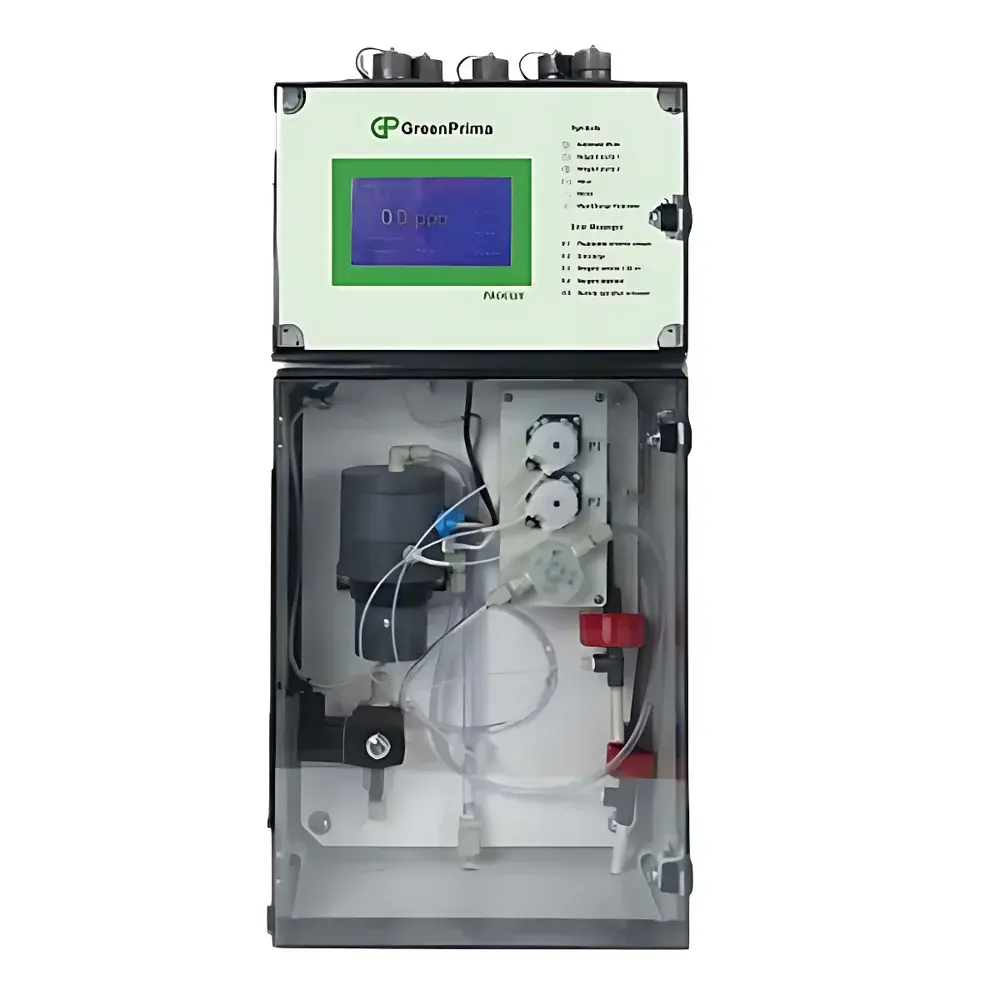
GreenPrima PROCON5000 Total Iron Analyzer
| Brand | GreenPrima |
|---|---|
| Origin | United Kingdom |
| Manufacturer Type | Manufacturer |
| Origin Category | Imported |
| Model | PROCON5000 |
| Price | Upon Request |
Overview
The GreenPrima PROCON5000 Total Iron Analyzer is a fully automated, laboratory-grade online spectrophotometric instrument engineered for continuous, unattended measurement of total dissolved iron (Fe²⁺ and Fe³⁺) in aqueous matrices. It operates on the principle of colorimetric complexation followed by photometric quantification at defined wavelengths—specifically employing the 1,10-phenanthroline method for higher concentration ranges (0.1–20.0 ppm) and the pyridyltriazine method for ultra-trace detection (10–500 ppb). The analyzer integrates a precision fluidic manifold—including peristaltic metering pumps, solenoid valves, a temperature-stabilized optical flow cell, and integrated reagent storage—with a microprocessor-controlled system that orchestrates sample aspiration, line rinsing, reagent dosing, reaction incubation, absorbance measurement, and data reporting. Designed for long-term operational stability in industrial and municipal water environments, the PROCON5000 delivers high reproducibility without manual calibration intervention, leveraging built-in zero-point drift compensation and self-diagnostic routines.
Key Features
- Fully automated operation with programmable analysis interval (4–7 minutes standard cycle; configurable from 1 to 99 minutes or externally triggered)
- Two-tier detection methodology: pyridyltriazine (low-range, 10–500 ppb) and 1,10-phenanthroline (high-range, 0.1–20.0 ppm), ensuring broad dynamic coverage
- Integrated touch-screen interface (240 × 128 pixel resolution) with intuitive menu navigation and real-time status visualization
- Auto-zero tracking and drift compensation algorithms eliminate need for routine manual calibration
- Configurable alarm and limit thresholds with three independent dry-contact relays (alarm, limit, analysis status), rated 230 V AC / 3 A
- Isolated 0/4–20 mA analog output (500 Ω load) with user-defined scaling and linearization
- Wide input power tolerance: 110–230 V AC, 50/60 Hz; typical power consumption ≤16 VA
- IP65-rated enclosure (640 × 315 × 190 mm H×W×D) suitable for wall- or panel-mount installation in non-hazardous indoor or sheltered outdoor locations
- Robust fluidic architecture supporting sample pressures from 0.1 to 10 bar and operating temperatures from 5 to 30 °C
Sample Compatibility & Compliance
The PROCON5000 is validated for use with clarified aqueous samples within pH 6–8 and free of suspended solids (>5 µm filtration recommended). It complies with established analytical frameworks including ASTM D1068 (Standard Test Methods for Iron in Water) and ISO 6332 (Water quality — Determination of iron — 1,10-Phenanthroline spectrophotometric method). Its design supports GLP-aligned data integrity through timestamped event logging, relay activation records, and audit-ready operational history. While not inherently 21 CFR Part 11 compliant out-of-the-box, the system’s deterministic control logic, non-volatile memory retention, and traceable output signals enable integration into validated GMP or regulated utility monitoring systems when deployed with appropriate procedural controls and electronic record governance.
Software & Data Management
Data acquisition is supported via USB interface (optional module) for periodic export of time-stamped measurement logs, diagnostic flags, and relay event timestamps in CSV format. The onboard firmware stores up to 30 days of rolling operational history, including measured values, zero/reference checks, pump actuation counts, and error codes. No proprietary software is required for basic configuration; all setup—including range selection, alarm thresholds, analog output mapping, and external trigger logic—is performed directly via the embedded touchscreen UI. For centralized telemetry, the 4–20 mA output can be interfaced with PLCs, SCADA systems, or DCS platforms using standard current-loop protocols. Firmware updates are delivered via USB stick with version-controlled checksum verification.
Applications
The PROCON5000 serves as a dedicated monitoring solution across multiple water quality domains: real-time surveillance of iron breakthrough in ion exchange or greensand filtration effluents; feedwater iron control in boiler make-up systems; compliance tracking for drinking water utilities subject to WHO or EPA secondary maximum contaminant levels (SMCL: 0.3 mg/L); and process optimization in mining leachate treatment, semiconductor ultrapure water loops, and food/beverage production rinse waters. Its dual-range capability makes it equally suitable for low-iron groundwater sources and high-iron industrial discharges requiring sub-ppb sensitivity or ppm-level robustness.
FAQ
What sample pretreatment is required prior to analysis?
Samples must be filtered to remove particulates >5 µm and maintained within pH 6–8. Acidification or oxidation steps are not required, as the analyzer simultaneously reduces Fe³⁺ to Fe²⁺ and forms stable chromophores.
How often do reagents need replacement?
Fe1001/1002/1003 reagent kits (250 mL each) support approximately 300 analyses; Fe2001 (500 mL) supports ~925 analyses, assuming standard 4–7 minute cycle time and default reagent dosing volumes.
Can the analyzer operate under variable inlet pressure?
Yes—the integrated pressure-tolerant fluid path accepts sample pressures from 0.1 to 10 bar, eliminating the need for pressure regulators in most municipal or pumped industrial applications.
Is remote configuration or diagnostics possible?
Basic configuration and status review are limited to the local touchscreen interface; however, analog output signals and relay states can be monitored remotely via connected control systems. USB data export enables offline trend analysis.
Does the system meet international electromagnetic compatibility standards?
The PROCON5000 conforms to EN 61326-1 (2013) for EMC in industrial environments and EN 61000-6-2/6-3 for immunity and emissions, ensuring reliable operation in electrically noisy plant settings.




