
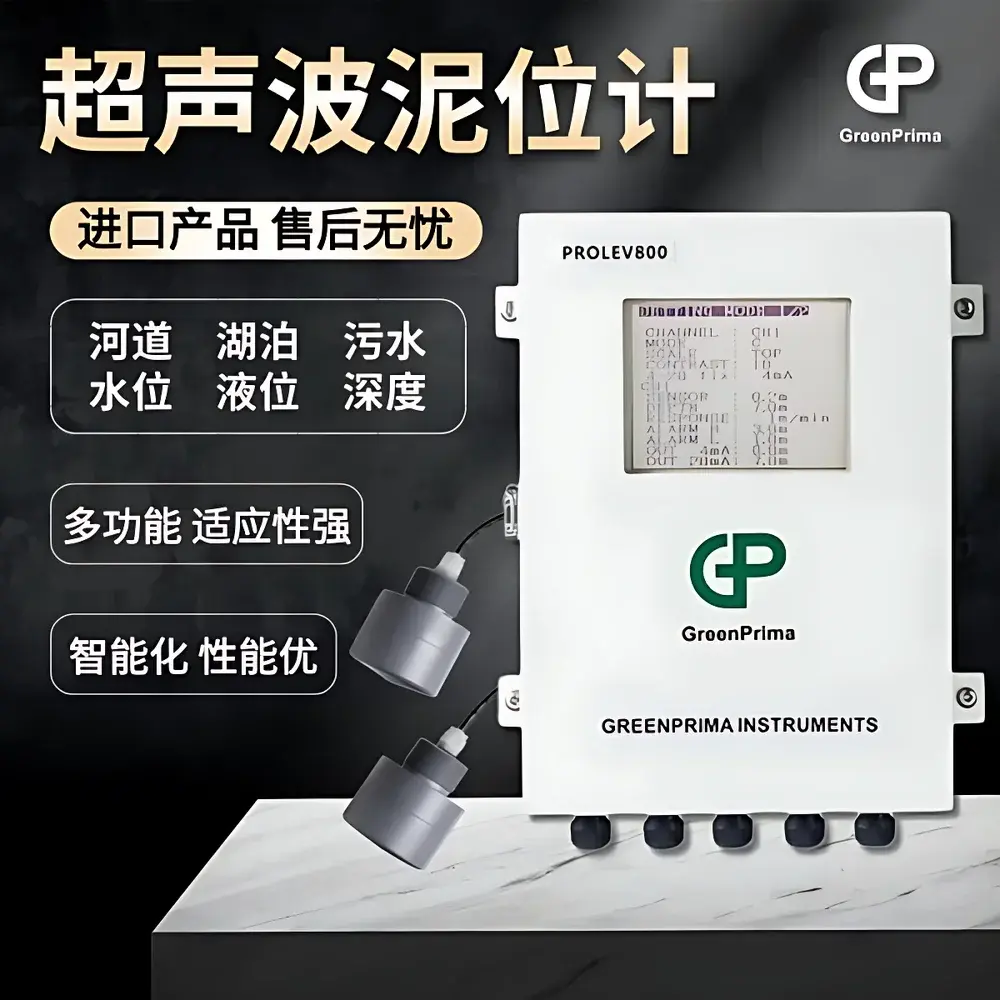
GreenPrima PROLEV800 Ultrasonic Sludge Interface Detector
| Brand | GreenPrima |
|---|---|
| Origin | UK |
| Manufacturer Type | Manufacturer |
| Origin Category | Imported |
| Model | PROLEV800 |
| Quotation | Upon Request |
| Measurement Range | 0.4–10 m |
| Sensor Capacity | Up to 2 independent transducers |
| Accuracy | ±1 cm |
| Response Time | 1 s |
| Operating Temperature | −20 to +60 °C |
| Display | Large LCD with graphical interface (numeric, trend plot, echo waveform) |
| Ingress Protection | IP68 |
| Weight | 3.6 kg (transmitter), 3 kg (per transducer) |
| Output | 4–20 mA analog output |
| Alarms | Dual high/low level relay outputs |
| Communication | RS-232C (max. 10 m cable length) |
| Power Supply | 85–264 VAC, 10 VA |
| Cable Length | 20 m |
Overview
The GreenPrima PROLEV800 Ultrasonic Sludge Interface Detector is an industrial-grade, non-invasive level measurement system engineered for continuous, real-time monitoring of sludge blanket depth and interface dynamics in clarifiers, thickeners, and settling basins. It operates on the principle of time-of-flight ultrasonic pulse-echo measurement: a high-frequency transducer emits short-duration acoustic pulses downward into the liquid column; the instrument precisely calculates the distance to the sludge–liquid interface by measuring the elapsed time between pulse emission and return echo reception. Unlike optical or conductivity-based methods, ultrasonic detection remains unaffected by turbidity, suspended solids concentration gradients, or chemical composition variations—making it uniquely suited for heterogeneous wastewater and slurry environments. The PROLEV800 is designed for deployment in primary, secondary, and tertiary treatment stages—including pre-thickening tanks, lamella settlers, and ash slurry ponds—where reliable interface tracking supports process stability, energy-efficient sludge recirculation, and early anomaly detection in sedimentation performance.
Key Features
- Large-format backlit LCD display supporting simultaneous numeric readout, real-time echo waveform visualization, and dynamic trend plotting (5 minutes to 48 hours)
- Embedded microprocessor architecture enabling continuous signal averaging, noise suppression, and adaptive threshold detection—ensuring stable operation without mechanical moving parts
- Sludge interface tracking algorithm with automatic drift compensation, capable of detecting subtle changes in blanket height (±1 cm resolution) within 1 second response time
- Configurable brightness control for optimal readability under varying ambient lighting conditions (e.g., outdoor exposure or low-light control rooms)
- Modular design permitting connection of up to two independent ultrasonic transducers to a single transmitter unit—ideal for differential interface profiling or redundancy-critical applications
- IP68-rated transmitter housing and submersible transducers certified for permanent immersion in aggressive aqueous environments containing abrasives, fats, and biofilms
- Dual programmable relay outputs for high/low interface alarms, integrated with 4–20 mA analog output for PLC/SCADA integration
Sample Compatibility & Compliance
The PROLEV800 is validated for use across diverse municipal and industrial wastewater matrices, including activated sludge, anaerobic digester supernatant, coal washery effluent, fly ash slurry, and lime softening residuals. Its ultrasonic methodology eliminates dependence on electrical conductivity or optical clarity—thereby ensuring consistent performance in high-TSS (>10,000 mg/L), oily, or chemically dosed streams where alternative technologies fail. The device complies with IEC 61000-6-2 (EMC immunity) and IEC 61000-6-4 (EMC emissions) standards. While not intrinsically safe, its 85–264 VAC power supply meets EN 61000-3-2 harmonic current limits. For regulated facilities operating under ISO/IEC 17025, EPA Method 1600-series, or EU WFD (Water Framework Directive) reporting frameworks, the PROLEV800 provides traceable, auditable interface data compatible with GLP-aligned documentation workflows.
Software & Data Management
Data acquisition and configuration are managed via local RS-232C serial interface (up to 10 m cable length), supporting ASCII command protocol for integration with legacy DCS or custom HMI systems. No proprietary software is required for basic commissioning; all parameters—including damping factor, alarm thresholds, trend duration, and echo gain—are adjustable directly through the front-panel menu. For centralized monitoring, the 4–20 mA output can be interfaced with standard analog input modules compliant with ISA-50.00.01 (analog signal transmission). The built-in trend buffer retains timestamped interface height values at user-defined intervals, enabling post-event analysis of settling rate anomalies, blanket collapse events, or hydraulic shock responses—without external logging hardware.
Applications
- Municipal wastewater treatment plants: real-time control of return activated sludge (RAS) and waste activated sludge (WAS) pumping based on secondary clarifier interface position
- Coal preparation facilities: monitoring of thickener underflow density gradients and overflow clarity assurance in wash water recycling loops
- Power generation stations: continuous surveillance of ash handling system sedimentation tanks to prevent pipeline blockage and optimize dewatering cycles
- Industrial pretreatment units: interface tracking in equalization basins receiving variable-strength influent, supporting adaptive flow balancing
- Drinking water treatment: detection of floc blanket height in upflow clarifiers and lamella settlers to maintain optimal coagulant dosing and reduce filter loading
FAQ
How does the PROLEV800 differentiate between water surface and sludge interface echoes?
It employs dual-echo discrimination logic based on amplitude decay profile and transit time variance—prioritizing the strongest sustained echo following initial surface reflection, which corresponds to the acoustically dense sludge layer.
Can the device operate in aerated basins or zones with surface turbulence?
Yes—its adaptive signal processing filters transient air entrainment artifacts; however, installation should avoid direct placement beneath diffusers or vigorous surface agitation to ensure consistent coupling.
Is calibration required after initial setup?
No field recalibration is needed; factory-trimmed transducers maintain accuracy across the full 0.4–10 m range. Zero offset verification may be performed using a known reference level during commissioning.
What maintenance is recommended for long-term reliability?
Annual visual inspection of transducer face for biofilm or scale accumulation; cleaning with soft brush and mild detergent if necessary. No consumables or scheduled replacement parts are specified.
Does the PROLEV800 support Modbus RTU or other industrial protocols?
Not natively—only RS-232 ASCII command set is provided. Protocol conversion to Modbus RTU or Ethernet/IP requires external gateway hardware.
Related Products







