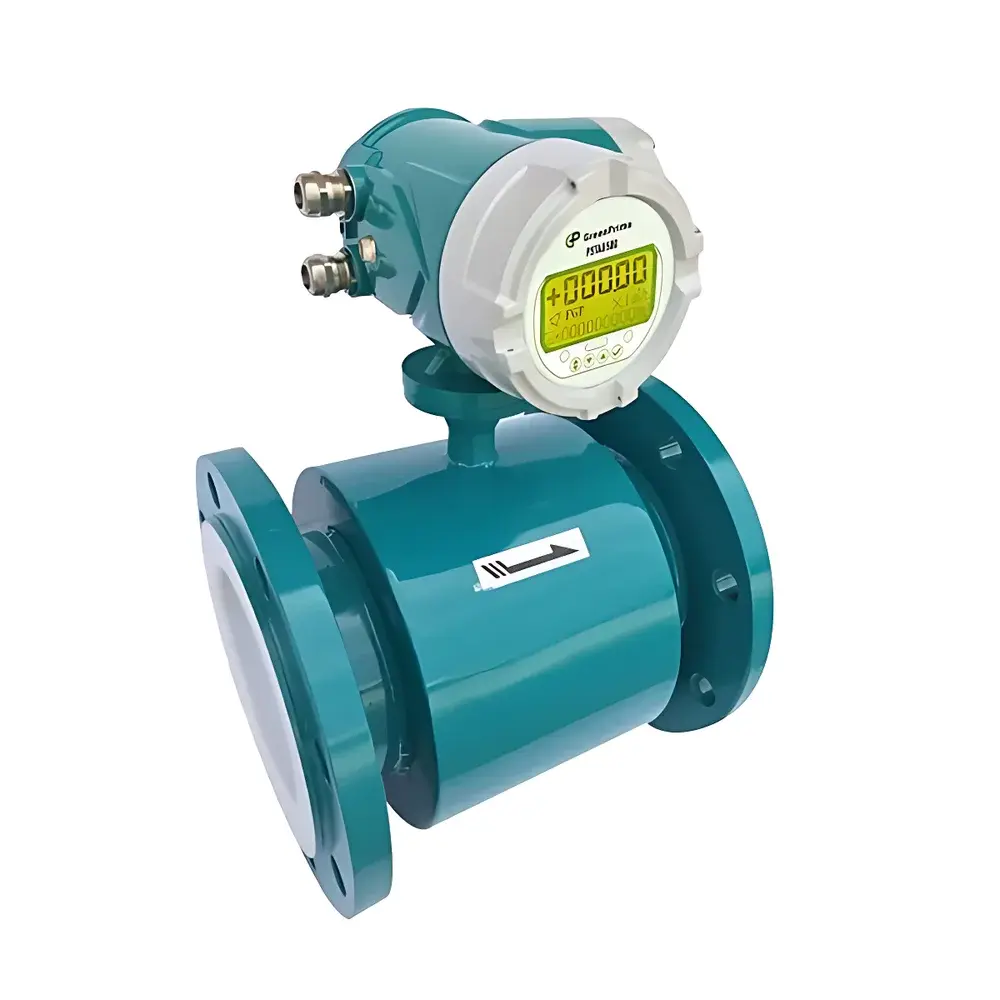
GreenPrima PSTAB 500 Online Electromagnetic Flowmeter
| Brand | GreenPrima |
|---|---|
| Origin | United Kingdom |
| Manufacturer Type | Manufacturer |
| Origin Category | Imported |
| Model | PSTAB 500 |
| Pricing | Upon Request |
Overview
The GreenPrima PSTAB 500 Online Electromagnetic Flowmeter is a precision industrial flow measurement instrument engineered for continuous, non-intrusive volumetric flow monitoring of conductive liquids in process pipelines. Based on Faraday’s Law of Electromagnetic Induction, the device generates a magnetic field perpendicular to the flow direction; as conductive fluid passes through this field, it induces a voltage proportional to the average flow velocity. This principle ensures measurement independence from fluid density, viscosity, temperature, pressure, and moderate variations in conductivity—provided the liquid maintains a minimum electrical conductivity of ≥5 µS/cm. Designed for permanent installation in pressurized piping systems, the PSTAB 500 supports inline (full-bore) mounting configurations and delivers high reproducibility across demanding industrial environments, including chemical processing, water/wastewater treatment, pulp & paper, mining slurry transport, and pharmaceutical utilities.
Key Features
- Fully integrated or remote-mounted sensor-transmitter architecture (一体式/分体式), supporting flexible installation in confined or hazardous areas.
- Zero-moving-parts measuring tube—eliminates pressure loss, mechanical wear, and susceptibility to clogging—ideal for abrasive slurries, mineral pulps, and corrosive media.
- Wide flow velocity range: 0.1–15 m/s, with extended turndown capability and stable low-flow performance down to 0.01 m/s under optimized conditions.
- High-accuracy metrology: ≤±0.3% of reading (typical), repeatability ±0.1%, verified per ISO 4064-1 and IEC 60534-2-1 standards.
- Robust electromagnetic noise immunity achieved via dual-frequency excitation, digital signal processing, and adaptive grounding compensation—critical in electrically noisy plants with VFDs or welding equipment.
- Self-diagnostics including electrode contamination detection, empty-pipe recognition, coil integrity verification, and signal-to-noise ratio monitoring—enabling predictive maintenance and reducing unplanned downtime.
- Bidirectional flow measurement with automatic flow direction indication and separate forward/reverse totalization registers.
Sample Compatibility & Compliance
The PSTAB 500 accommodates a broad spectrum of process fluids—including strong acids (e.g., H₂SO₄, HCl), caustic alkalis (e.g., NaOH), oxidizing agents, and heterogeneous two-phase media such as limestone slurry, iron ore pulp, cellulose fiber suspensions, and coal-water mixtures. Electrode materials include 316L stainless steel, Hastelloy B/C, titanium, tantalum, platinum-iridium, and ceramic-coated variants; liner options comprise PTFE, F46 (ETFE), chloroprene rubber, polyurethane, and alumina ceramic—each selected per ASTM D149, IEC 60252-1, and EN 14897 chemical resistance guidelines. The device meets IP65 (standard), IP67, and IP68 ingress protection ratings, and complies with ATEX II 2G Ex d IIB T4 Gb, IECEx Ex d IIB T4 Gb, and UL/cUL Class I Div 1 Groups B, C, D for hazardous locations. Electromagnetic compatibility conforms to EN 61326-1 (industrial environment) and EMC Directive 2014/30/EU.
Software & Data Management
The PSTAB 500 integrates native Modbus RTU/ASCII (RS485, RS232) as standard communication protocol, with optional HART 7.5 (4–20 mA loop-powered) and GPRS-based telemetry modules for remote SCADA integration. Configuration, calibration, and diagnostics are performed via an intuitive backlit LCD interface with multilingual menu navigation (English, German, French, Spanish), supporting full parameter logging, event timestamps, and audit trail generation. Firmware supports GLP/GMP-compliant data integrity features—including user-access levels, password-protected configuration changes, and tamper-evident calibration history—aligning with FDA 21 CFR Part 11 requirements when deployed in regulated manufacturing environments. Optional PC software enables firmware updates, trend analysis, and export of CSV/Excel-compatible flow logs.
Applications
- Chemical dosing control in batch reactors and continuous synthesis lines.
- Effluent flow quantification and regulatory reporting in municipal wastewater plants.
- Slurry flow monitoring in mineral processing circuits (grinding mills, thickeners, tailings transfer).
- Process water and steam condensate return measurement in power generation facilities.
- Sanitary flow verification in biopharmaceutical CIP/SIP loops (with FDA-compliant wetted materials).
- Desalination plant intake and brine discharge metering under high-chloride conditions.
FAQ
What is the minimum required conductivity for accurate measurement?
The PSTAB 500 requires a minimum liquid conductivity of 5 µS/cm. Below this threshold, signal-to-noise ratio degrades significantly, compromising measurement stability.
Can the flowmeter operate in partially filled pipes?
No—it is designed exclusively for full-pipe operation. Partially filled or air-entrained flow violates Faraday’s Law assumptions and triggers the built-in empty-pipe detection alarm.
Is zero calibration possible without process shutdown?
Yes. The “empty pipe zero” function allows in-situ zero adjustment during maintenance windows without removing the sensor from the line, provided the pipe is confirmed dry and static.
What is the maximum allowable process temperature for PTFE-lined models?
For standard PTFE (F4) liners, the continuous operating limit is +150 °C; short-term excursions up to +180 °C are permissible for ≤30 minutes per occurrence.
Does the device support SIL2 functional safety certification?
The PSTAB 500 platform is certified to IEC 61508 SIL2 for use in safety instrumented systems (SIS) when configured with redundant sensors and approved logic solvers per IEC 61511.